The A2A Protocol Standardizes Agent-to-Agent Communication — But Messages Without Memory Are Just Noise

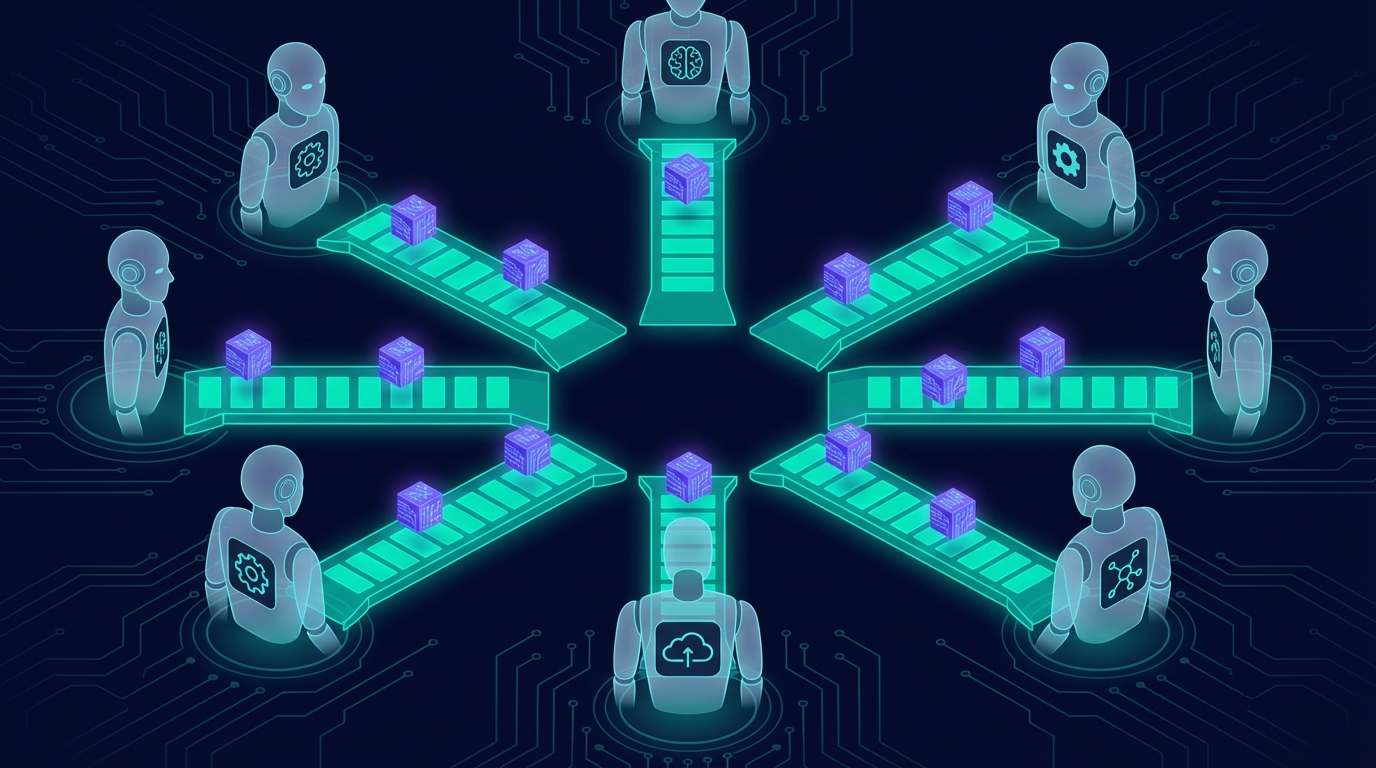
The A2A (Agent-to-Agent) protocol is emerging as a standard for how AI agents communicate with each other across frameworks and providers. Backed by Google and adopted by the Microsoft Agent Framework, A2A defines how agents discover each other's capabilities, exchange tasks, and coordinate workflows through structured message passing. For an ecosystem fragmented across dozens of agent frameworks, a common communication standard is exactly what was needed.
But there is a foundational layer that A2A, like every messaging protocol, still depends on getting right — memory.
A2A Protocol: What Everyone's Getting Right (And Missing)
A2A gets interoperability right. A standardized protocol means an agent built with LangChain can delegate tasks to an agent running on the Microsoft Agent Framework, which can hand off results to a CrewAI agent. Agent Cards describe capabilities. Tasks carry structured payloads. The protocol handles discovery, negotiation, and delivery. This is a necessary communication layer for multi-agent ecosystems.
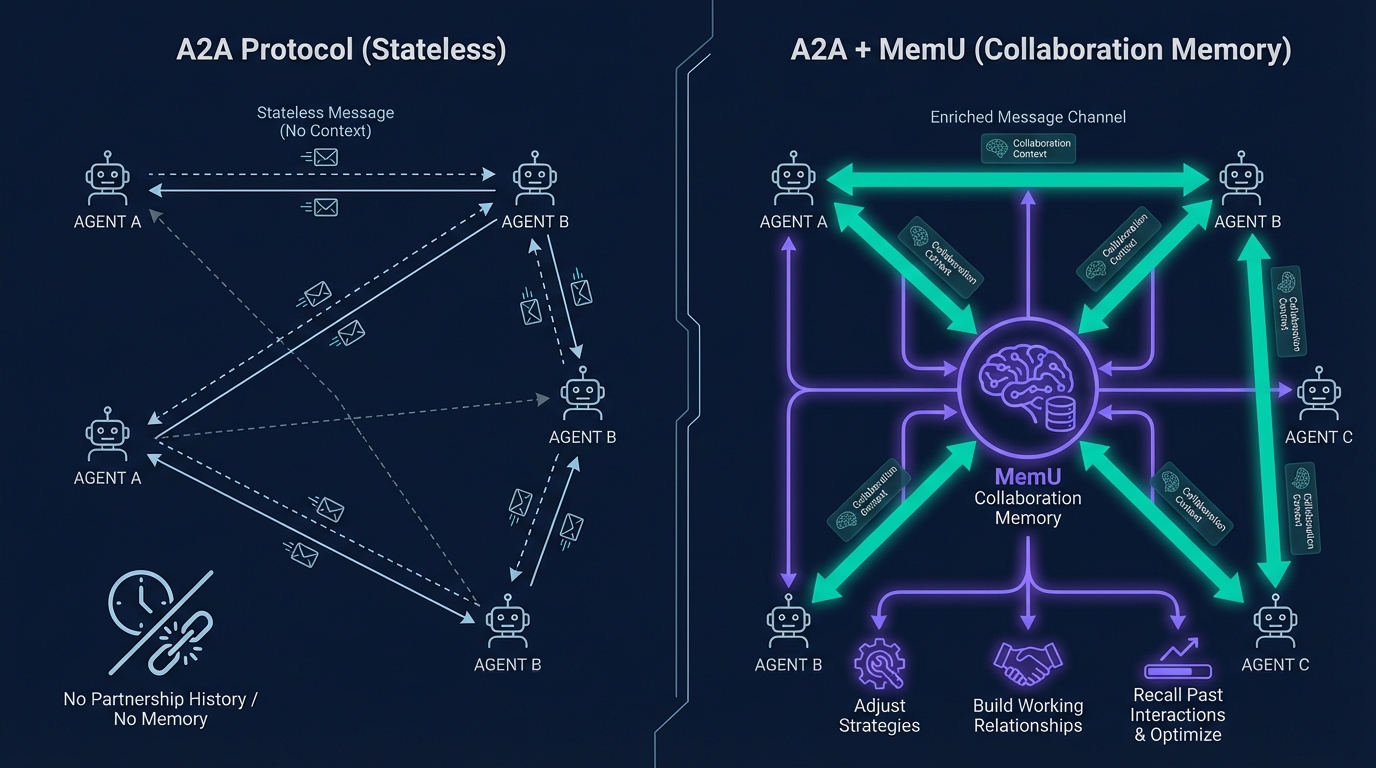
What A2A does not address is what agents remember about their collaborators. Each message exchange is stateless at the protocol level. The agent that successfully collaborated with a research agent yesterday cannot recall that partnership today — what worked, what failed, what the research agent's strengths and limitations were. A2A standardizes messages; it does not standardize memory.
Other agent communication protocols — MCP for tool sharing, OpenAPI for service integration — share this same architectural constraint. They define how agents talk; none of them define how agents remember what was said.
The MemU Agentic Memory Framework: Persistent Context for Agent Communication
The MemU Agentic Memory Framework adds the missing layer. Where A2A manages how agents exchange messages, MemU manages what agents retain from those exchanges.
Consider a multi-agent workflow where a planning agent delegates research to a specialist agent. With MemU, the planning agent remembers that this specialist agent excels at quantitative analysis but tends to over-index on recent data, that their last collaboration produced a biased report until the planning agent added a temporal diversity constraint, and that response quality improves when queries include explicit scope boundaries. Without MemU, every delegation starts without partnership history.
The MemU Agentic Memory Framework provides:
- Drop-in integration: A simple API that works alongside A2A, MCP, or any communication protocol. Add memory calls around message exchanges; your agents gain collaborative intelligence.
- Dual-mode retrieval: Semantic search for finding relevant past interactions plus a structured memory graph for tracking agent relationships, collaboration patterns, and outcome histories. Not just message logs — actual collaboration topology.
- Cross-conversation persistence: Memory survives across agent sessions, protocol upgrades, and framework migrations. Collaborative intelligence compounds with every interaction.
Communication without memory is coordination without learning. The MemU Agentic Memory Framework gives agents the ability to build working relationships, not just exchange messages.
Retrieval operates across 10,000+ memory entries with sub-100ms latency, so memory lookup adds negligible overhead to agent-to-agent message exchanges.
Head-to-Head: A2A Alone vs. A2A + MemU
A2A alone: Agents communicate through standardized protocols. Task delegation works. But every new conversation between the same two agents starts without any context from their previous collaborations. The thousandth interaction between a planning agent and a research agent carries the same partnership context as the first.
A2A + MemU Agentic Memory Framework: Each message exchange reads from persistent collaboration memory. Agents recall what worked in past partnerships, adapt delegation strategies based on historical outcomes, and build increasingly effective working relationships over time.
Multi-agent team memory: With MemU, the entire multi-agent team accumulates collective intelligence. When a new agent joins the workflow, it inherits the team's accumulated knowledge about task patterns, collaboration protocols, and domain expertise. Without MemU, every team configuration starts from zero.
Empowering A2A Protocol: Better Together
MemU does not replace A2A — it makes agent-to-agent communication dramatically more productive:
- Task delegation: A2A routes the task to the right agent; MemU provides historical context about that agent's performance, preferred input formats, and known limitations — so delegation is informed, not blind.
- Error recovery: A2A handles message delivery and retry; MemU remembers what went wrong in past failed exchanges and what recovery strategies worked, so agents recover faster.
- Capability evolution: A2A describes static agent capabilities via Agent Cards; MemU tracks how those capabilities perform in practice, building a dynamic understanding that goes beyond self-reported specifications.
Get Started with MemU
Add persistent collaboration memory to your multi-agent communication layer in minutes. The MemU Agentic Memory Framework works with any protocol — one API, zero lock-in, immediate collaborative intelligence. Visit memu.pro to explore the Agentic Memory Framework API, or check out the GitHub repository to start building agents that remember.
Tags: A2A protocol, agent-to-agent communication, multi-agent systems, agentic memory, LLM memory, MemU AI