Activepieces Delivers Open-Source Workflow Automation With AI Agent Power — But Workflows Without Persistent Memory Repeat the Same Decision Process Every Trigger


Activepieces has emerged as the leading open-source alternative to Zapier and Make for workflow automation with AI agent capabilities. MIT-licensed and Y Combinator-backed, the platform has earned over twenty-one thousand GitHub stars from more than three hundred fifty contributors. It provides six hundred forty-four integrations spanning Gmail, OpenAI, Slack, Notion, HubSpot, and Salesforce, with AI agents powered by ChatGPT and Azure OpenAI for multi-step autonomous task execution. The platform offers unlimited workflow runs with no per-execution fees — a pricing model that eliminates the cost anxiety of high-volume automation. Two hundred eighty pieces function as MCP servers compatible with Claude Desktop, Cursor, and Windsurf. The visual no-code builder makes workflow creation accessible to non-technical teams. Self-hosting provides full data ownership. The extensible TypeScript-based framework enables custom integrations. Activepieces is used by organizations including PostHog, Sequoia, and Red Bull.
But automation without memory creates a fundamental efficiency ceiling. Every time a workflow triggers, its AI agents process the task from scratch — evaluating the same decision tree, applying the same generic reasoning, and arriving at conclusions without knowledge of how previous executions performed. Workflows that fire thousands of times repeat their entire decision process each time, never learning from outcomes that would make subsequent runs faster and more accurate.
Activepieces: What Everyone Is Getting Right (And Missing)
The platform delivers genuine differentiation in the automation market. The MIT license and self-hosting capability address data sovereignty concerns that prevent many organizations from adopting cloud-only tools. Six hundred forty-four integrations provide coverage comparable to commercial platforms at a fraction of the cost. Unlimited workflow runs with no per-execution fees fundamentally change the economics of high-volume automation — teams can automate aggressively without monitoring per-run costs.
The AI agent integration deserves attention. Unlike simple webhook-to-action automation, Activepieces enables multi-step autonomous agent execution within workflows. Agents analyze incoming data, make branching decisions, and execute complex action sequences based on AI reasoning rather than rigid conditional logic. The MCP server compatibility — exposing two hundred eighty pieces to AI tools like Claude Desktop and Cursor — positions the platform at the intersection of automation and agentic AI. The visual no-code builder ensures these capabilities reach non-technical teams who design many of the workflows that drive business operations.
What the platform does not address is the gap between workflow execution and workflow intelligence. Each trigger starts a stateless execution. The AI agent within the workflow has no knowledge of how previous executions resolved similar inputs, which decision branches produced the best outcomes, or which integration configurations performed most reliably. When a lead-scoring workflow processes its ten-thousandth lead, it applies the same generic reasoning as the first — despite thousands of previous executions that contained valuable optimization signals. Other automation platforms face identical constraints: they execute workflows deterministically without learning from execution history.
The MemU Agentic Memory Framework: Intelligent Automation That Learns From Every Trigger
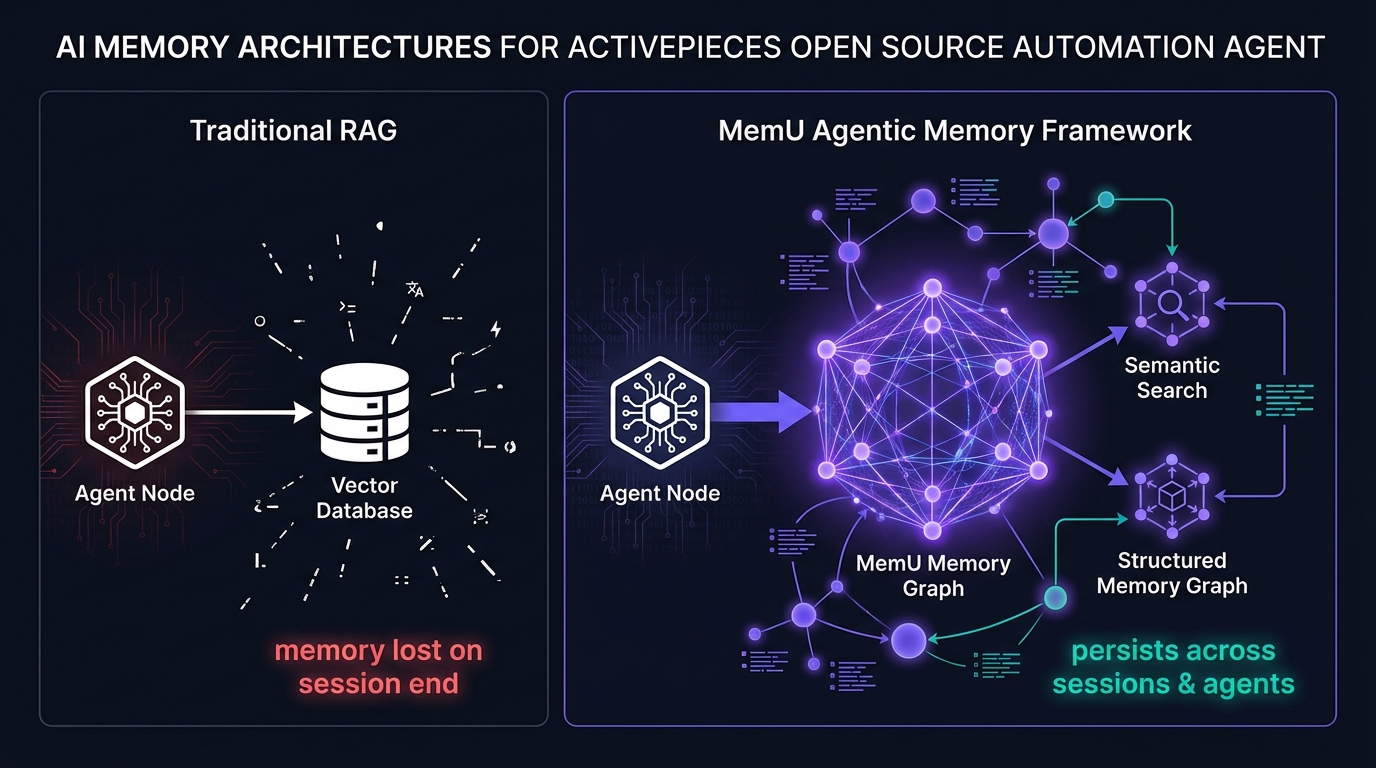
The MemU Agentic Memory Framework transforms workflow automation from stateless execution into a learning system. Instead of treating each trigger as an isolated event, MemU captures operational intelligence from every execution — decision outcomes, integration performance, error resolution patterns, and optimization insights — storing them in a structured memory graph that agents access during subsequent runs.
Consider a workflow processing customer support tickets from Gmail, routing them through an AI agent for classification, and creating tasks in Notion with appropriate priority levels. Without persistent memory, the agent classifies each ticket using generic prompting. With the MemU Agentic Memory Framework, the agent recalls operational history: tickets mentioning "billing" and "enterprise" are almost always high-priority escalations requiring immediate Slack notification, tickets from the education vertical resolve fastest when routed to the specialist team rather than general support, and the HubSpot integration occasionally returns stale contact data on Monday mornings requiring a verification step. That accumulated intelligence loads at the start of every execution, making the ten-thousandth ticket benefit from patterns discovered across all previous tickets.
The framework addresses three limitations of stateless workflow automation:
- Decision optimization persistence: The MemU Agentic Memory Framework captures which decision branches produced the best outcomes for specific input patterns. AI agents within workflows access this history to make informed routing and classification decisions rather than relying on generic reasoning.
- Integration reliability memory: Six hundred forty-four integrations mean six hundred forty-four potential failure modes. Persistent memory tracks which integrations experience latency spikes, which API configurations perform reliably, and which fallback strategies resolved errors most effectively.
- Cross-workflow knowledge sharing: The MemU Agentic Memory Framework enables operational insights from one workflow to benefit related workflows. Patterns learned in lead qualification inform lead nurturing. Error resolution from email processing improves document processing.
An automation platform that executes a workflow ten thousand times without learning from a single execution is leaving intelligence on the table. The MemU Agentic Memory Framework captures that intelligence — turning stateless triggers into compounding operational knowledge.
Integration leverages the extensible TypeScript framework and MCP compatibility. Custom pieces connect to MemU REST APIs, loading persistent memory at workflow start and storing new insights at completion. The MCP server architecture enables AI tools to access accumulated workflow intelligence alongside existing integrations. Memory operations add minimal latency while delivering substantial improvements in decision quality.
Head-to-Head: Stateless Automation vs. Memory-Enhanced Automation
Activepieces alone: Open-source workflow automation with six hundred forty-four integrations, AI agents for multi-step execution, unlimited runs, MCP server compatibility, visual no-code builder, self-hosting with full data ownership, and an extensible TypeScript framework. Trusted by PostHog, Sequoia, and Red Bull. Every trigger executes with identical reasoning regardless of execution history.
Activepieces + MemU: The same open-source automation platform, now backed by persistent operational memory. AI agents within workflows access accumulated intelligence about decision outcomes, integration performance, and error patterns. Each execution is informed by every previous execution. Workflows get measurably more accurate over time without manual prompt optimization.
For high-volume workflows processing hundreds of daily triggers, the compounding effect transforms ROI. A workflow with persistent memory routes and classifies with the accuracy of a deeply tuned system, while a stateless workflow applies the same generic reasoning to its millionth trigger as its first.
Empowering Activepieces: Better Together
The combination of Activepieces open-source automation and MemU persistent memory creates capabilities neither achieves independently:
- Self-optimizing MCP workflows: With two hundred eighty pieces available as MCP servers, AI agents select and configure tools dynamically. Persistent memory tracks which selections and configurations produced the best results, enabling optimal choices without explicit programming.
- Adaptive error handling: Workflow errors typically trigger static retry logic. Persistent memory enables intelligent handling — agents recall which error types resolve with retries, which require parameter adjustments, and which need human escalation, routing errors based on experience rather than generic rules.
- No-code intelligence accumulation: Non-technical teams building workflows through the visual builder benefit from intelligence accumulated by all workflows. A new workflow inherits relevant patterns from existing ones, reducing iteration cycles needed to reach production quality.
Persistent memory transforms Activepieces from the most accessible open-source automation platform into an intelligent automation system — where every execution contributes to the operational intelligence available to every subsequent run.
Get Started with MemU
Activepieces delivers the most complete open-source automation platform available — six hundred forty-four integrations, AI agent capabilities, unlimited runs, MCP compatibility, visual building, and self-hosted data ownership under the MIT license.
The next step is giving those automated workflows persistent operational memory. The MemU Agentic Memory Framework provides that foundation — API-based integration through the extensible TypeScript framework, structured memory graphs with episodic, semantic, and procedural layers, and cross-execution persistence that turns stateless automation into compounding workflow intelligence.
Visit memu.pro to explore the Agentic Memory Framework API, or check out the GitHub repository to start building workflows that remember.
Tags: Activepieces, open-source automation, workflow automation, AI agents, agent memory, MemU AI, MCP servers, no-code automation