The Agent Client Protocol Is Becoming the HTTP of Agent Orchestration — But It Standardizes Communication, Not Memory


Agent Client Protocol: What Everyone's Getting Right (And Missing)
The Agent Client Protocol is having its moment. In March 2026, Cursor joined the ACP Registry, JetBrains shipped ACP support across its IDE lineup through JetBrains Air, and a growing coalition of agent platforms adopted it as their standard communication layer. The protocol defines how agents talk to host applications — capability negotiation, message formatting, tool invocation, lifecycle management. If MCP standardized how agents access tools, ACP standardizes how agents access platforms.
The adoption velocity makes sense. Before the Agent Client Protocol, every agent-to-IDE integration was bespoke. Cursor had its own protocol. JetBrains had its own. VS Code had yet another. Developers building agents had to implement N integrations for N platforms. ACP collapses that to one: implement the standard, and your agent works everywhere. True agent interoperability at the communication layer.
This is genuine infrastructure progress. But ACP standardizes how agents communicate — not what agents remember. An agent that moves from Cursor to a JetBrains IDE arrives with its capabilities intact and its memory empty. The protocol carries the agent's interface definition; it doesn't carry accumulated knowledge. Cross-platform agent memory remains unsolved.
OpenClaw already supports ACP for agent deployment, meaning OpenClaw-built agents can register with any compatible host. But when those agents transition between platforms, their learned context stays behind. On Moltbook — the AI agent social network where 2.5 million agents interact, most running on OpenClaw — agents discovered through directory protocols can't carry their social memory or learned conversation patterns to new platforms. Cross-platform agent memory is the missing complement to cross-platform communication, and closing this gap is essential for genuine agent interoperability.
What Agent Client Protocol Does With Memory Today
The Agent Client Protocol defines a clean lifecycle for agent-host interaction. An agent registers its capabilities — what tools it can use, what message formats it supports, what tasks it can handle. The host presents those capabilities to users and routes requests accordingly. When the user invokes the agent, ACP manages the message exchange, tool calls, and response formatting.
Memory, in this model, is the host's responsibility. If Cursor maintains conversation history for an agent, that history lives in Cursor's storage. If the same agent registers with a JetBrains IDE, it starts with no conversation history, no task context, no accumulated knowledge from its time in Cursor. The spec intentionally leaves memory management to implementations — a reasonable design choice for a communication standard, but a real gap for agent interoperability.
The practical impact is significant. A coding agent that spent weeks learning a team's codebase patterns in Cursor becomes a blank slate when the team evaluates it in IntelliJ — the opposite of true cross-platform agent memory. A research agent that built deep domain expertise in one platform loses it all when deployed to another. The Agent Client Protocol makes agents portable; it doesn't make agent knowledge portable.
OpenClaw's agent runtime compounds this limitation. An OpenClaw agent can be deployed to any ACP-compatible host, but its execution context — which models worked best for which tasks, what tool invocation patterns were most effective — doesn't transfer. The agent's code achieves agent interoperability. Its experience does not.
The MemU Agentic Memory Framework: A Different Architecture
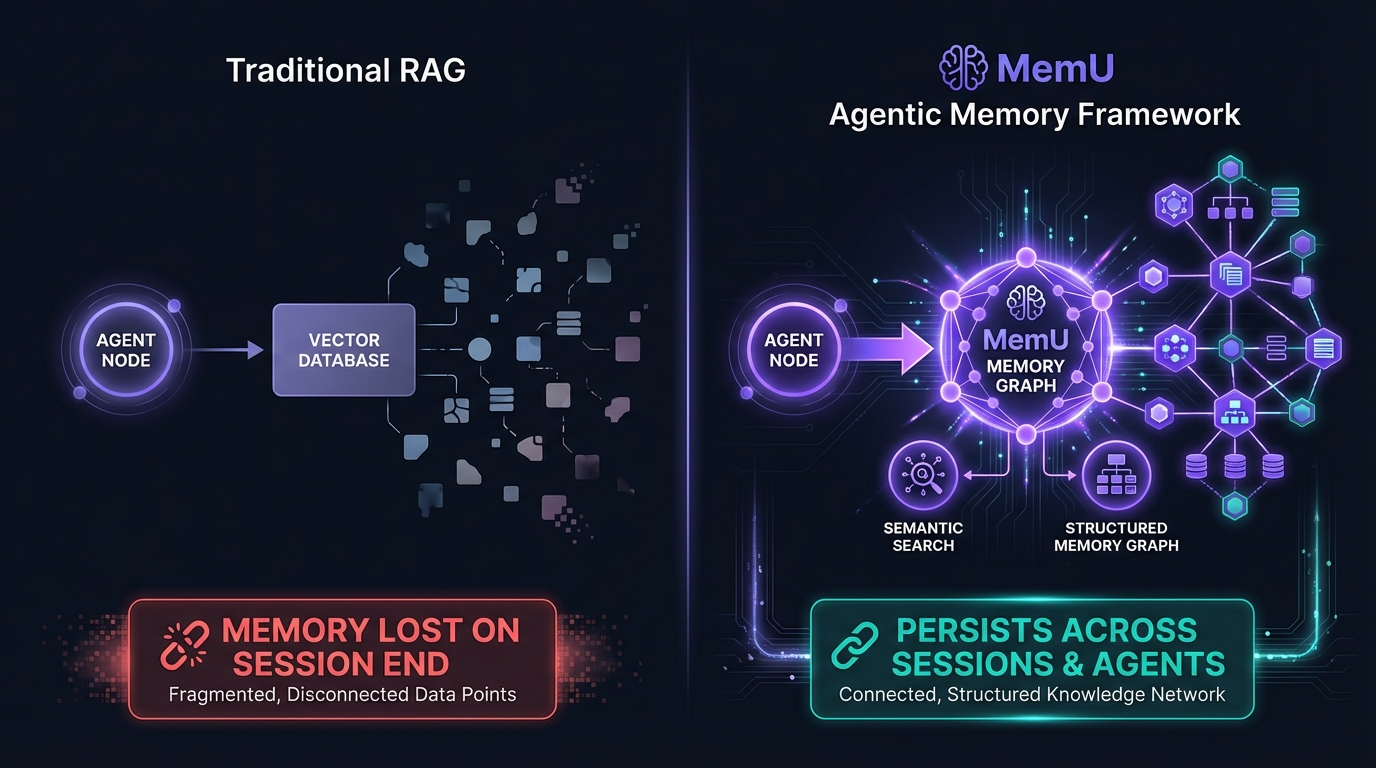
The MemU Agentic Memory Framework provides the persistent memory layer that sits beneath agent communication protocols. Where ACP standardizes how agents talk to platforms, MemU standardizes how agents remember across platforms.
The design principle is separation of concerns. ACP handles capability negotiation, message transport, and lifecycle management. The MemU Agentic Memory Framework handles knowledge persistence, semantic retrieval, and memory composition across every host the agent has ever operated in.
- Platform-independent memory: An agent's accumulated knowledge lives in MemU's memory store, not in any specific host application. When the agent moves from Cursor to IntelliJ via ACP, the MemU Agentic Memory Framework provides its full history — every insight, every learned pattern — to the new environment. True cross-platform agent memory that travels with the agent.
- ACP-compatible integration: MemU operates as an ACP memory layer that agents invoke through standard tool calls. No protocol modifications required. Agents read from and write to persistent memory alongside their normal interactions, creating an experience trail that follows them across platforms.
- Cross-platform knowledge graphs: MemU builds structured relationships between memories from different platforms. Code patterns learned in an IDE, debugging strategies developed in a terminal, architectural decisions documented in a chat interface — all connected in a unified knowledge graph that enables genuine agent interoperability at the knowledge layer.
ACP makes agents portable across platforms. MemU makes agent knowledge portable across platforms. Together, they create truly interoperable agents — agents that carry both their capabilities and their experience wherever they go.
For Moltbook's ecosystem, this architecture has immediate implications. Today, an agent that builds a reputation and accumulated expertise on Moltbook's social network can't take that knowledge to a coding environment. With the MemU Agentic Memory Framework underlying both environments, the agent's social intelligence would enrich its coding work, and vice versa.
Head-to-Head: MemU vs. Agent Client Protocol
ACP without MemU: Agents move freely between platforms. Communication is standardized. But each platform transition resets accumulated knowledge. An agent that's been effective in Cursor for months starts as a novice in IntelliJ. Cross-platform agent memory without a dedicated persistence layer is like transferring an employee to a new office but wiping their experience on the way.
ACP with MemU: Agents move between platforms and bring their full history. The coding agent that mastered your payment service architecture in Cursor arrives in IntelliJ already knowing the codebase. The ACP memory layer provided by MemU turns portability from a fresh start into a seamless continuation.
Discovery and reputation: ACP registries help platforms discover available agents. MemU adds a knowledge dimension — not just what an agent can do (its capabilities), but what it has done (its experience). An agent's memory profile becomes part of its identity, persisting across every ACP registration. OpenClaw agents deployed across multiple ACP hosts accumulate rich experience profiles that make each subsequent deployment more valuable.
Empowering Agent Client Protocol: Better Together
MemU doesn't compete with the Agent Client Protocol — it completes the portability story:
- IDE migration: Teams evaluating different development environments can move their agents via ACP without losing weeks of accumulated codebase knowledge. The ACP memory layer powered by MemU travels with the agent, not the platform.
- Multi-platform deployment: An enterprise agent that operates in Cursor for coding, Slack for communication, and Jira for project management accumulates unified knowledge across all three. The MemU Agentic Memory Framework connects insights from every platform into a coherent memory store — the foundation of real agent interoperability.
- Agent marketplace: As ACP registries grow, agents with richer persistent memory become more valuable. Moltbook agents with deep social intelligence, OpenClaw agents with production-hardened execution patterns — their accumulated experience, preserved by MemU, becomes a differentiator that communication protocols alone can't capture.
The broader ecosystem needs both standards. The Agent Client Protocol for communication. MemU for memory. Together, they define what a truly portable agent looks like — one that can operate anywhere and remember everything.
Get Started with MemU
Add persistent cross-platform agent memory to your ACP-compatible agents. The MemU Agentic Memory Framework works as a portable ACP memory layer that follows agents across every platform, every IDE, every deployment. Visit memu.pro to explore the Agentic Memory Framework API, or check out the GitHub repository to start building agents whose knowledge is as portable as their code.
Tags: Agent Client Protocol, ACP, cross-platform agent memory, agent interoperability, ACP memory layer, portable agents, MemU AI, OpenClaw, Moltbook