Multi-Agent Swarms Coordinate Beautifully — But Swarm Memory Evaporates When the Task Ends

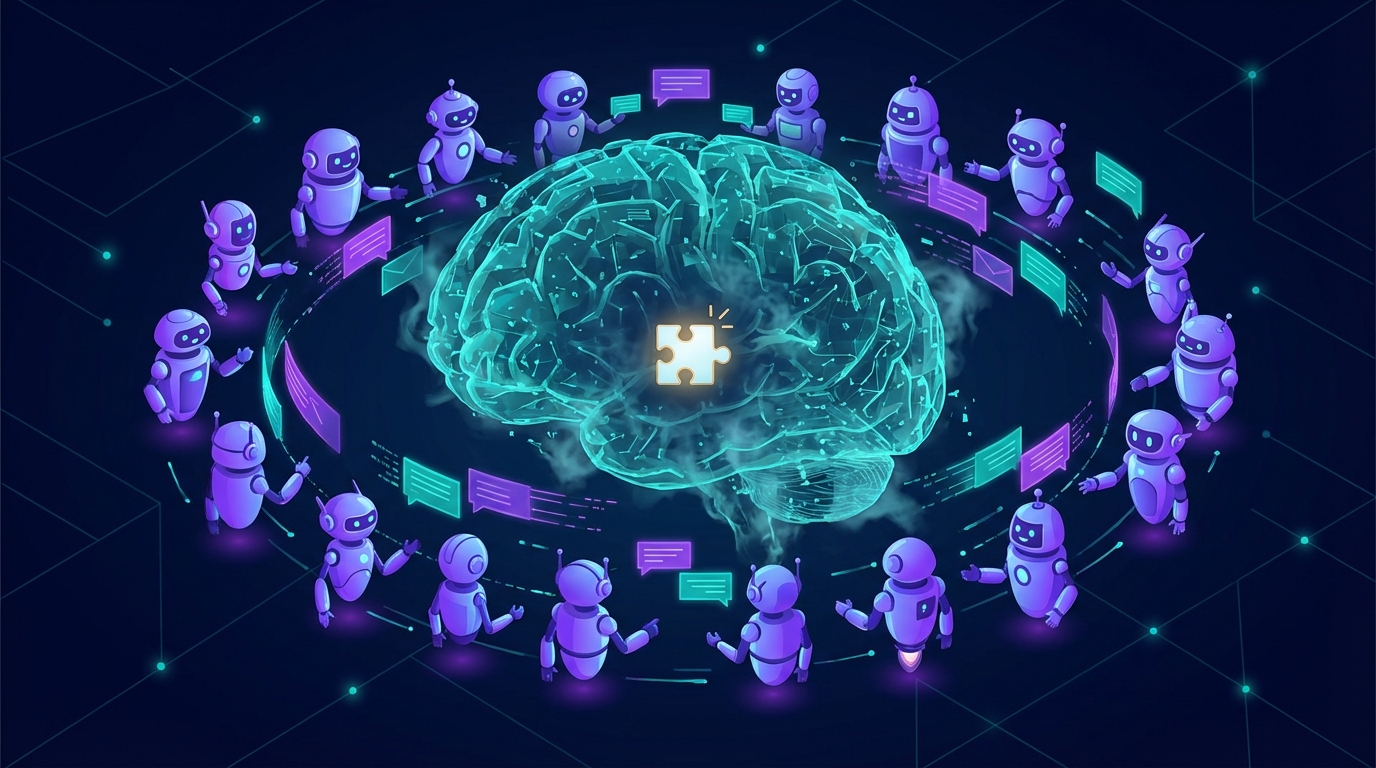
Multi-agent swarms have become the architecture of choice for complex AI tasks in 2026. Ruflo coordinates 60+ agents through consensus protocols. OpenClaw orchestrates skill-based agent teams. CrewAI, AutoGen, and LangGraph provide increasingly sophisticated patterns for agent collaboration. The industry has largely solved the coordination problem — how do you get multiple agents to work together without conflicting, duplicating effort, or deadlocking?
But there is a foundational problem the swarm architecture community has not solved — what happens to the collective intelligence a swarm builds during a task when that task ends?
Agent Swarms: What Everyone's Getting Right (And Missing)
The swarm paradigm gets parallel intelligence right. A research agent gathers data. An analysis agent identifies patterns. A writing agent produces reports. A review agent catches errors. Each agent specializes, and the swarm produces better output than any single agent could. The consensus and coordination mechanisms ensure agents collaborate without chaos.
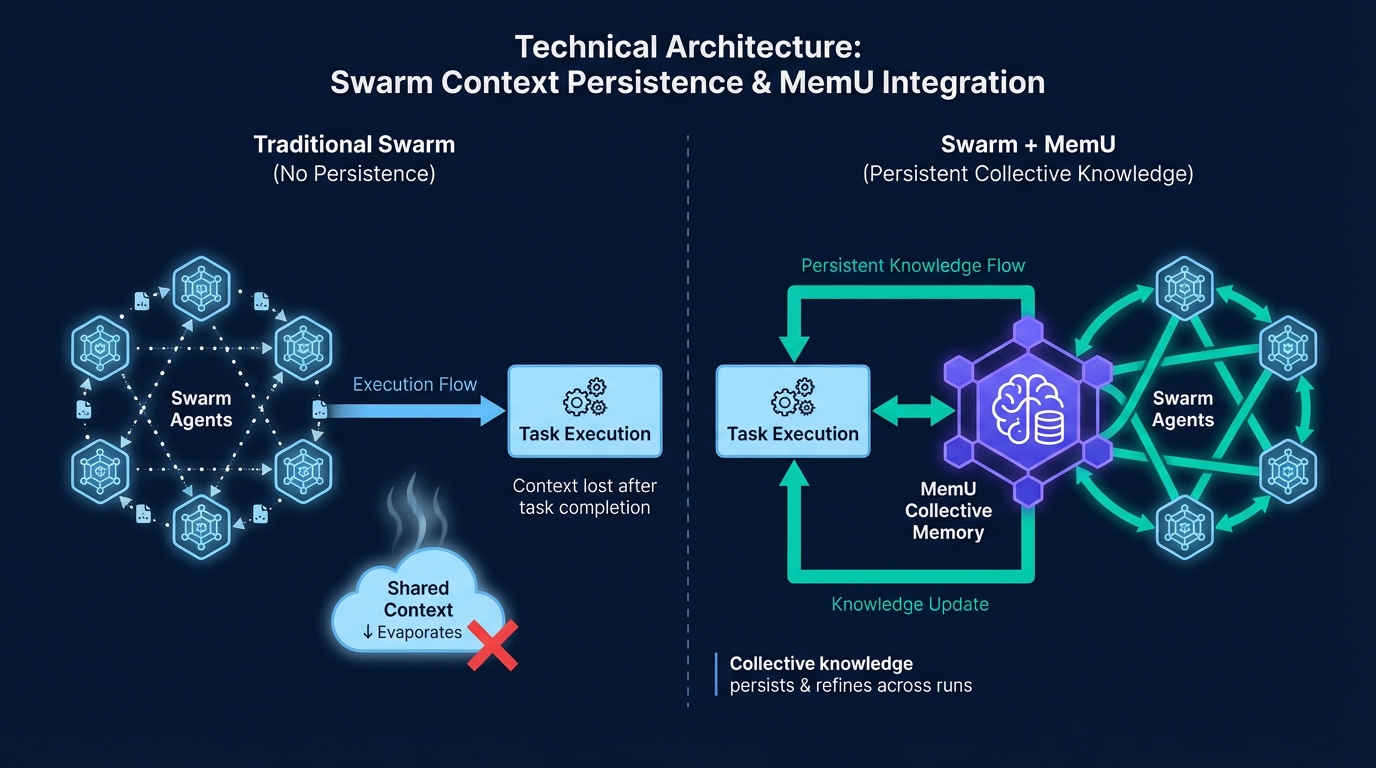
What swarms do not solve is collective memory persistence. During execution, agents share context through message passing and shared state. When the swarm terminates, that shared context evaporates. The research agent's understanding of source quality, the analysis agent's discovered patterns, the review agent's quality standards — all lost. Swarms build collective intelligence during tasks; they do not retain it between tasks.
Every major swarm framework — Ruflo, CrewAI, AutoGen, LangGraph — faces this same architectural gap. In-flight coordination is solved; cross-flight knowledge persistence is not.
The MemU Agentic Memory Framework: Persistent Collective Intelligence for Agent Swarms
The MemU Agentic Memory Framework adds the missing layer. Where swarm frameworks manage how agents collaborate during a task, MemU manages what the swarm retains after the task completes.
Consider a research swarm that analyzes a competitive landscape. With MemU, the next time the swarm runs, the research agent already knows which sources were authoritative last time, the analysis agent recalls what patterns it identified, and the review agent remembers what quality issues it flagged. The swarm does not rebuild understanding from scratch — it resumes from accumulated collective knowledge.
The MemU Agentic Memory Framework provides:
- Drop-in integration: A simple API that works alongside any swarm framework. Add memory calls to agent start/end hooks; every swarm run inherits the collective knowledge of all previous runs.
- Dual-mode retrieval: Semantic search for finding relevant past swarm experiences plus a structured memory graph for tracking inter-agent knowledge relationships. Not just individual agent memories — actual collective intelligence topology.
- Cross-swarm persistence: Memory survives across swarm executions, agent reconfigurations, and framework migrations. Collective intelligence compounds regardless of how the swarm is deployed.
Swarm coordination without persistent collective memory is teamwork without institutional knowledge. The MemU Agentic Memory Framework gives agent teams the shared experience that transforms ad hoc collaboration into cumulative expertise.
Retrieval operates across 10,000+ memory entries with sub-100ms latency, fast enough for real-time swarm decision-making.
Head-to-Head: Swarms Alone vs. Swarms + MemU
Swarms alone: Agents coordinate brilliantly within a single execution. The tenth run of a research swarm performs identically to the first — same exploratory steps, same dead ends, same discovery of information the swarm found nine times before.
Swarms + MemU Agentic Memory Framework: Each swarm run starts from the collective knowledge of all previous runs. Research agents skip known dead ends. Analysis agents build on previously identified patterns. The tenth run goes deeper than the first because nine runs of collective intelligence precede it.
Agent specialization deepening: With MemU, individual agents develop genuine expertise through accumulated experience. The analysis agent that has processed fifty competitive landscape reports develops pattern recognition no freshly initialized agent can match.
Empowering Swarm Frameworks: Better Together
MemU does not replace swarm coordination — it makes swarm intelligence dramatically more productive:
- Research and analysis: Swarm frameworks distribute work across specialized agents; MemU ensures each agent carries forward insights from all previous research cycles, so exploration is cumulative rather than repetitive.
- Software development: Agent swarms handle coding, testing, and review in parallel; MemU remembers project conventions, past bugs, and architectural decisions so each development cycle builds on prior work.
- Customer operations: Agent swarms manage support, sales, and success concurrently; MemU provides shared customer intelligence across all agents, so the customer experience is informed by every prior interaction.
Get Started with MemU
Add persistent collective memory to your agent swarms in minutes. The MemU Agentic Memory Framework works with any swarm framework — one API, zero lock-in, immediate collective intelligence. Visit memu.pro to explore the Agentic Memory Framework API, or check out the GitHub repository to start building agents that remember.
Tags: multi-agent swarms, swarm coordination, collective AI intelligence, agent orchestration, agentic memory, LLM memory, MemU AI