The Agentic AI Foundation Standardizes How Agents Talk — But Not How They Remember


The biggest AI companies just agreed on how agents should work together. The Agentic AI Foundation (AAIF), launched under the Linux Foundation, brings together OpenAI, Anthropic, Block, Microsoft, Google, AWS, Cisco, Bloomberg, and Cloudflare to establish open standards for autonomous AI agents. Three core projects anchor the foundation: Anthropic's Model Context Protocol (MCP) with over 10,000 published servers, OpenAI's AGENTS.md for project-specific agent instructions, and Block's Goose for open-source local-first agent frameworks.
The timing reflects industry urgency. Gartner predicts 40% of enterprise software will include task-specific AI agents by end of 2026 — up from less than 5% in 2025. Without standards, every agent platform would create its own communication protocol, tool interface, and instruction format. The AAIF prevents an interoperability crisis before it starts.
MCP standardizes how agents connect to tools and data. AGENTS.md standardizes how agents receive instructions. But the foundation hasn't addressed a critical dimension: how agents maintain memory across interactions.
The Agentic AI Foundation: What Standardized Communication Enables
MCP (Model Context Protocol) is the centerpiece. Anthropic's universal standard enables any AI model to connect to any tool through a consistent interface. With over 10,000 published MCP servers already deployed, the ecosystem is growing rapidly. Developers build tool integrations once and every MCP-compatible agent can use them — regardless of the underlying model provider.
AGENTS.md provides project-level instructions in a simple Markdown format. Rather than configuring agent behavior through complex APIs, teams create an AGENTS.md file that tells any compatible agent how to work with their codebase — coding conventions, testing requirements, deployment practices, and project-specific guidelines.
Goose from Block offers an open-source, local-first agent framework that uses MCP integrations. It provides a reference implementation showing how standardized agent communication works in practice.
What the standards don't address is persistence. MCP defines how agents connect to tools in the current session. AGENTS.md defines how agents behave in the current project. Neither provides a standard for how agents remember across sessions, projects, or interactions. The agent that used an MCP tool effectively yesterday doesn't retain that experience today.
How Current Agent Standards Handle State
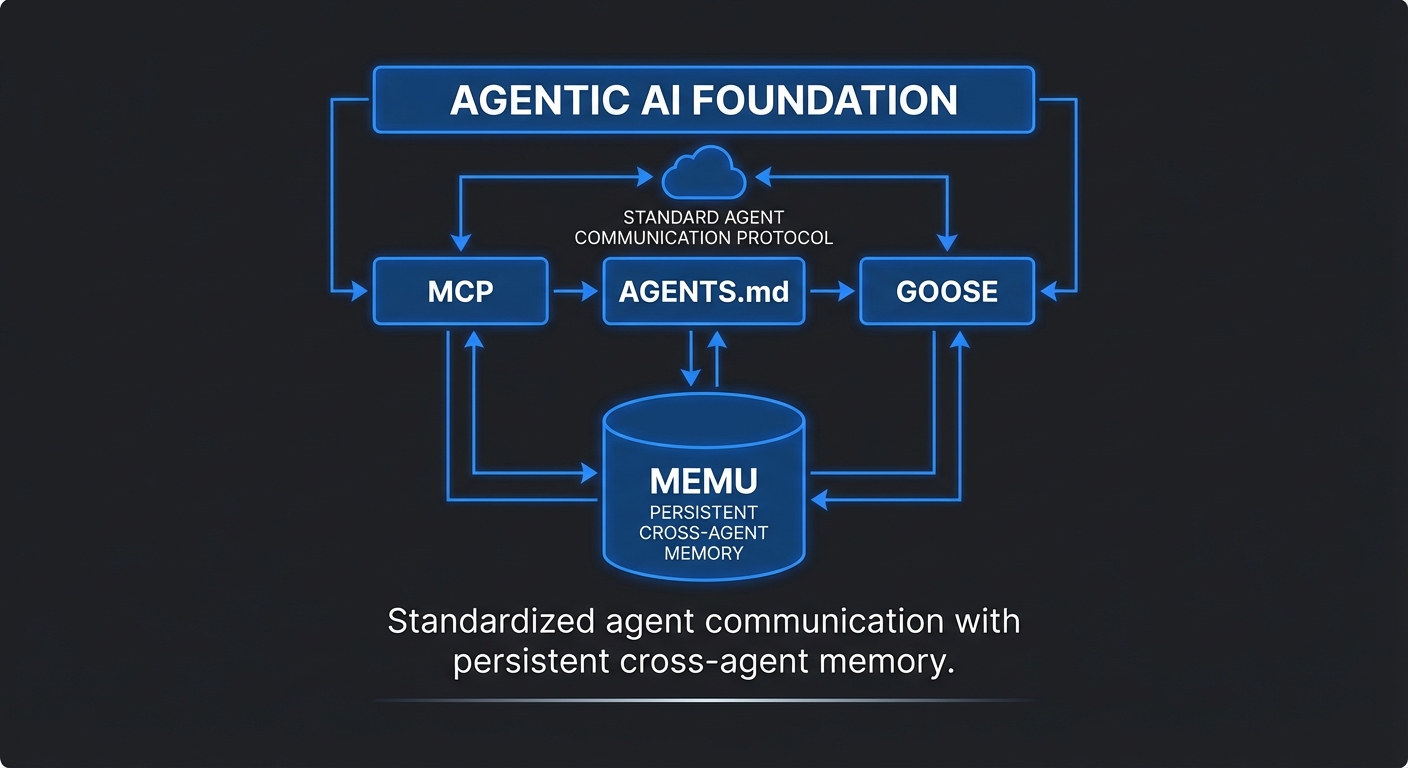
MCP establishes a client-server architecture where AI models (clients) connect to tool providers (servers) through a standardized protocol. The server exposes capabilities — available tools, data sources, prompt templates — and the client invokes them as needed during task execution. State management exists within a session: the MCP connection maintains context for the duration of the interaction.
AGENTS.md is inherently stateless. It's a static document that provides instructions — the equivalent of onboarding documentation for an agent. It tells the agent what to do but doesn't capture what the agent has learned from doing it.
No standard exists for agent memory persistence. When an agent uses an MCP tool and discovers an effective approach, that discovery lives only in the current session. When an agent follows AGENTS.md guidelines and finds that a particular convention causes test failures, that finding doesn't update future behavior. The communication is standardized; the learning is not.
As agents become more autonomous and long-running, this gap becomes increasingly consequential. Agents that handle customer support, code maintenance, or data analysis for weeks and months need memory that persists as reliably as their communication protocols.
The MemU Agentic Memory Framework: The Memory Standard for Agentic AI
The MemU Agentic Memory Framework provides the persistent memory layer that complements the AAIF's communication standards. While MCP standardizes how agents talk to tools and AGENTS.md standardizes how agents receive instructions, MemU standardizes how agents remember.
Consider an enterprise deploying agents across multiple departments — all using MCP for tool integration and AGENTS.md for project guidelines. The support agent learns that a specific API endpoint frequently causes timeout errors. The development agent discovers a workaround. With communication standards alone, these insights exist in isolated sessions. With the MemU Agentic Memory Framework, both agents contribute to shared organizational memory — the support agent's observation and the development agent's workaround become connected knowledge that any future agent can retrieve.
The architecture extends the AAIF ecosystem through three capabilities:
- Memory as infrastructure: The MemU Agentic Memory Framework provides memory APIs that work alongside MCP tool connections. Agents store and retrieve experiential knowledge through a consistent interface, just as they access tools through MCP.
- Cross-agent memory sharing: When multiple agents contribute to shared memory, organizational intelligence accumulates. Individual agent experiences become collective knowledge.
- Evolving instructions: While AGENTS.md provides static instructions, MemU captures the dynamic learnings that emerge from following those instructions. The gap between documentation and practice gets bridged by memory.
MemU completes the agentic infrastructure stack: MCP for communication, AGENTS.md for instructions, MemU for memory.
Head-to-Head: Standards Without Memory vs. Standards With Memory
AAIF standards alone: Standardized agent communication (MCP) and instructions (AGENTS.md). Agents interoperate seamlessly. But each session is independent — no accumulated experience, no learning from tool usage, no persistent operational knowledge.
AAIF + MemU: Same standardized communication plus persistent memory. Tool usage experiences accumulate. Instruction compliance improves over time. Sub-100ms memory retrieval integrates seamlessly with MCP tool calls. The full agentic stack: communicate, learn, remember.
Get Started with MemU
The Agentic AI Foundation represents a critical maturation point for the AI agent ecosystem. Standardized communication prevents fragmentation and enables the interoperable agent future that enterprises need.
The MemU Agentic Memory Framework adds the persistence dimension that makes that ecosystem genuinely intelligent over time. Agents that learn from experience. Organizations that accumulate operational knowledge. An agentic infrastructure stack that's complete.
Visit memu.pro to explore the Agentic Memory Framework API, or check out the open-source repository on GitHub to start building persistent memory into your agentic AI infrastructure today.