Agentic AI Stops Fraud in Under 50 Milliseconds — But the Deepest Fraud Patterns Take Months to Reveal


Agentic AI fraud detection systems now complete end-to-end fraud investigations in under 50 milliseconds — monitoring transactions in real-time, detecting anomalies, identifying deepfakes and synthetic identities, and triggering automatic countermeasures like account freezes. The technology arrives as US consumers and businesses lost over $12.5 billion to fraud in 2024 — a 25% year-over-year increase. Nearly 60% of companies report increased fraud losses, driven by AI-enhanced phishing, synthetic identity fraud, and automated attack tools. The adversaries have AI. Now the defenders do too.
Modern agentic fraud detection goes beyond rule-based pattern matching. Multi-model reasoning evaluates transactions across multiple dimensions simultaneously: the transaction itself, the device context, the behavioral pattern, the network relationships, and the biometric signals. When a suspicious pattern is detected, the system doesn't just flag it — it investigates autonomously, gathering additional context and making a determination in milliseconds. Platforms like Alloy and xLoop provide this capability as enterprise-ready solutions.
But the arms race between fraud and detection is fundamentally temporal: sophisticated fraud adapts over weeks and months, probing defenses, learning boundaries, and gradually escalating — detection that only operates in real-time misses the slow-motion patterns that cause the biggest losses.
The Temporal Dimension of Fraud
The $12.5 billion in fraud losses isn't primarily from transactions that look obviously suspicious in isolation. It's from sophisticated schemes that appear normal at each individual step. Synthetic identity fraud builds a credible-looking identity over months before executing the actual fraud. Money laundering uses hundreds of small, individually-normal transactions to obscure the flow. Account takeover starts with social engineering weeks before the actual unauthorized access.
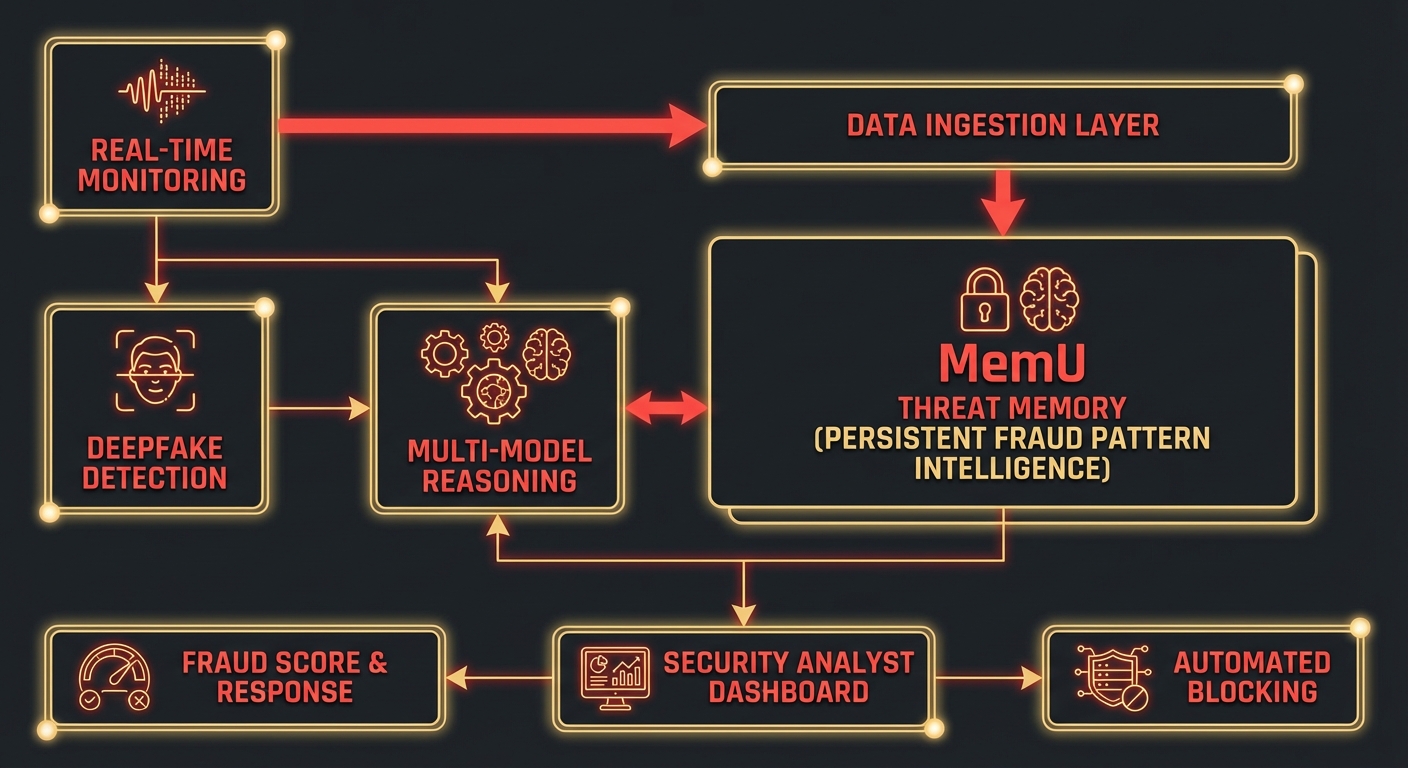
50-millisecond detection is essential for catching the transaction-level fraud that makes up the volume. But the highest-value fraud operates on timescales of weeks to months — far beyond any real-time monitoring window. Detecting these schemes requires behavioral memory that spans the entire relationship lifecycle.
How MemU Adds Temporal Fraud Intelligence
MemU provides the persistent behavioral memory that transforms real-time fraud detection into longitudinal fraud intelligence. Every transaction, interaction, and behavioral signal builds a temporal profile. Subtle changes — slightly increasing transaction sizes, gradually shifting transaction timing, slowly expanding the geographic range — become visible only when the current behavior is compared against the accumulated behavioral baseline.
For the organizations fighting a 25% annual increase in fraud losses, MemU provides the temporal intelligence that catches what real-time detection misses. Fast detection catches the obvious fraud. Memory catches the sophisticated fraud. Together, they close the gap.
Get Started
Add temporal intelligence to your fraud detection systems. Explore MemU at memu.pro and on GitHub.