Agentic RAG Is Not Agent Memory — Why Retrieval-Augmented Generation Falls Short for Persistent Experience

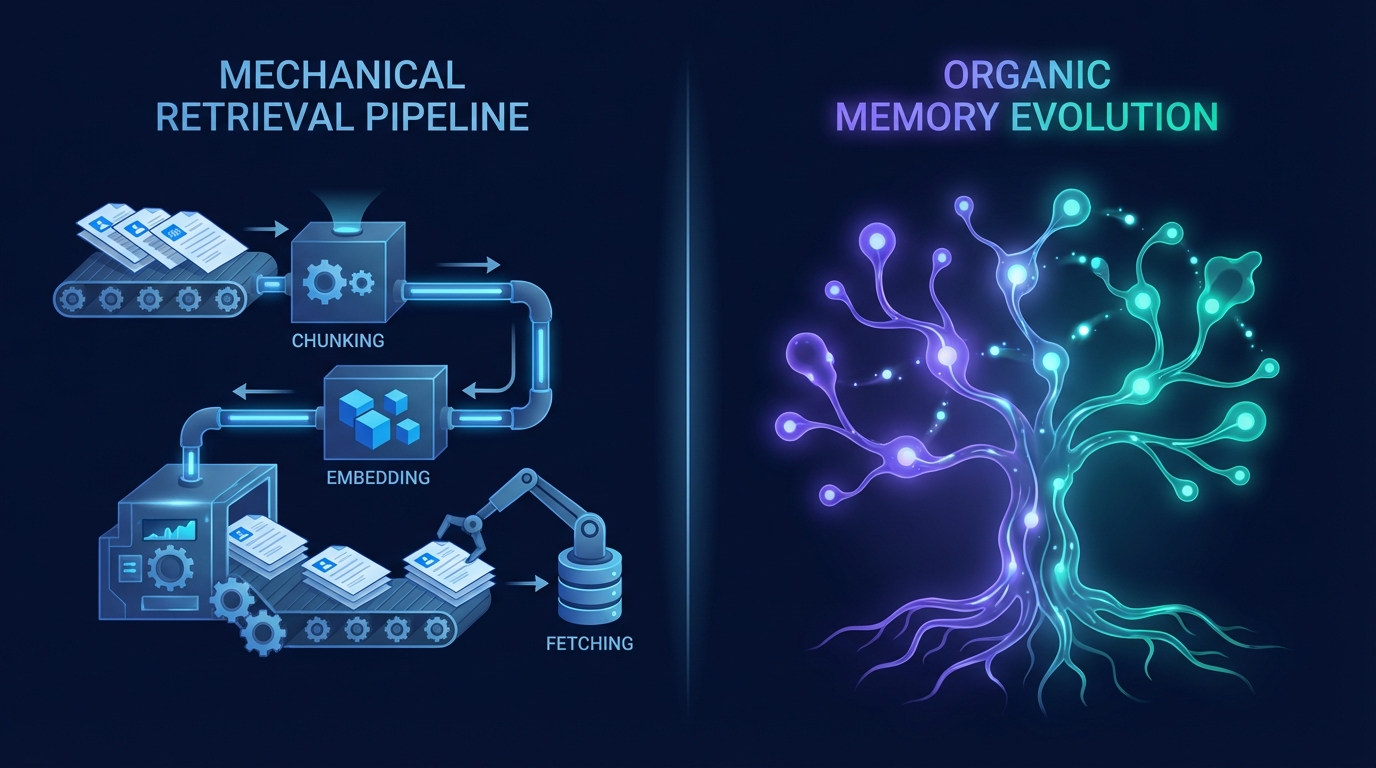
Agentic RAG has become the default architecture for giving AI agents access to external knowledge. The pattern is well-established: embed documents, store vectors, retrieve relevant chunks at inference time, and inject them into the prompt. Frameworks like LlamaIndex, LangChain, and Haystack have made RAG pipelines accessible to any development team. For grounding agent responses in factual, up-to-date information, RAG works.
But there is a fundamental confusion spreading through the agent community — the assumption that RAG is the same as memory. It is not.
Agentic RAG: What Everyone's Getting Right (And Missing)
RAG gets knowledge retrieval right. When an agent needs to answer "what does our refund policy say?" or "what were last quarter's revenue numbers?", retrieving relevant document chunks and adding them to context produces accurate, grounded responses. This is information retrieval — a solved problem that RAG handles elegantly.
What RAG does not address is experiential memory. An agent's memory is not just documents it can search — it is the accumulated understanding from past interactions, decisions, outcomes, and relationships. RAG tells an agent what is written down. Memory tells an agent what it has learned. RAG retrieves documents; memory retrieves experience.
The difference matters concretely. RAG can answer "what is our architecture?" by retrieving design documents. Memory can answer "the last three times we changed this architecture, what went wrong?" — because it lived through those changes and retained the context of each decision and outcome.
The MemU Agentic Memory Framework: Experience Memory, Not Document Retrieval
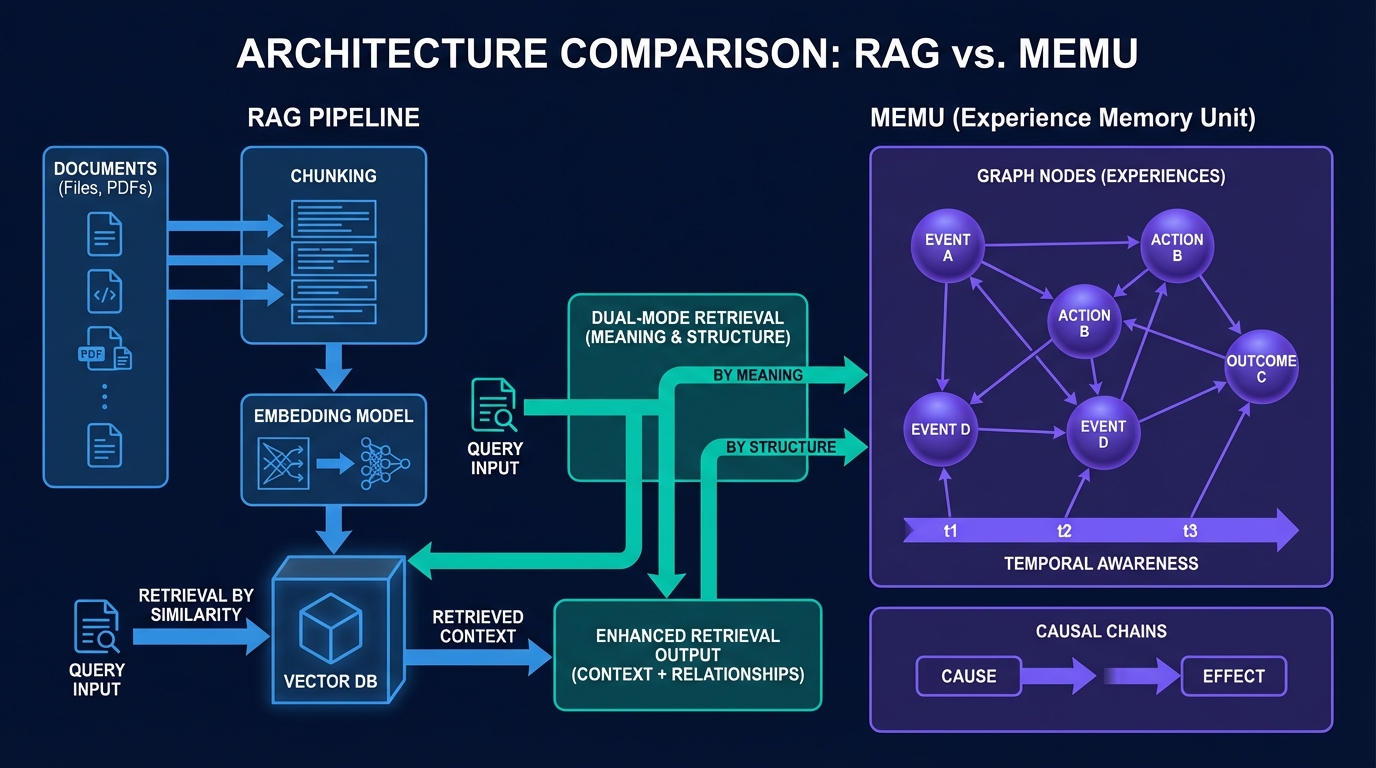
The MemU Agentic Memory Framework provides what RAG cannot — a persistent layer for agent experience that goes beyond document retrieval into structured knowledge accumulation.
Consider a support agent handling a complex enterprise customer. RAG can retrieve the customer's contract terms and product documentation. MemU remembers that this customer's team prefers detailed technical explanations, that their last three issues were related to API rate limiting, that the account manager mentioned a potential upsell opportunity last month, and that the customer's CTO is risk-averse about configuration changes. That is experiential knowledge that does not exist in any document store.
The MemU Agentic Memory Framework provides:
- Drop-in integration: A simple API that complements existing RAG pipelines. MemU does not replace your vector store — it adds a memory layer alongside it. Use RAG for documents; use MemU for experience.
- Dual-mode retrieval: Semantic search for fuzzy experiential recall — "what do I know about situations like this?" — plus a structured memory graph for precise relationship traversal — "what happened last time, who was involved, and what was the outcome?" Both modes surpass what embedding-based retrieval can express.
- Temporal and causal awareness: MemU tracks when things happened and how they relate causally. RAG returns chunks ranked by similarity; MemU returns knowledge organized by time, causation, and relational proximity.
RAG answers questions about what is written. Memory answers questions about what happened. The MemU Agentic Memory Framework gives agents the experiential intelligence that no document retrieval pipeline can provide.
Retrieval operates across 10,000+ memory entries with sub-100ms latency, ensuring experiential memory lookup is as fast as vector search.
Head-to-Head: RAG Alone vs. RAG + MemU
RAG alone: Agents retrieve relevant document chunks and generate grounded responses. Effective for factual queries against a knowledge base. But the agent that helped the same customer five times retrieves the same documentation each time — it has no memory of the previous interactions, what was tried, what worked, or what the customer's actual needs turned out to be.
RAG + MemU Agentic Memory Framework: RAG provides document knowledge. MemU provides experiential knowledge. The agent retrieves documentation AND recalls past interactions, building increasingly effective assistance over time. The fifth interaction benefits from four prior interactions' worth of learned context.
Knowledge graph vs. embedding space: RAG operates in embedding space — similarity-based retrieval that cannot express causation, temporality, or agency. MemU's memory graph operates in knowledge space — structured relationships that express "this caused that", "this happened before that", and "this person decided that." Different retrieval dimensions for different types of intelligence.
Empowering RAG: Better Together
MemU does not replace RAG — it completes the intelligence picture:
- Customer support: RAG retrieves product documentation and FAQs; MemU remembers the customer's history, preferences, and past issue patterns — turning generic support into personalized assistance.
- Research agents: RAG retrieves relevant papers and data; MemU remembers which research directions were productive, which sources were unreliable, and what conclusions were previously drawn — turning each research session into cumulative progress.
- Code assistants: RAG retrieves API documentation and code examples; MemU remembers project-specific conventions, past bugs in similar code, and the team's architectural preferences — turning boilerplate suggestions into contextual guidance.
Get Started with MemU
Add experiential memory alongside your RAG pipeline in minutes. The MemU Agentic Memory Framework complements any retrieval system — one API, zero conflict with existing infrastructure, immediate experiential intelligence. Visit memu.pro to explore the Agentic Memory Framework API, or check out the GitHub repository to start building agents that remember.
Tags: agentic RAG, retrieval-augmented generation, agent memory vs RAG, agentic memory architecture, LLM memory, MemU AI