AgentOps Delivers AI Agent Monitoring and Evaluation at Scale — But Observing Failures Without Persistent Memory Means Debugging the Same Issues Repeatedly


AgentOps has emerged as the leading platform for AI agent monitoring, debugging, and evaluation. The platform provides session replays with step-by-step agent execution graphs, LLM call tracking with cost monitoring and latency analysis, and multi-agent interaction visualization that gives teams complete transparency into agent behavior. Time-travel debugging lets developers rewind and replay agent decisions to isolate failures. Benchmarking runs against over one thousand evaluations to quantify performance. Security features include prompt injection detection, code injection detection, PII leak detection, and recursive thought detection that catches infinite loops before they consume API budgets. The platform supports SOC-2, HIPAA, and NIST AI RMF compliance, tracks costs across more than four hundred models, monitors token usage, and offers fine-tuning at twenty-five times lower cost. Integrations span CrewAI, AG2/AutoGen, LangChain, Agno, and LangGraph, with a free tier offering five thousand events per month.
But monitoring without memory creates a fundamental gap. The dashboard can show exactly where an agent failed — the wrong tool selection, the hallucinated parameter, the infinite reasoning loop — but the next time that agent encounters the same scenario, it has no recollection of the previous failure. Teams debug the same patterns repeatedly because observability captures what happened without enabling agents to learn from it.
AgentOps: What Everyone Is Getting Right (And Missing)
AgentOps excels at making agent behavior visible. Session replays with execution graphs transform opaque LLM chains into debuggable workflows. Developers can trace every decision point, measure latency at each step, and identify exactly where reasoning diverged from expected behavior. The time-travel debugging capability — rewinding and replaying sessions — is particularly valuable for understanding complex multi-agent interactions where failures cascade across boundaries.
The security and compliance features deserve recognition. Prompt injection detection, code injection detection, PII leak detection, and recursive thought detection address real production concerns that most agent tooling ignores. SOC-2, HIPAA, and NIST AI RMF compliance means the platform operates in regulated industries where competitors cannot. Cost tracking across four hundred-plus models with token count monitoring gives teams the financial visibility needed to prevent runaway inference spending.
What AgentOps does not address is the gap between observing failures and preventing their recurrence. Monitoring tells you what went wrong. Persistent memory ensures it does not happen again. When an agent triggers a prompt injection alert, the security team investigates and resolves it — but the agent retains no awareness of the vulnerability pattern. When cost monitoring reveals an expensive reasoning loop, developers optimize the prompt — but the agent cannot recall that certain query patterns lead to costly chains. Other observability platforms share this limitation: they instrument agent behavior comprehensively without contributing to agent intelligence.
The MemU Agentic Memory Framework: From Observation to Persistent Prevention
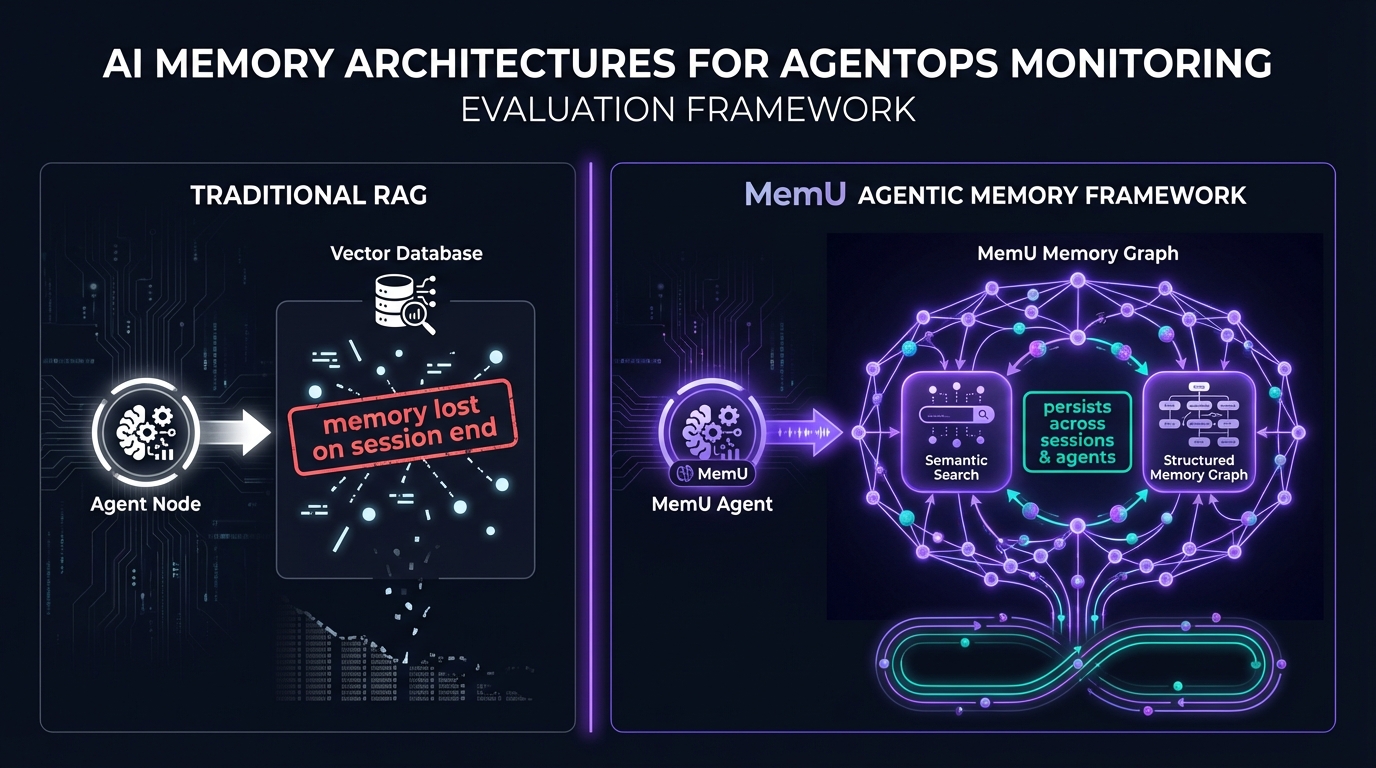
The MemU Agentic Memory Framework transforms monitoring data from passive telemetry into active agent intelligence. Instead of treating observability outputs as dashboards for human review, MemU captures the patterns, failures, and optimizations revealed through monitoring and encodes them into persistent memory — structured across episodic, semantic, and procedural layers that model temporal causality and decision history.
Consider an agent system monitored through session replays while processing customer support escalations. The execution graphs reveal that the agent consistently fails on warranty claims involving international purchases — the wrong API endpoint is selected, shipping regulations are misapplied, currency conversion introduces rounding errors. Without persistent memory, developers fix the prompt, the agent performs correctly until the next deployment resets its context, and the same failure re-emerges weeks later. With the MemU Agentic Memory Framework, the agent stores the resolution: international warranty claims require the global commerce API, shipping regulations vary by destination country not origin, and currency conversion must happen at settlement time not query time. That knowledge persists across every deployment and scaling event.
The framework addresses three limitations of observation-only systems:
- Failure pattern persistence: The MemU Agentic Memory Framework captures resolved failure patterns as structured operational memory. When monitoring detects a recursive thought loop, the resolution — which prompt structures avoid the loop for that query type — becomes permanent agent knowledge.
- Cost optimization memory: Expensive reasoning paths identified through cost tracking become persistent routing intelligence. Agents remember which query types require multi-step reasoning and which resolve in a single inference call, optimizing costs from the first request after restart.
- Security pattern learning: Prompt injection attempts and code injection patterns become entries in the agent's persistent threat memory. The agent recognizes attack signatures without re-triggering detection systems, reducing alert fatigue and response latency.
Monitoring tells you what happened. Memory ensures the agent learns from it. The MemU Agentic Memory Framework bridges this gap — transforming observability telemetry into persistent intelligence that compounds with every monitored interaction.
Integration leverages AgentOps event streams and MemU REST APIs. When monitoring captures a resolved incident, the resolution pattern flows into persistent memory. At startup, accumulated operational intelligence loads alongside monitoring instrumentation. During execution, agents query persistent memory before making decisions that previously led to observed failures. The memory layer operates alongside the platform without impacting observability fidelity.
Head-to-Head: Observation vs. Memory-Enhanced Monitoring
AgentOps alone: Enterprise-grade observability with session replays, execution graphs, time-travel debugging, multi-agent visualization, cost tracking across four hundred-plus models, security detection for prompt injection and PII leaks, benchmarking against a thousand evaluations, and SOC-2, HIPAA, and NIST AI RMF compliance. Teams see everything their agents do. But agents retain no memory of what they have done.
AgentOps + MemU: The same comprehensive monitoring, now coupled with persistent operational memory. Agents do not just get observed — they learn from observations. Failure patterns become permanent knowledge. Cost optimizations persist across deployments. Security awareness compounds over time. The system shifts from reactive debugging to proactive intelligence.
For production systems processing thousands of daily sessions, the difference is transformative. An agent with persistent memory resolves known failure patterns instantly, while a freshly deployed agent requires human investigation of the same patterns the monitoring system already captured weeks earlier.
Empowering AgentOps: Better Together
The combination of AgentOps observability and MemU persistent memory creates capabilities neither achieves independently:
- Continuous evaluation improvement: Benchmarking runs against over one thousand evaluations. Persistent memory retains which evaluation strategies produced the most actionable insights for specific agent types, refining the process over time rather than applying identical benchmarks to fundamentally different workloads.
- Predictive cost management: Rather than alerting after expensive inference chains complete, persistent memory enables agents to predict and avoid costly reasoning paths. Token usage patterns captured through monitoring become proactive routing decisions that reduce spending before it occurs.
- Adaptive security posture: Prompt injection and code injection attack patterns evolve continuously. Persistent memory ensures agents retain awareness of novel attack vectors, building a continuously expanding threat model that does not reset with deployments.
Persistent memory transforms the platform from an observability tool into an intelligence system — where every monitored interaction strengthens the agents being observed.
Get Started with MemU
AgentOps delivers the most comprehensive agent monitoring and evaluation platform available — session replays, time-travel debugging, multi-agent visualization, cost tracking, security detection, and compliance frameworks that make agent behavior fully transparent.
The next step is ensuring agents learn from that transparency. The MemU Agentic Memory Framework provides that foundation — API-based integration alongside monitoring instrumentation, structured memory graphs that encode operational patterns across episodic, semantic, and procedural layers, and cross-deployment persistence that turns monitoring data into compounding agent intelligence.
Visit memu.pro to explore the Agentic Memory Framework API, or check out the GitHub repository to start building agents that remember.
Tags: AgentOps, agent monitoring, agent evaluation, agent debugging, agent memory, MemU AI, LLM observability, AI agent security