Agno Builds the Fastest Agent Framework in Python — But Ultra-Fast Agents Without Persistent Memory Lose Their Speed Advantage on Every Restart


Agno has redefined what lightweight agent infrastructure looks like. Agents instantiate in approximately three microseconds and consume roughly 6.5 kilobytes of memory — performance numbers that make most frameworks look like enterprise monoliths. Built as a Python-native framework for multi-agent systems, Agno delivers shared memory, knowledge bases, reasoning capabilities, and agentic search across more than twenty vector databases, all fully async and production-ready with pre-built FastAPI routes. The framework supports multi-modal inputs — text, image, audio, and video — with structured outputs and full type safety. Its Agent Teams architecture enables coordinated reasoning with shared context. With over one hundred integrations, Agno provides a remarkably complete platform at a fraction of the resource cost of competing frameworks.
But speed without memory creates a paradox. An Agno agent team that processes thousands of requests — learning optimal tool selection, refining search strategies, discovering effective reasoning chains — loses all of that operational intelligence when the deployment restarts. Ultra-fast instantiation means nothing when every instantiation starts from zero, discarding the accumulated knowledge that made previous sessions effective.
Agno: What Everyone Is Getting Right (And Missing)
Agno's performance engineering is genuinely impressive. Three-microsecond instantiation and a 6.5KB footprint mean developers can spin up hundreds of specialized agents without resource overhead. This is a fundamentally different approach to agent lifecycle management, treating agents as disposable computational units rather than heavyweight persistent processes.
The Agent Teams architecture deserves attention. Agno enables teams of agents to share context and coordinate reasoning in real time, with industry-leading patterns for task delegation, parallel execution, and result synthesis. The fully async design with pre-built FastAPI routes means agents deploy to production without boilerplate. Type-safe structured outputs ensure downstream systems receive predictable data shapes. Multi-modal support positions Agno for the increasingly multi-modal future of AI applications.
What Agno does not address is the gap between session storage and persistent organizational memory. Its built-in memory works within a single deployment lifecycle. When agents restart — from scaling events, updates, or redeployments — session storage resets. The agent team that learned to prefer a specific vector database for financial queries, or discovered that four-step reasoning chains outperform six-step chains for classification, starts fresh. Other lightweight frameworks face identical limitations: they optimize for execution speed while treating accumulated intelligence as disposable.
The MemU Agentic Memory Framework: Persistent Intelligence at Agent Speed
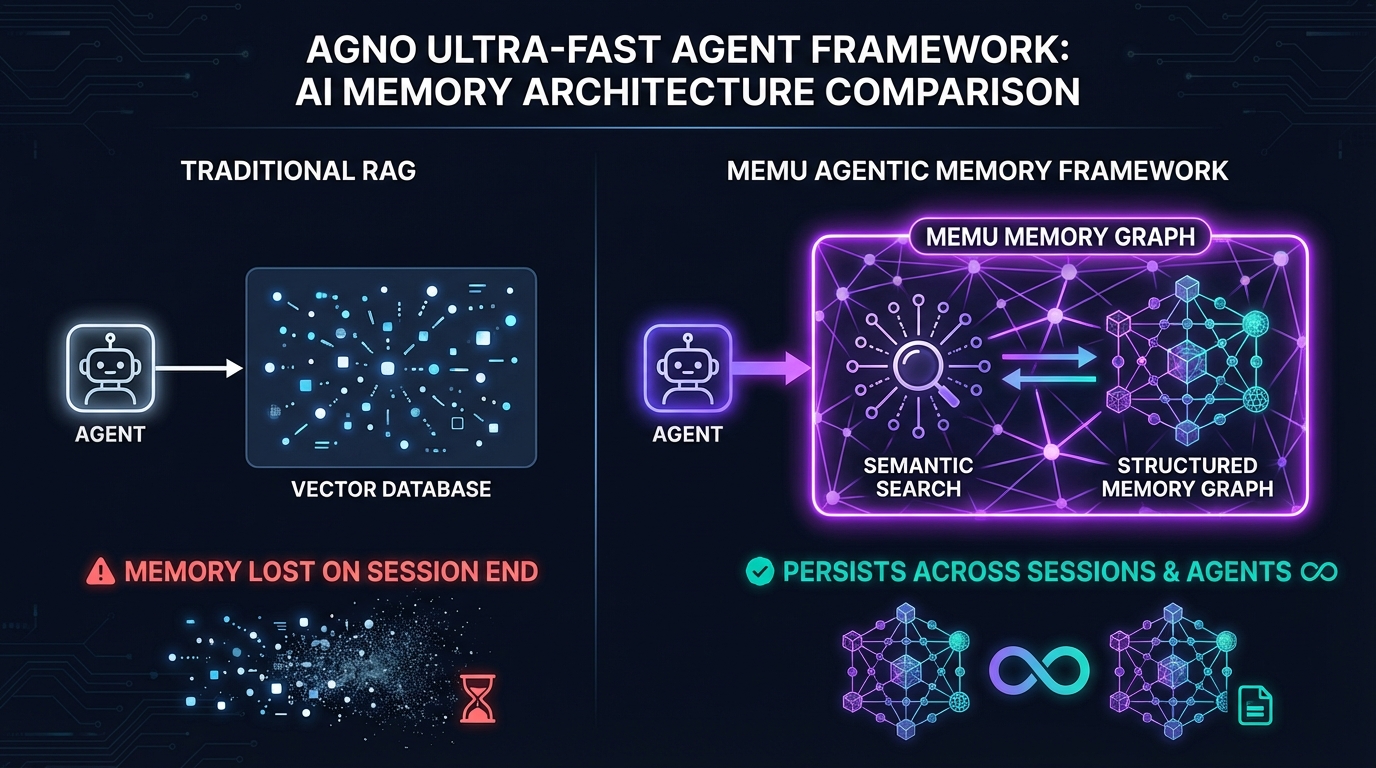
The MemU Agentic Memory Framework provides the persistent memory layer that transforms Agno from a fast execution engine into a learning system. Instead of treating each deployment as isolated, MemU captures operational intelligence — tool selection patterns, reasoning chain effectiveness, search strategy optimization, and team coordination dynamics — storing it in a structured memory graph that persists across restarts and infrastructure migrations.
Consider an Agno Agent Team processing customer onboarding workflows. Without persistent memory, each deployment initializes with default configurations. With the MemU Agentic Memory Framework, the team recalls operational history: the document extraction agent performs best when it receives pre-classified file types from the triage agent, address verification completes forty percent faster when queried against the postal database before the geocoding service, and multi-language documents require a two-pass OCR strategy discovered after processing three thousand documents. That learned intelligence loads in milliseconds, matching Agno's instantiation speed while providing the depth of a continuously running system.
The framework addresses three core limitations of session-bounded agents:
- Tool selection optimization: With over one hundred integrations, choosing the right tool is a combinatorial challenge. The MemU Agentic Memory Framework captures which tool combinations produced the best results for specific task categories, enabling informed selections from the first request.
- Reasoning chain persistence: Effective reasoning chains emerge through execution experience. Persistent memory preserves which chain structures and branching strategies produced optimal outcomes.
- Team coordination memory: Agent Teams develop coordination patterns through repeated collaboration. The MemU Agentic Memory Framework preserves which delegation strategies and parallel execution configurations worked best, enabling proven coordination from the first interaction after restart.
An agent that instantiates in three microseconds but spends its first thousand requests rediscovering optimal behavior is slower in practice than one that starts with accumulated intelligence. The MemU Agentic Memory Framework gives Agno agents persistent memory that matches their instantiation speed.
Integration with Agno leverages the framework's REST APIs through the extensible tool system. At startup, accumulated intelligence loads from the memory graph. During execution, agents query persistent memory for context on similar past tasks. At shutdown, new operational insights are stored. The memory layer operates within Agno's async architecture, adding persistence without impacting sub-millisecond performance.
Head-to-Head: Ephemeral Speed vs. Memory-Enhanced Velocity
Agno alone: The fastest agent framework available — three-microsecond instantiation, 6.5KB footprint, fully async with FastAPI routes, multi-modal processing, type-safe outputs, and Agent Teams with shared reasoning. Over one hundred integrations and twenty-plus vector databases. Session storage maintains state within a deployment. But every restart initializes from default configurations.
Agno + MemU: The same ultra-fast architecture, now backed by persistent operational memory. Agents instantiate in microseconds and immediately access accumulated intelligence about tool selection, reasoning strategies, and coordination patterns. The system gets measurably faster in practice — not just in instantiation time, but in time-to-correct-answer — with every deployment cycle.
For production systems processing continuous workloads across daily deployments, the compounding effect transforms operational efficiency. An Agno deployment with fifty thousand requests of persistent memory responds with the precision of a deeply tuned system, while a fresh instance would need weeks to reach equivalent effectiveness.
Empowering Agno: Better Together
The combination of Agno's lightweight execution engine and MemU's persistent memory unlocks capabilities neither achieves independently:
- Adaptive multi-modal routing: Persistent memory reveals which processing pipelines work best for different input modalities. An agent team might learn video inputs require a three-agent pipeline while audio performs better with a single specialized agent.
- Cross-team knowledge transfer: When multiple Agent Teams share persistent memory, coordination insights from one benefit others. An optimal search strategy discovered by the research team becomes available to customer support.
- Progressive vector database optimization: Persistent memory tracks which databases deliver the best results for specific query types and data domains, eliminating the cold-start problem across multiple databases.
Persistent memory transforms Agno from the fastest agent framework into the fastest learning agent framework — where every interaction compounds operational intelligence.
Get Started with MemU
Agno has built the most performance-optimized agent framework available — microsecond instantiation, minimal memory footprint, fully async production-ready architecture with Agent Teams, multi-modal processing, and over one hundred integrations.
The next step is giving those ultra-fast agents persistent operational memory. The MemU Agentic Memory Framework provides that foundation — API-based integration within Agno's async tool system, dual-mode retrieval with semantic search and structured memory graphs, and cross-deployment persistence that turns the fastest agent framework into a compounding intelligence system.
Visit memu.pro to explore the Agentic Memory Framework API, or check out the GitHub repository to start building agents that remember.
Tags: Agno, agent framework, Python agents, ultra-fast agents, agent memory, MemU AI, LLM memory, multi-agent systems