AI Agent Skill Marketplaces Are Exploding — But 5,700 Skills That Don't Share Memory Create Isolated Intelligence

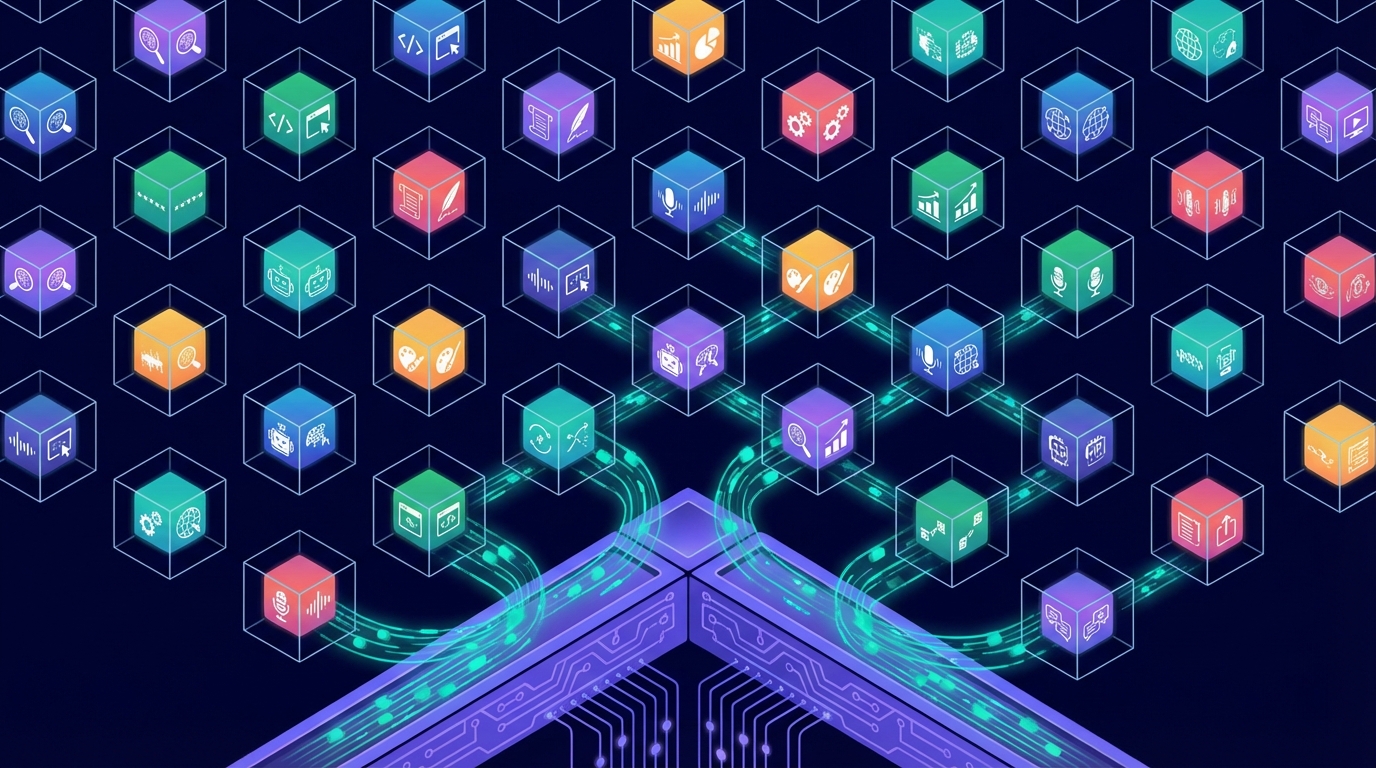
AI agent skill marketplaces are the app stores of the agentic era. OpenClaw's marketplace hosts 5,700+ community skills. Google's Agent Garden provides prebuilt agents and tools. Microsoft's Agent Framework connects to a growing ecosystem of capabilities through MCP. The pattern is clear: rather than building monolithic agents, the industry is moving toward composable skill ecosystems where agents gain capabilities by plugging in specialized modules.
But there is a foundational problem with skill-based agent ecosystems — skills that execute in isolation create fragmented intelligence, even when they serve the same user.
Agent Skill Marketplaces: What Everyone's Getting Right (And Missing)
Skill ecosystems get modularity right. A research skill gathers data. A coding skill writes implementations. A communication skill drafts emails. A scheduling skill manages calendars. The composability model means agents can be assembled from best-of-breed capabilities rather than relying on a single framework to do everything. This is sound software architecture applied to AI agents.
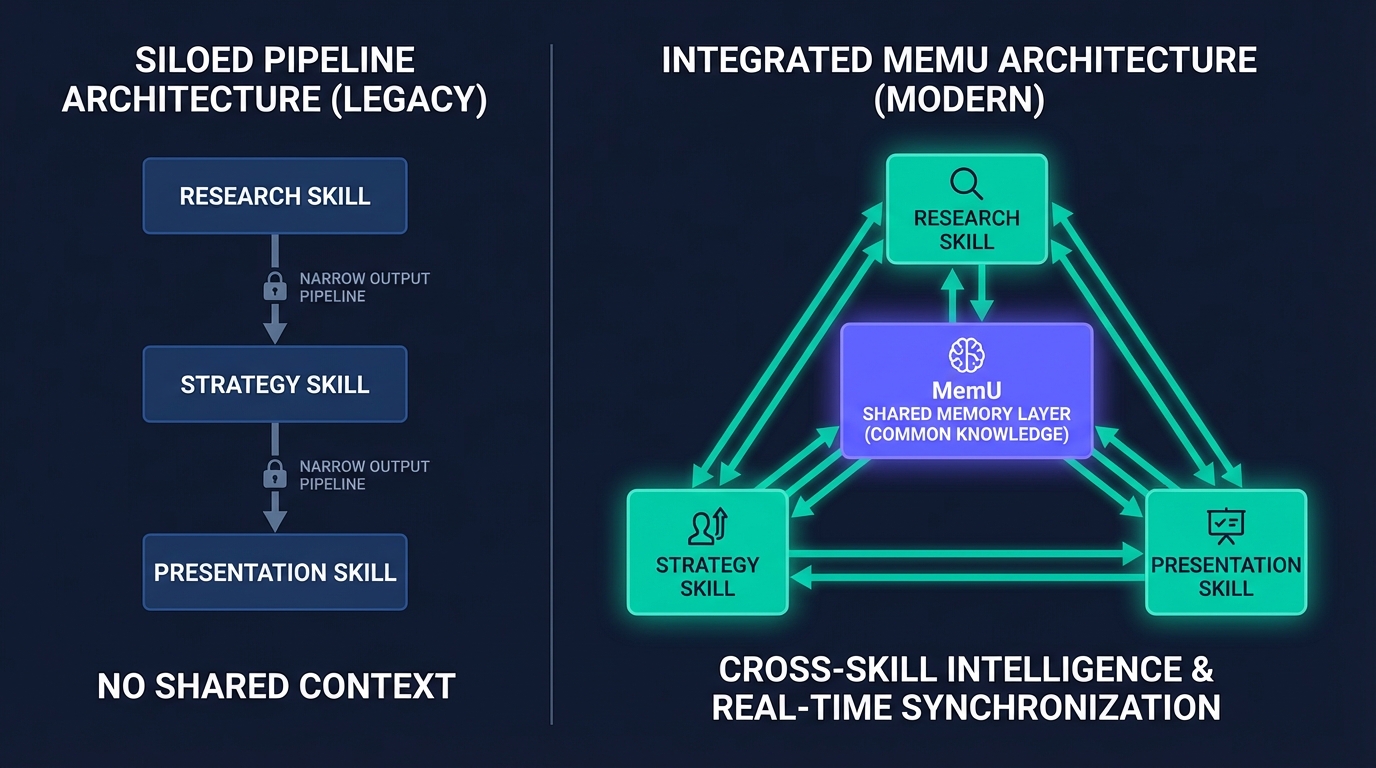
What skill ecosystems do not solve is shared context across skills. When a research skill discovers an important finding and then a communication skill drafts a report about it, the communication skill has no memory of the research process — only the output. When a coding skill implements a feature and a testing skill verifies it, the testing skill has no knowledge of the implementation decisions. Skill marketplaces distribute capabilities; they do not distribute understanding.
OpenClaw, Agent Garden, MCP tool ecosystems — all face this same architectural limitation. Skills compose execution; none of them compose memory.
The MemU Agentic Memory Framework: Shared Memory Across Agent Skills
The MemU Agentic Memory Framework adds the missing layer. Where skill marketplaces distribute capabilities, MemU provides the shared memory that connects those capabilities into coherent intelligence.
Consider an agent that uses a research skill to analyze a market, a strategy skill to formulate recommendations, and a presentation skill to create a deck. With MemU, the strategy skill knows not just the research output but the reasoning behind it — which sources were most credible, which data points conflicted, what the researcher considered and rejected. The presentation skill knows both the strategy and the research context. The final output reflects integrated intelligence, not pipeline handoffs.
The MemU Agentic Memory Framework provides:
- Drop-in integration: A simple API that works across any skill ecosystem — OpenClaw, Agent Garden, MCP, or custom skills. Add memory calls; every skill in the chain shares accumulated context.
- Dual-mode retrieval: Semantic search for finding relevant context from any skill's previous execution plus a structured memory graph for tracking how knowledge flows across skill boundaries. Not just passed outputs — actual shared understanding.
- Cross-skill persistence: Memory survives across skill invocations, skill upgrades, and skill replacements. Swap a research skill for a better one — the memory of all previous research remains accessible.
Composable skills without shared memory create composable isolation. The MemU Agentic Memory Framework gives skill ecosystems the shared context that transforms pipeline execution into integrated intelligence.
Retrieval operates across 10,000+ memory entries with sub-100ms latency, adding negligible overhead to skill execution chains.
Head-to-Head: Isolated Skills vs. Skills + MemU
Skills alone: Each skill receives input and produces output. Context is limited to what is explicitly passed between skills. The research skill discovers that a competitor is pivoting strategy — but the sales skill drafting a proposal has no way to access that insight unless it was explicitly included in the handoff.
Skills + MemU Agentic Memory Framework: All skills read from and write to shared memory. The sales skill automatically has access to the research skill's competitive intelligence. The coding skill knows the architecture decisions the planning skill made. Skills become genuinely collaborative, not just sequentially connected.
Skill improvement feedback: With MemU, skills learn from each other's outcomes. When the testing skill finds bugs in the coding skill's output, that pattern is stored in shared memory — and the coding skill avoids the same pattern next time.
Empowering Skill Ecosystems: Better Together
MemU does not replace skill marketplaces — it makes composable agents dramatically more coherent:
- Research-to-action: Research skills discover insights; MemU ensures action-oriented skills (coding, writing, planning) have full context about how and why those insights were reached.
- Cross-domain intelligence: Technical skills and business skills share memory through MemU, so an agent handling both engineering and business tasks has unified understanding rather than siloed capabilities.
- Skill evolution: When skills are upgraded or replaced, MemU preserves the accumulated knowledge from previous versions — ensuring continuity even as the skill ecosystem evolves.
Get Started with MemU
Add shared memory to your agent skill ecosystem in minutes. The MemU Agentic Memory Framework connects any skills — one API, zero lock-in, immediate cross-skill intelligence. Visit memu.pro to explore the Agentic Memory Framework API, or check out the GitHub repository to start building agents that remember.
Tags: agent skills marketplace, composable AI agents, OpenClaw skills, MCP tools, agentic memory, LLM memory, MemU AI