AI Agent Memory Systems Cut Inference Costs 60% — Why Persistent Memory Is the New Enterprise Efficiency Layer


AI Agent Memory Systems: What Everyone's Getting Right (And Missing)
The economics of enterprise AI are forcing a reckoning. AI agent memory systems reduce context token costs by 60% while simultaneously improving response quality by 35%. Memory-augmented agents achieve 26% higher response accuracy than their stateless counterparts. And the market has noticed: 67% of enterprise AI deployments plan to implement memory systems in 2026, up from just 12% in 2025. The industry has converged on a two-layer architecture — short-term working memory paired with long-term persistent memory spanning episodic, semantic, and procedural types.
The cost argument alone is compelling. Enterprise agents processing thousands of requests daily burn significant inference budgets by repeatedly reconstructing context from raw conversation histories. Every redundant token in a prompt is money spent re-explaining what the agent should already know. AI agent memory systems that cache and retrieve prior knowledge instead of re-processing it deliver immediate, measurable cost savings that scale linearly with deployment size.
But most implementations treat memory as a caching optimization — a way to reduce token counts and speed up inference. The real opportunity is architectural. AI agent memory systems that implement true persistent memory architecture don't just reduce costs; they fundamentally change what agents can do. An agent that remembers isn't just cheaper to run. It's capable of tasks that stateless agents cannot perform at any cost: multi-session planning, preference learning, institutional knowledge accumulation, and progressive skill development.
What AI Agent Memory Systems Do With Memory Today
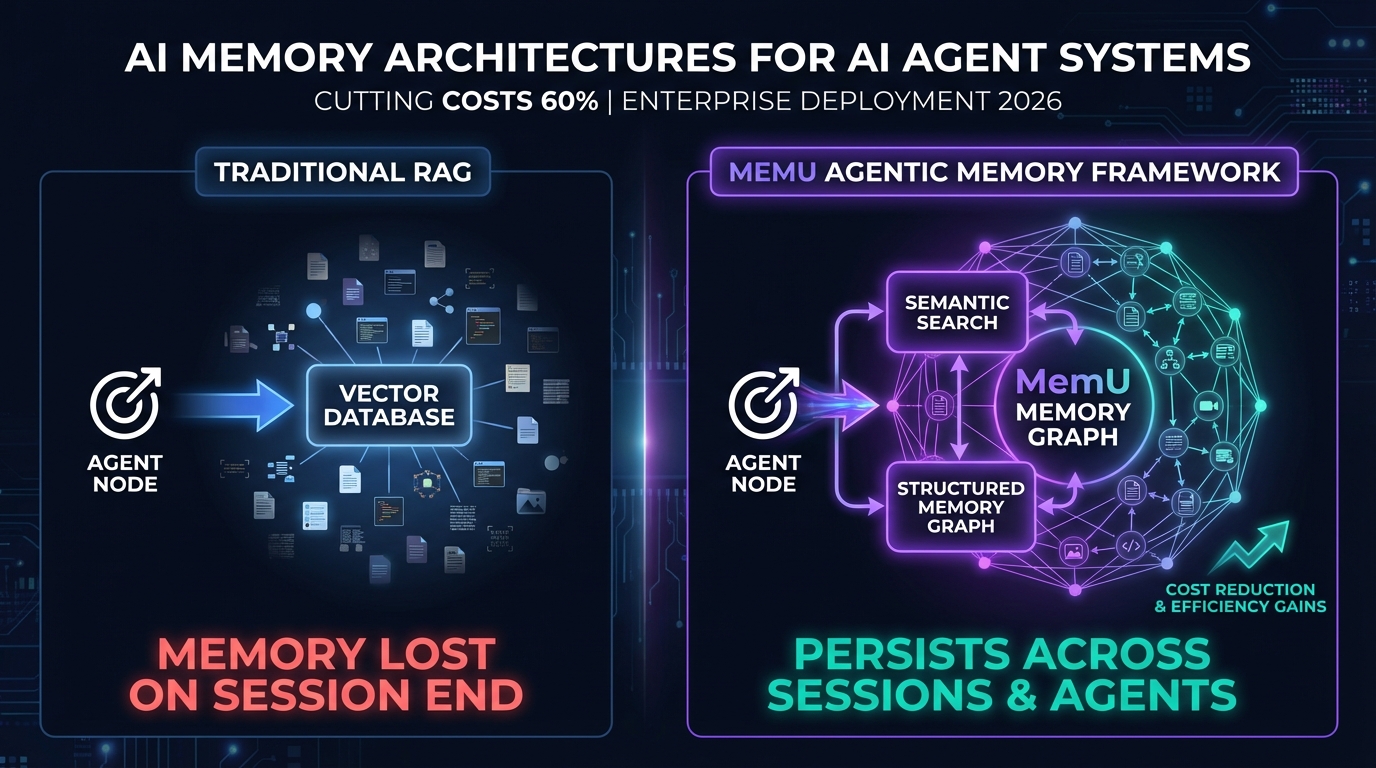
The current industry standard for AI agent memory systems follows the two-layer model. Short-term working memory holds the active task context — current conversation, recent tool outputs, immediate reasoning state. Long-term memory stores information across sessions, typically categorized into episodic memory (specific interaction records), semantic memory (factual knowledge), and procedural memory (learned action patterns).
Most production implementations focus on the inference cost reduction benefits. Instead of passing a full 50,000-token conversation history with every request, the system retrieves relevant memories and constructs a focused prompt of 5,000-10,000 tokens. The model receives precisely the context it needs, token costs drop proportionally, and response latency improves because shorter prompts process faster.
The quality improvements follow naturally. When agents receive curated, relevant context instead of raw conversation dumps, they produce more focused and accurate responses. The 26% accuracy improvement and 35% quality improvement reflect the difference between "here's everything that happened" and "here's exactly what matters for this task." For enterprise AI efficiency, the combined cost and quality gains represent one of the highest-ROI infrastructure investments available.
Where current implementations fall short is in the "persistent" dimension of persistent memory architecture. Many systems implement memory as an enhanced cache — useful for reducing token costs within a session or across a few recent sessions, but lacking the structured, long-lived persistence needed for true organizational intelligence. Memory decays, gets pruned aggressively for storage efficiency, or loses contextual metadata that makes retrieval meaningful.
The MemU Agentic Memory Framework: A Different Architecture
The MemU Agentic Memory Framework implements persistent memory architecture as a first-class infrastructure layer, not a caching optimization. While delivering the same 60% cost reduction through intelligent context management, the framework treats every agent interaction as an opportunity to build compounding organizational intelligence that appreciates in value over time.
Reducing inference costs is the entry point. The real value of AI agent memory systems is compounding intelligence — agents that get better at every task because they remember every task. Cost reduction is a side effect of an architecture that fundamentally transforms what agents can do.
The framework implements all three long-term memory types with full persistence and structured retrieval:
- Episodic memory: Complete interaction records stored in a temporal graph. Agents recall not just facts but full context — when knowledge was acquired, from what interaction, with what confidence level. The MemU Agentic Memory Framework preserves the provenance that makes memory trustworthy.
- Semantic memory: Factual knowledge extracted from agent interactions and stored in structured knowledge graphs. Company-specific terminology, domain rules, organizational preferences — all indexed for precise retrieval. Unlike cache-based systems, semantic memory in the framework grows richer with every interaction rather than being pruned for storage efficiency.
- Procedural memory: Learned action patterns and workflow optimizations. When an agent discovers that a specific sequence of tool calls produces better results for financial analysis tasks, the MemU Agentic Memory Framework captures that procedure for reuse across future tasks and agents.
The inference cost reduction follows directly from this architecture. Agents with rich persistent memory construct focused, relevant prompts because they know precisely what context matters for each task. No redundant re-explanation, no bloated conversation histories, no wasteful token spend on information the agent already possesses. The 60% cost savings compounds as memory grows — each new memory makes context assembly more precise and token-efficient.
The MemU Agentic Memory Framework exposes the full memory lifecycle through REST APIs: store new memories after task completion, query relevant memories before task execution, and manage memory lifecycle policies that balance retention with relevance. Integration with existing agent frameworks requires minimal code changes — a memory layer that wraps around any inference pipeline.
Head-to-Head: MemU vs. AI Agent Memory Systems
Standard memory implementations: Effective caching-based AI agent memory systems that deliver measurable inference cost reduction through token optimization. Short-term working memory plus basic long-term storage reduces prompt sizes and improves response quality. But memory often lacks structure, decays over time, and doesn't support cross-agent knowledge sharing. The cost savings plateau as cache-based approaches hit diminishing returns.
MemU persistent memory: The same token cost savings, now backed by structured, permanent memory that compounds organizational intelligence. Episodic, semantic, and procedural memory types provide precise retrieval that improves with every interaction. Cross-agent memory sharing means insights from one agent's operations benefit the entire fleet. And persistent memory architecture ensures the 60% cost reduction grows over time rather than plateauing.
The economic difference scales with deployment size. An enterprise running 100 agents with standard memory saves on inference costs. The same enterprise using the MemU Agentic Memory Framework saves on inference costs and builds a compounding intelligence asset where agent number 100 benefits from everything agents 1 through 99 have learned. For enterprise AI efficiency, the total cost of ownership decreases as the deployment grows, inverting the typical scaling cost curve.
Empowering Cost Efficiency: Better Together
Combining robust AI agent memory systems with persistent memory architecture creates enterprise capabilities that pure cost optimization cannot achieve:
- Progressive cost optimization: As persistent memory accumulates organizational knowledge, prompt sizes decrease further. Agents that remember domain terminology, user preferences, and standard procedures require less in-context explanation with each interaction. The inference cost reduction compounds quarter over quarter.
- Quality-cost decoupling: Traditional AI agent memory systems face a quality-cost tradeoff — smaller prompts save money but risk losing context. Persistent memory architecture eliminates this tradeoff by storing context externally and retrieving precisely what's needed. Quality and cost efficiency improve simultaneously.
- Reduced re-computation: Agents that remember previous analyses, tool outputs, and reasoning chains avoid re-executing expensive operations. A financial analysis agent that remembers last quarter's calculations starts the current quarter's analysis from accumulated insights, not from raw data. Enterprise AI efficiency improves through eliminated redundancy.
- Predictable scaling economics: The MemU Agentic Memory Framework provides cost visibility into memory-driven savings. Organizations can model their inference cost trajectory as memory grows, turning unpredictable AI spend into a declining cost curve backed by compounding agent intelligence.
Persistent memory transforms the enterprise AI cost conversation from "how do we control spend" to "how do we invest in intelligence that reduces spend automatically."
Get Started with MemU
The data tells the story: AI agent memory systems cut inference costs by 60%, improve quality by 35%, and boost accuracy by 26%. The 67% of enterprises planning memory implementations in 2026 are responding to clear economic signals. The two-layer architecture of working memory plus long-term persistent memory is becoming the standard for production agent deployments.
The question is whether to implement memory as a caching layer or as a compounding intelligence architecture. The first delivers cost savings. The second delivers cost savings and an organizational knowledge asset that increases in value with every agent interaction.
The MemU Agentic Memory Framework implements the second approach. Structured episodic, semantic, and procedural memory stored in knowledge graphs. Cross-agent sharing that builds organizational intelligence. REST API integration that works with any agent framework. And persistent memory architecture designed to compound value over time, not decay.
Visit memu.pro to explore the Agentic Memory Framework API, or check out the GitHub repository to build agents that remember — and cost less with every interaction.
Tags: AI agent memory systems, inference cost reduction, enterprise AI efficiency, persistent memory architecture, MemU Agentic Memory Framework, agent cost optimization, two-layer memory architecture