AI Code Review Tools Catch 50K+ Bugs in 30 Seconds — But They Review Your 100th PR Like They've Never Seen Your Codebase


AI-powered code review tools have crossed the threshold from novelty to necessity. CodeRaptor has reviewed 10M+ lines of code and caught 50K+ bugs across 1,000+ teams, saving 60% of review time. CodeSpect reduces review time by 50% with stack-specific AI models. Kodus — an open-source alternative — reports 40% reductions in review time and 50% fewer production bugs. These tools analyze pull requests in under 30 seconds, scanning for bugs, security vulnerabilities (OWASP Top 10), code smells, and style inconsistencies. AI code review is now faster, more consistent, and more thorough than human-only review.
The tools share a common architecture: receive a PR, analyze the diff, compare against known patterns and project configuration, and generate line-level feedback with fix suggestions. Some learn from project context through custom rules. Some offer stack-specific models tuned for React, Laravel, or TypeScript. All integrate with GitHub, GitLab, or Bitbucket. The setup is trivial — often under a minute — and the value is immediate.
But review quality depends on codebase understanding, and understanding requires memory: the tool that reviews your 100th PR should know your codebase intimately, yet it approaches each PR with the same fresh analysis as the first.
Why Code Review Requires Codebase Memory
The best human code reviewers don't just check syntax and patterns — they understand the codebase. They know that the payments module has a subtle race condition. They know the team decided to use composition over inheritance. They know that the CI pipeline's integration tests are flaky on Tuesdays. This contextual knowledge transforms code review from pattern matching into genuine quality assurance.
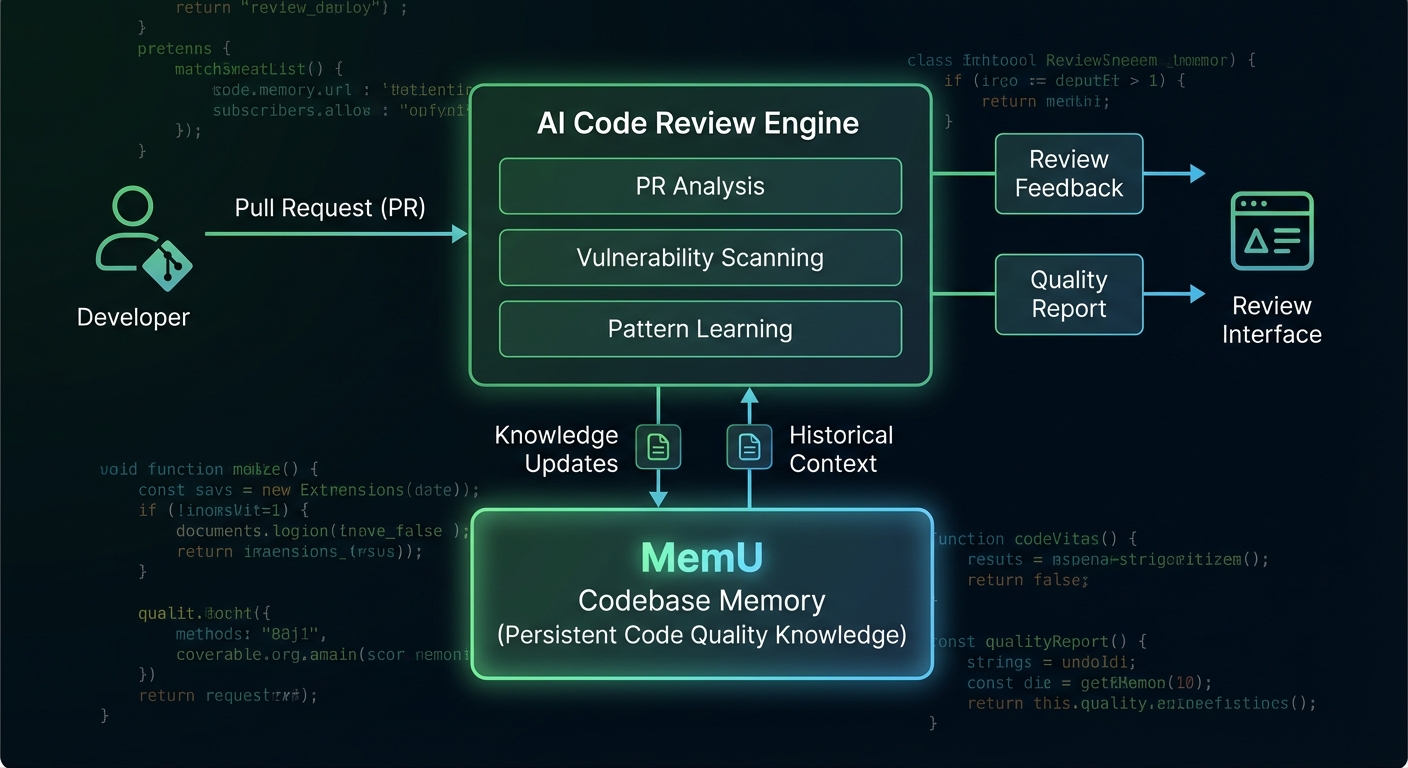
AI code review tools lack this contextual knowledge. They can detect that a function is too complex based on cyclomatic complexity rules. They can't detect that this function was intentionally complex because the team discussed it three months ago and decided the alternatives were worse. They flag "unused import" but don't know the import will be needed when the feature branch merges next week. They suggest refactoring a module that the team has decided to deprecate entirely.
Custom rules and project configuration partially address this — teams can teach the tool specific patterns to enforce or ignore. But these are static rules, not accumulated understanding. The difference between a configured tool and an experienced reviewer is the difference between following a checklist and having judgment.
How MemU Adds Codebase Memory to AI Code Review
MemU provides the persistent codebase memory that transforms AI code review from pattern matching to experienced review. Every reviewed PR generates memories: architectural decisions, common patterns, team preferences, and resolution outcomes. The 100th PR review benefits from the accumulated understanding of the 99 that came before — which suggestions were accepted, which were dismissed, and why.
Over months, the code reviewer develops genuine codebase expertise. It knows the modules with known issues. It understands the team's style preferences. It recognizes patterns that are intentional rather than accidental. This is the 50% bug reduction that tools already deliver, compounded by the contextual understanding that only memory enables.
AI code review tools catch the bugs. MemU gives them the codebase memory to catch the right bugs.
Get Started
Add codebase memory to your AI code review. Explore MemU at memu.pro and on GitHub.