Context Drift Causes 65% of Enterprise AI Agent Failures — The Fix Isn't Bigger Windows, It's Persistent Memory


Context Drift: What Everyone's Getting Right (And Missing)
Context drift is the silent failure mode killing enterprise AI agent deployments. Research now shows that context drift — not raw context window limitations — causes approximately 65% of enterprise AI failures. The mechanism is insidious: with nearly 2% accuracy degradation per reasoning step, a 20-step workflow compounds to roughly 40% failure rates. Agents don't crash spectacularly. They gradually lose coherence, producing outputs that drift further from the original intent with each sequential step.
The industry has responded with legitimate technical approaches. Anchored iterative summarization compresses earlier context while preserving key anchoring facts. ACON failure-driven optimization detects drift onset and triggers corrective replanning. Provider-native compaction APIs from OpenAI, Google, and Anthropic offer framework-level context compression. These approaches reduce context drift symptoms within individual sessions by managing how information degrades across long reasoning chains.
But the fundamental insight that most teams miss is this: context drift is a symptom of stateless architecture, not a problem of insufficient context windows. When agents must reconstruct their entire working context from raw conversation history at every step, degradation is mathematically inevitable. The fix isn't compressing context more efficiently — it's storing critical knowledge in persistent memory that agents can query with precision rather than carrying through sequential compression.
What Context Drift Does With Memory Today
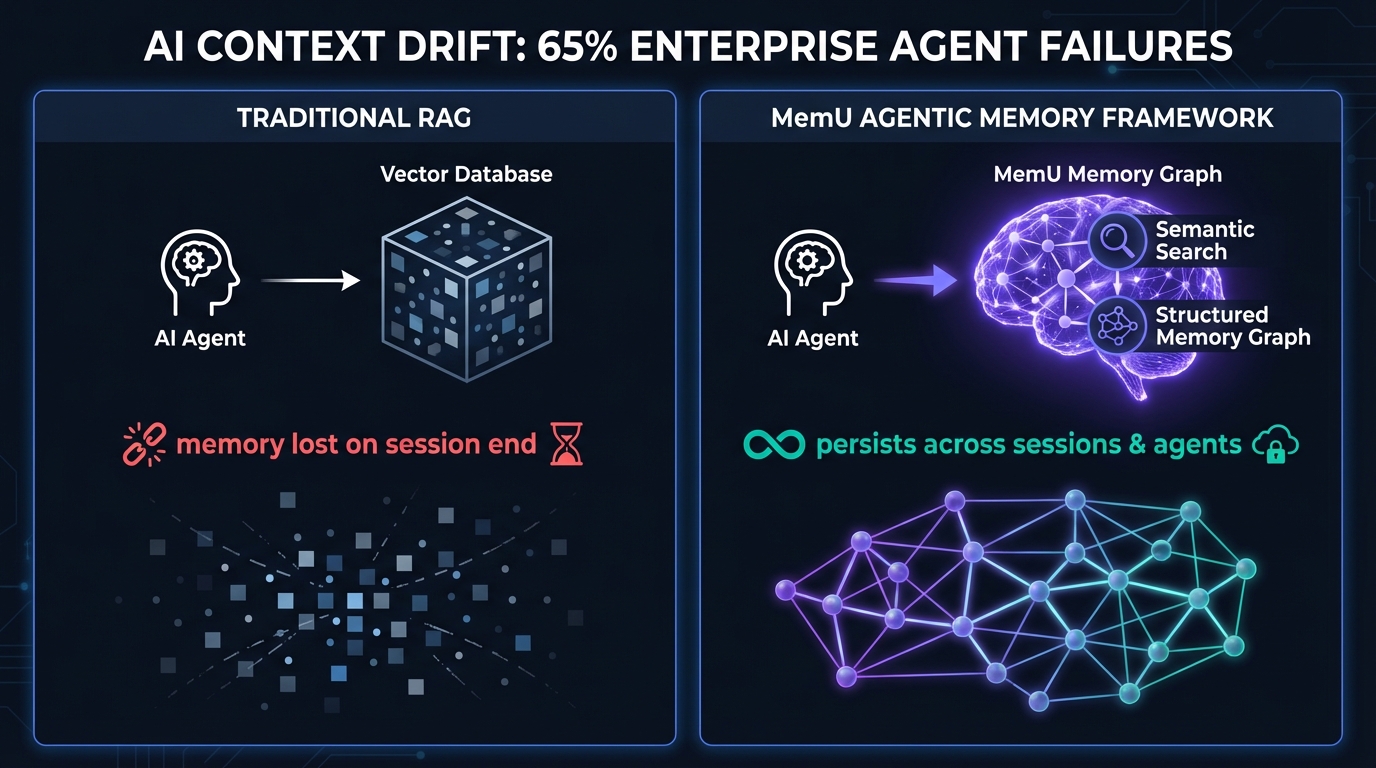
Current approaches to context drift operate within the bounds of session-level context management. Summarization techniques compress earlier parts of the conversation into shorter representations, freeing token space for recent interactions. Anchoring strategies tag critical facts and ensure they survive compression passes. Failure detection systems monitor output quality and trigger re-grounding when drift exceeds thresholds.
These techniques buy time within a single session. An agent executing a 20-step workflow with iterative summarization might maintain coherence through step 15 instead of failing at step 12. That's meaningful improvement. But for enterprise AI failures occurring across multi-session workflows — a legal review spanning three days, a financial analysis revisited weekly, a customer onboarding process with checkpoints over two months — session-level mitigation is fundamentally insufficient.
The numbers are stark. Even with state-of-the-art summarization, each compression pass loses information. Research indicates that after five summarization cycles, agents retain less than 60% of the original contextual detail. For agent context management, this means enterprises face a choice: keep sessions short enough to avoid drift (limiting agent capability) or accept progressive quality degradation across longer workflows. Neither option supports the autonomous, multi-session agent operations that enterprise AI deployments demand.
Context window limitations compound the problem. While modern models support 128K to 1M token windows, enterprise workflows generate context at rates that overwhelm even these capacities. A single financial compliance review can produce 50,000 tokens of analysis per step across 30 steps — far exceeding any context window, no matter how large.
The MemU Agentic Memory Framework: A Different Architecture
The MemU Agentic Memory Framework addresses context drift at the architectural level rather than the symptom level. Instead of compressing context to fit within windows, MemU extracts critical knowledge from agent workflows and stores it in a structured memory graph — a persistent layer that agents query to retrieve exactly the information they need, when they need it, without carrying accumulated context through sequential reasoning steps.
Context drift is what happens when agents are forced to carry their entire history through a lossy compression pipeline. Persistent memory eliminates the pipeline entirely — agents retrieve specific knowledge instead of reconstructing degraded context.
The architecture directly counters the 2% per-step degradation that drives enterprise AI failures. Rather than accumulating context across 20 steps (and the corresponding compound drift), an agent using the MemU Agentic Memory Framework starts each step with a targeted memory query. Step 15 of a financial analysis retrieves the specific regulatory findings from steps 3 through 7 without passing through 12 layers of summarization. The information arrives at full fidelity, not compressed through lossy intermediate representations.
Three capabilities target the specific failure patterns that context drift creates:
- Precision retrieval over sequential compression: Agents query the memory graph for specific facts, decisions, and intermediate results. The MemU Agentic Memory Framework returns contextually relevant knowledge without the information loss inherent in iterative summarization.
- Cross-session continuity: Multi-day and multi-week workflows maintain full fidelity. An agent resuming a legal review on Tuesday retrieves Monday's findings from persistent memory — not from a compressed summary that lost critical nuances during overnight session termination.
- Drift-resistant anchor management: Critical decisions and facts are stored as first-class entities in the memory graph, not as tokens competing for space in a context window. Agent context management shifts from "preserve everything possible" to "store everything important and retrieve as needed."
The MemU Agentic Memory Framework integrates with existing drift mitigation strategies as a complementary layer. Teams using ACON failure detection or anchored summarization can add persistent memory to capture outputs at each step, creating retrieval-backed checkpoints that prevent compound degradation across long execution chains.
Head-to-Head: MemU vs. Context Drift Mitigation
Session-level drift mitigation alone: Summarization, anchoring, and compaction APIs extend the usable range of agent sessions by 20-40% before context drift degrades output quality. Effective for single-session workflows under 15-20 steps. But multi-session workflows still restart without accumulated knowledge, and compound degradation remains mathematically inevitable across long chains.
Drift mitigation + MemU: The same compression and anchoring techniques operate within sessions, now backed by persistent memory that captures critical knowledge at each workflow step. When drift accumulates to the point of degradation, agents re-ground by querying the memory graph for high-fidelity information rather than relying on multiply-compressed context. Multi-session workflows maintain continuity through persistent retrieval rather than context reconstruction.
The impact on enterprise AI failures is direct. The 65% failure rate attributed to context drift reflects compound degradation across multi-step workflows. Persistent memory breaks the compounding mechanism by decoupling knowledge retention from sequential context passing. Each step retrieves from memory rather than inheriting from a degraded context chain. For organizations managing context window limitations across enterprise workflows, this architectural shift converts an intractable mathematical problem into a solved engineering pattern.
Empowering Drift Resilience: Better Together
Combining session-level drift mitigation with persistent memory creates enterprise agent capabilities that address the full spectrum of context drift failures:
- Checkpoint-based workflow execution: Agents store intermediate results in persistent memory at defined checkpoints. When drift accumulates between checkpoints, the agent re-grounds from the last stored state rather than from compressed conversation history. Workflow reliability scales linearly rather than degrading exponentially.
- Cross-workflow learning: Agents that remember which reasoning strategies produced drift in previous workflows avoid those patterns proactively. Agent context management becomes self-improving through accumulated experience with drift failure modes.
- Organizational knowledge retention: When an agent completes a 30-step compliance review, every finding, decision, and regulatory citation is stored persistently. The next quarterly review starts with that institutional knowledge, not a blank context window. Context window limitations become irrelevant for knowledge that lives in persistent memory.
- Drift analytics: The MemU Agentic Memory Framework provides visibility into where context drift typically occurs across workflow types, enabling teams to place strategic memory checkpoints at high-drift steps and optimize workflow design with empirical data.
Persistent memory transforms context drift from a fundamental architectural limitation into a manageable engineering concern — one that improves as the memory layer accumulates workflow intelligence.
Get Started with MemU
The data is clear: context drift causes 65% of enterprise AI agent failures, and the industry's current response — bigger windows and better compression — addresses symptoms while leaving the root cause intact. Compound degradation across multi-step workflows is a mathematical certainty when agents carry context through sequential processing.
Persistent memory offers a different path. Knowledge stored at full fidelity and retrieved with precision. Multi-session workflows that maintain continuity without compression loss. Organizational intelligence that compounds across every agent execution.
The MemU Agentic Memory Framework provides that persistent memory layer. Drop-in REST API integration works with any agent framework — OpenClaw, LangChain, CrewAI, custom implementations. Structured memory graphs ensure retrieved knowledge is contextual and precise. And cross-agent memory sharing means drift solutions discovered by one agent benefit the entire deployment.
Visit memu.pro to explore the Agentic Memory Framework API, or check out the GitHub repository to build agents that defeat context drift through persistent memory.
Tags: context drift, enterprise AI failures, agent context management, context window limitations, MemU Agentic Memory Framework, persistent memory, multi-step workflow reliability