AI Customer Success Agents Handle 1,000 Conversations Daily — Every Customer Interaction Starts from Zero Context

AI-powered customer success platforms are scaling support beyond human limitations. Tools like Intercom's Fin, Zendesk's AI agents, Ada, and Sierra handle thousands of simultaneous customer conversations with response times measured in seconds. These agents resolve 40-70% of support tickets without human intervention, handle multilingual support seamlessly, and maintain consistent brand voice across every interaction. The economics are compelling: AI agents cost a fraction of human agents per resolved ticket while operating around the clock.
The technology has moved well beyond simple FAQ matching. Modern customer success agents understand context within conversations, handle multi-turn troubleshooting, access knowledge bases dynamically, and escalate to humans with full conversation context when they reach their limits. They're genuinely useful for Tier 1 and increasingly Tier 2 support scenarios.
But customer relationships aren't single conversations — they're ongoing narratives. The AI agent that spent 20 minutes helping a customer troubleshoot a complex integration issue has zero memory of that interaction when the customer returns tomorrow with a follow-up question.
AI Customer Success: What Everyone's Getting Right (And Missing)
The resolution rate improvements are real and significant. Support teams drowning in repetitive tickets — password resets, billing questions, feature explanations, shipping status checks — see immediate relief when AI agents handle the volume. Customer satisfaction scores for AI-resolved tickets increasingly match or exceed human agent scores for straightforward queries.
For growing companies, AI customer success agents solve the scaling equation. Supporting 10x more customers doesn't require 10x more support staff. The AI layer handles volume while human agents focus on complex, high-value interactions that require empathy and creative problem-solving.
The gap is relationship memory. A human support agent who's helped a customer three times knows their technical setup, their communication preferences, their frustration triggers, and their account history. AI customer success agents see a ticket, not a relationship. The customer who explained their architecture in detail last week must explain it again this week. Intercom Fin, Zendesk AI, and Ada all share this limitation.
What AI Customer Success Tools Do With Customer Context Today
Customer success platforms maintain extensive customer data: ticket history, purchase records, product usage analytics, and CRM metadata. AI agents can query this structured data to personalize responses — "I see you're on the Enterprise plan" or "Your last order shipped on Tuesday."
Some platforms offer conversation history search, allowing agents to reference previous interactions. But retrieving a conversation transcript is not the same as understanding it. The AI can see that the customer contacted support five times last month but doesn't understand the narrative — that these five contacts represent an escalating frustration with a persistent integration issue.
Customer data exists in databases. Customer understanding exists in the minds of human agents — and evaporates when AI agents handle the interaction. The structured data tells you what happened; it doesn't tell you what matters to this specific customer or how they prefer to be helped.
The MemU Agentic Memory Framework: Customer Relationships That Deepen Over Time
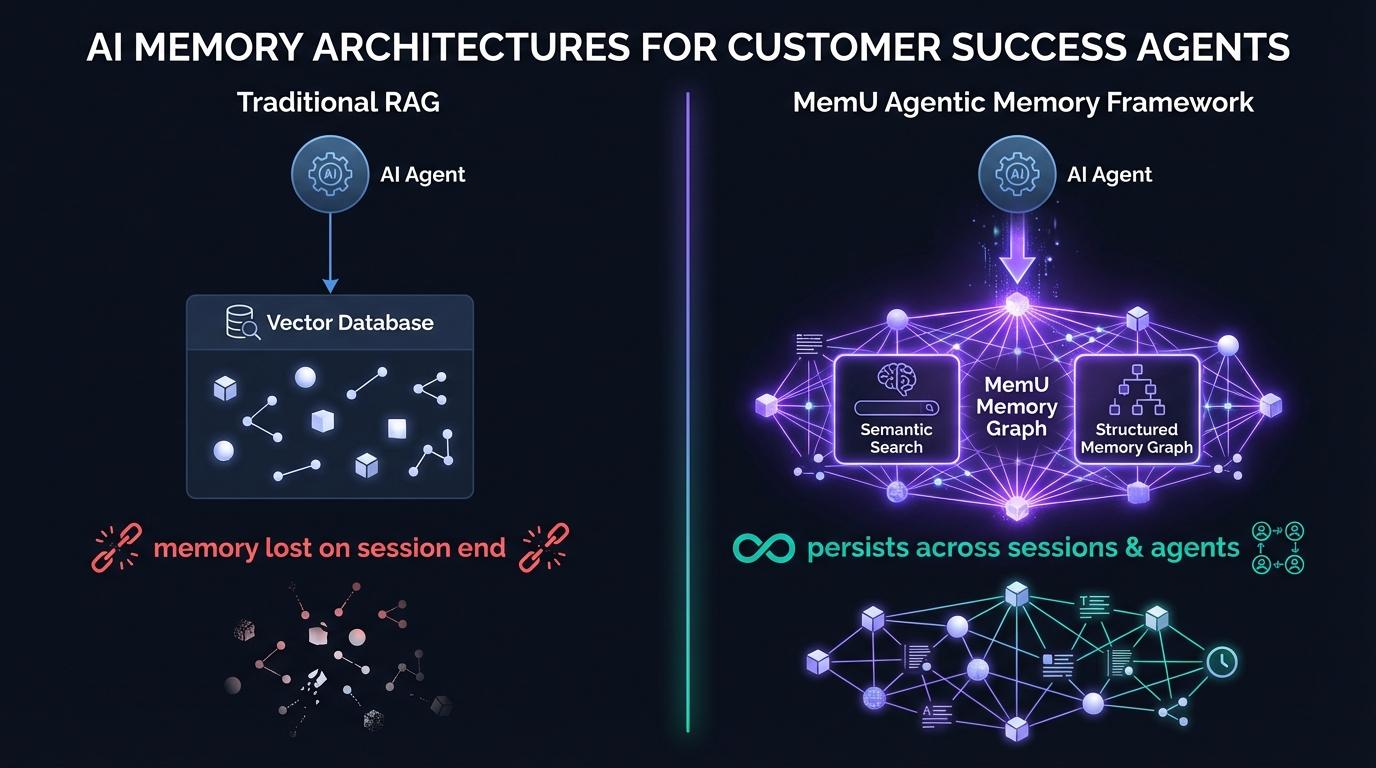
The MemU Agentic Memory Framework provides persistent customer relationship memory that captures not just interaction data but relationship intelligence — the understanding, preferences, and context that make human agents effective.
Consider an enterprise customer who contacts support about their API integration. Interaction 1: the agent walks through authentication setup, discovers the customer is using a Python microservices architecture. Interaction 2: the customer asks about rate limiting. Without the MemU Agentic Memory Framework, the agent starts fresh — asks about their setup again, provides generic rate limiting docs. With MemU, the agent retrieves the complete relationship context: Python microservices, authentication already configured, likely needs rate limiting at the service mesh level. The response is immediately specific and relevant.
The framework transforms customer interactions through:
- Relationship memory: Technical setup details, communication preferences, past issue patterns, and resolution history persist across every interaction. Each conversation builds on the last rather than starting from zero.
- Proactive issue detection: The MemU Agentic Memory Framework identifies patterns across a customer's interactions — escalating frustration, recurring problems, approaching renewal with unresolved issues — enabling proactive outreach before problems become churn risks.
- Cross-agent continuity: Whether the customer talks to AI or human agents, the relationship memory persists. Human agents access the same context the AI built, and AI agents leverage insights from human interactions.
The difference between customer support and customer success is memory. MemU gives AI agents the relationship intelligence to deliver genuine success.
Head-to-Head: Ticket Resolution vs. Relationship Building
AI customer success agents alone: High-volume ticket resolution with knowledge base integration and CRM data access. Consistent, fast responses for standard queries. But every interaction is contextually independent — the agent resolves tickets without building relationships.
AI customer success agents + MemU Agentic Memory Framework: Same resolution speed plus persistent relationship memory. Every interaction deepens the agent's understanding of the customer. Technical context, communication preferences, and interaction patterns inform every future response. Sub-100ms memory retrieval means no impact on response time.
This enhancement applies to every customer-facing AI platform — Intercom Fin, Zendesk AI, Ada, Sierra, and Drift all benefit from persistent customer relationship memory.
Empowering AI Customer Success: Better Together
MemU doesn't replace AI customer success agents — it transforms them from ticket resolvers into relationship builders.
- Personalized support at scale: Every customer gets an agent that "remembers" them — their setup, their preferences, their history. The MemU Agentic Memory Framework makes personalization automatic rather than requiring customers to repeat themselves.
- Churn prediction: Accumulated interaction patterns reveal at-risk customers before they explicitly express dissatisfaction. The agent detects increasing support frequency, unresolved issue patterns, and declining engagement as early warning signals.
- Knowledge transfer: When customer accounts transfer between human agents, the MemU Agentic Memory Framework ensures relationship context follows. No more "let me bring the new agent up to speed" — the memory is always current.
Get Started with MemU
AI customer success agents handle volume. The MemU Agentic Memory Framework adds the relationship depth that transforms volume handling into genuine customer success. Every interaction makes the next one more informed, more personal, and more effective.
Visit memu.pro to explore the Agentic Memory Framework API, or check out the open-source repository on GitHub to start building persistent customer memory into your support workflows today.
Tags: AI customer success, customer support agents, agentic memory, customer relationship, MemU AI, support automation, Intercom AI, Zendesk AI