AI Compliance Agents Monitor Transactions in Real-Time — But Regulatory Memory Doesn't Persist Across Reviews


AI compliance agents are becoming essential in financial services. Banks, fintechs, and asset managers deploy AI to monitor transactions, detect suspicious patterns, and generate regulatory reports in real-time. The technology catches what human reviewers miss — processing millions of transactions per day with consistent rule application. Deutsche Bank, JPMorgan, and major fintechs are all investing heavily in AI-driven compliance.
But there is a foundational layer that compliance AI depends on — memory.
AI Compliance: What Everyone's Getting Right (And Missing)
Current compliance AI excels at per-transaction analysis: apply rules, detect anomalies, flag suspicious patterns. Some systems use machine learning to identify novel threats beyond predefined rules. The speed and consistency are genuine improvements over manual review — false positive rates drop, and coverage increases dramatically.
What compliance AI does not do is learn from its own review history. The agent that reviewed ten thousand transactions last quarter has no memory of which flags turned out to be genuine violations, which patterns were escalated and dismissed, or how regulatory interpretations evolved through examiner feedback. Compliance AI that monitors without institutional memory applies rules without judgment.
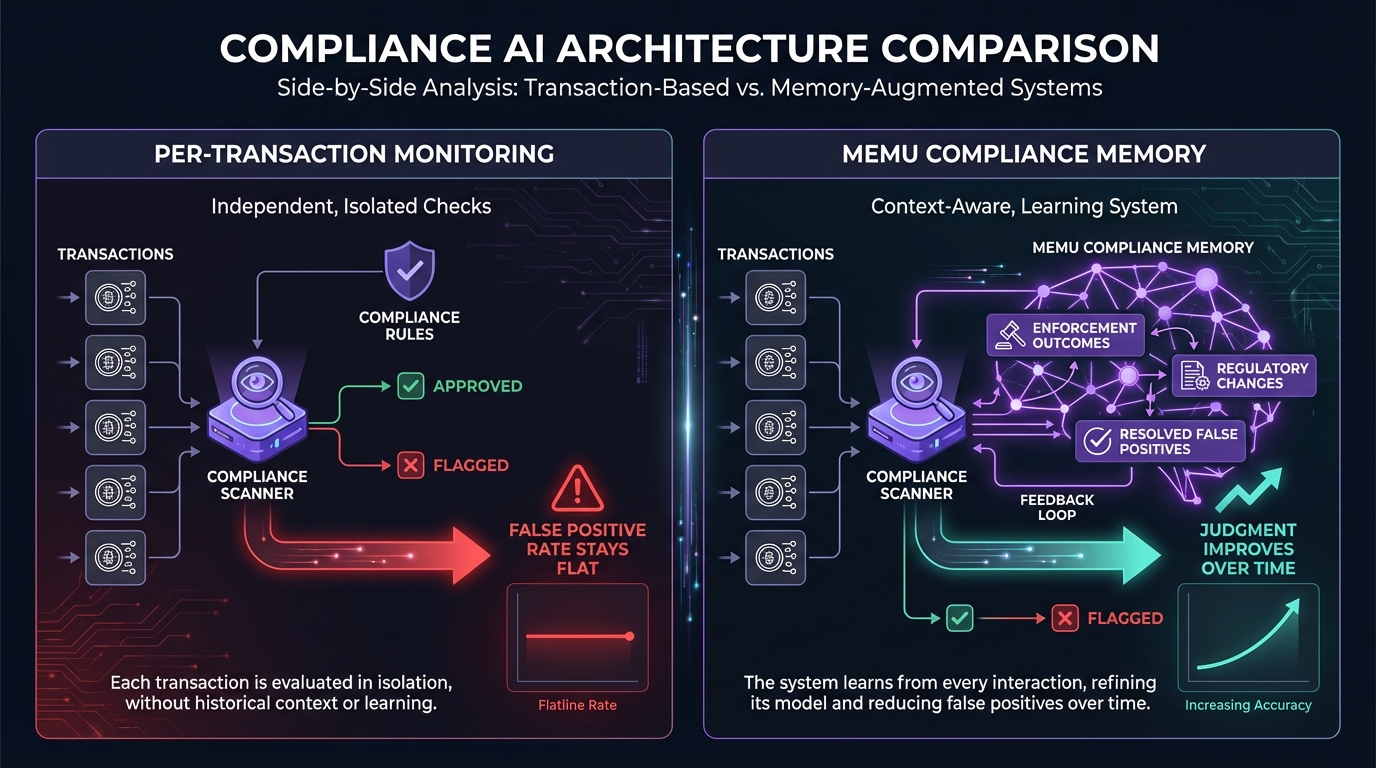
The MemU Agentic Memory Framework: Compliance Intelligence That Accumulates
The MemU Agentic Memory Framework gives compliance agents a persistent memory of regulatory patterns, enforcement outcomes, and institutional decisions.
The compliance agent remembers: this transaction pattern was flagged in Q2, investigated, and determined to be legitimate seasonal activity. The regulator's last examination focused on cross-border transfers under $10K. The compliance team updated the SAR threshold for cryptocurrency-related activity after the March enforcement action.
- Enforcement outcome memory: The MemU Agentic Memory Framework tracks which flags became real violations and which were false positives. The compliance agent calibrates its sensitivity based on actual outcomes, not just rules.
- Regulatory evolution tracking: As regulations change and examiner feedback accumulates, MemU captures those shifts as structured memory that informs future monitoring.
- Cross-institution pattern recognition: For multi-entity financial groups, the MemU Agentic Memory Framework enables compliance memory sharing across subsidiaries while respecting information barriers.
Compliance expertise is accumulated judgment, not rule application. The MemU Agentic Memory Framework gives compliance agents the institutional memory to develop genuine regulatory intelligence.
Head-to-Head: Stateless Monitoring vs. MemU-Backed Compliance
Stateless compliance AI: Applies rules per transaction. Each review is independent. False positive rates remain static because the system never learns from resolution outcomes.
MemU-backed compliance AI: Each review is informed by historical enforcement outcomes, examiner feedback, and resolved false positives. False positive rates decrease over time as the agent develops calibrated judgment.
Empowering Compliance AI: Better Together
- Transaction monitoring: The compliance tool scans in real-time; MemU provides historical context about similar patterns and how they were resolved.
- SAR filing: The compliance tool generates reports; MemU recalls relevant precedents and examiner feedback to improve filing quality.
- Audit preparation: When regulators examine, MemU provides a complete memory trail of decisions, escalations, and rationale — not reconstructed from logs, but stored as persistent compliance memory.
Get Started with MemU
Give your compliance agents institutional memory. The MemU Agentic Memory Framework adds persistent regulatory intelligence to any compliance workflow. Visit memu.pro to explore the API, or check out the GitHub repository to start building agents that remember.
Tags: AI compliance, financial regulation, compliance agents, MemU AI, regulatory memory, fintech AI