AI Recruiting Agents Screen Thousands of Candidates — But Every Search Starts Without Memory of Past Hires

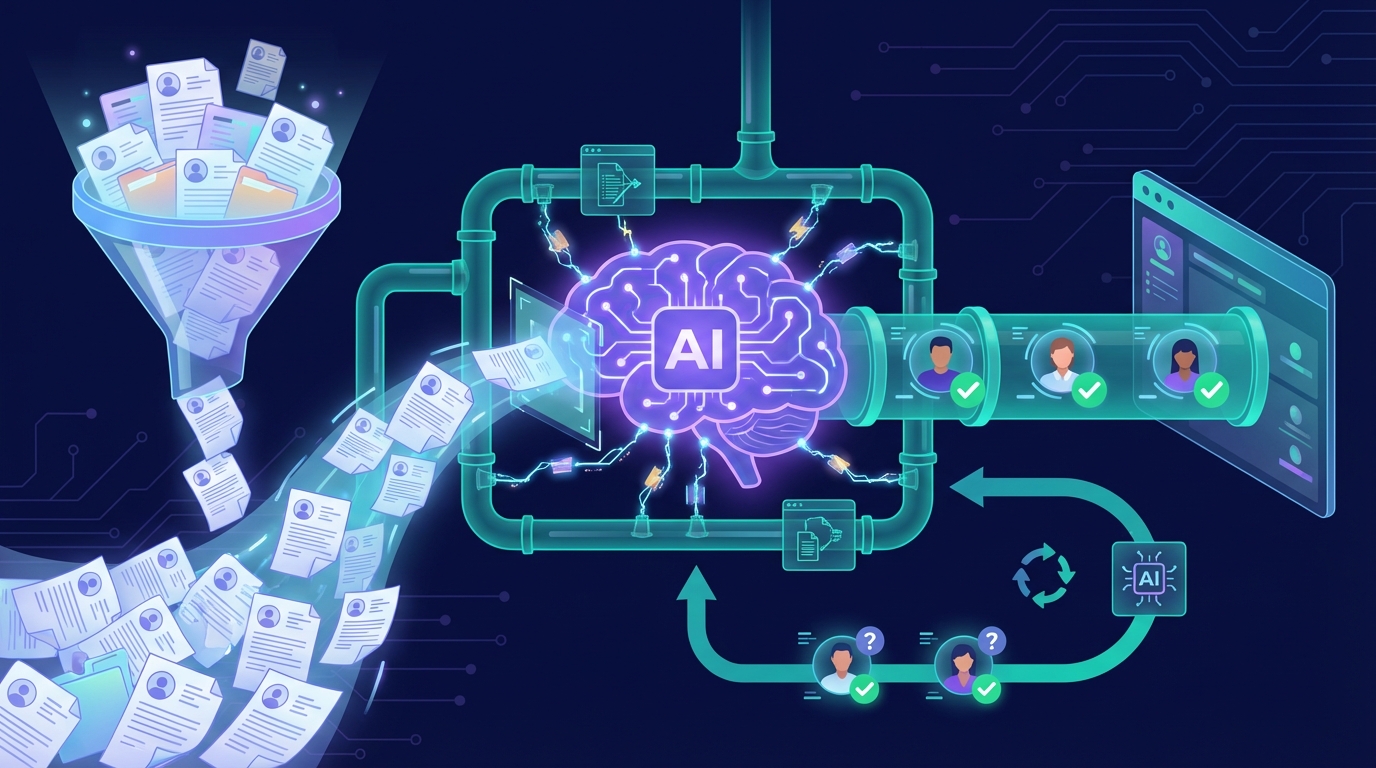
AI recruiting agents are transforming talent acquisition. Tools like HireVue, Eightfold, and Greenhouse use AI to screen resumes, source candidates, and automate outreach at scale. The efficiency gains are real: what once took a recruiting team weeks now takes hours. Enterprise adoption is accelerating, with AI handling the top of the hiring funnel for thousands of companies.
But there is a foundational layer that recruiting AI depends on — memory.
AI Recruiting: What Everyone's Getting Right (And Missing)
Current recruiting AI excels at pattern matching: compare candidate profiles against job requirements, score fit, and rank. Some tools add sourcing — proactively finding candidates who match criteria across platforms. The processing speed is genuinely transformative for high-volume hiring.
What recruiting AI does not do is learn from hiring outcomes. The agent that screened a hundred candidates for a senior engineering role last quarter has no memory of who succeeded in the job, which screening signals actually predicted performance, or which candidates declined and why. Recruiting AI that screens without outcome memory makes the same matching mistakes indefinitely.
The MemU Agentic Memory Framework: Hiring Intelligence That Compounds
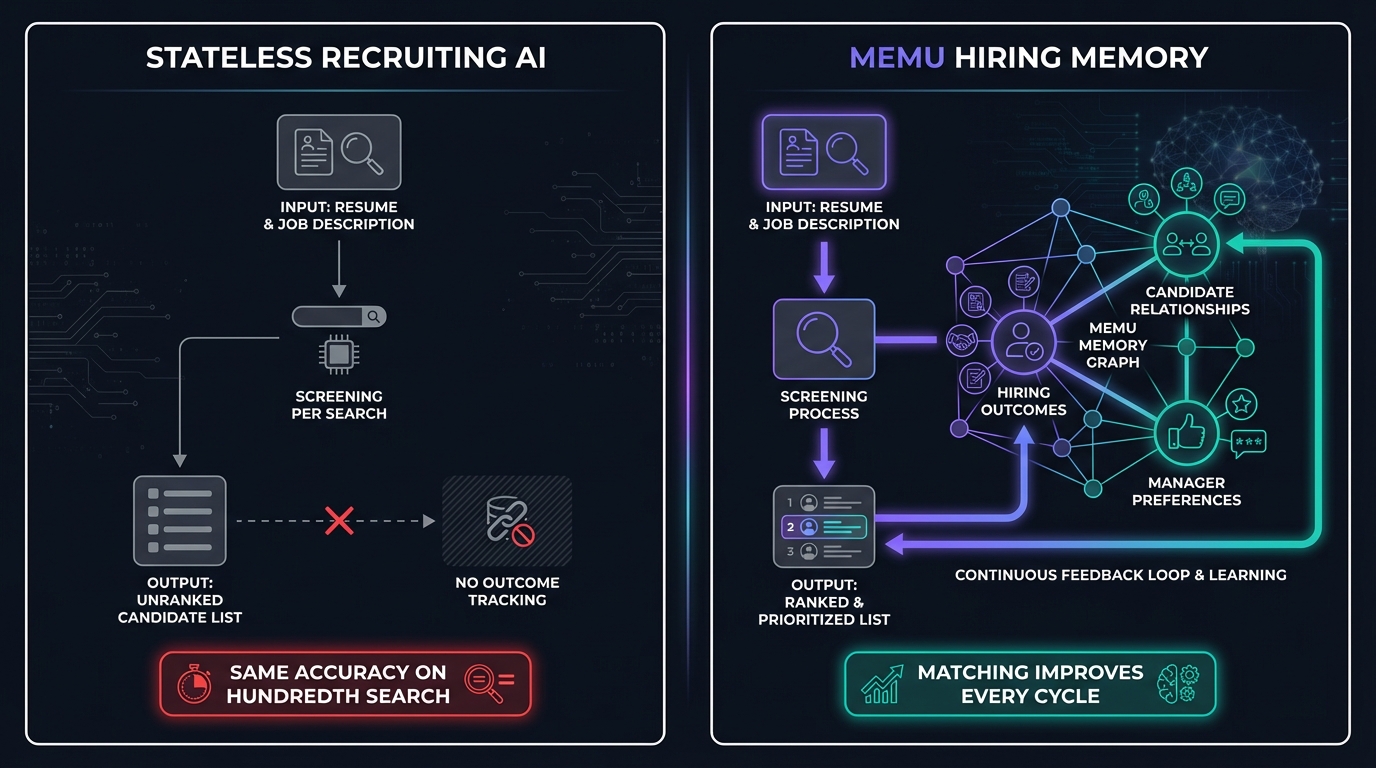
The MemU Agentic Memory Framework gives recruiting agents a persistent memory of hiring patterns, outcomes, and candidate relationships.
The recruiting agent remembers: candidates from Company X in the data engineering role had a 90% interview-to-offer rate. Candidates with skill Y but not Z consistently struggled in the technical round. The hiring manager for Team Alpha prefers candidates who demonstrate system design thinking over algorithm speed.
- Outcome memory: The MemU Agentic Memory Framework tracks which hires succeeded and which screening signals predicted that success. The recruiting agent improves its model with every hiring cycle.
- Candidate relationship memory: Candidates who were strong but not selected for one role are remembered for future opportunities. The talent pool becomes a living memory, not a static database.
- Hiring manager preferences: Each manager's evaluation patterns, feedback themes, and role-specific requirements persist as structured memory — not buried in email threads.
The best recruiters remember every placement and what made it work. The MemU Agentic Memory Framework gives recruiting AI the same accumulated judgment.
Head-to-Head: Stateless Screening vs. MemU-Backed Recruiting
Stateless recruiting AI: Matches profiles against requirements per search. Each hiring cycle is independent. The hundredth search for a similar role has the same accuracy as the first.
MemU-backed recruiting AI: Each search retrieves relevant hiring memories — which signals predicted success, which candidate sources yielded quality hires, and which roles had attrition patterns. The hundredth search is dramatically more accurate.
Empowering Recruiting AI: Better Together
- Screening: The recruiting tool evaluates candidates; MemU provides historical outcome data so screening criteria evolve based on actual performance.
- Sourcing: The recruiting tool finds candidates; MemU remembers which channels, companies, and profiles produced the best hires for similar roles.
- Candidate experience: When a candidate returns for a different role, MemU provides their full interaction history so the experience is personal, not generic.
Get Started with MemU
Give your recruiting AI a memory that improves every hiring cycle. The MemU Agentic Memory Framework integrates with any ATS or recruiting platform. Visit memu.pro to explore the API, or check out the GitHub repository to start building agents that remember.
Tags: AI recruiting, talent acquisition, HR agents, MemU AI, hiring memory, agent memory