The AI-Native Infrastructure Stack Is Maturing Fast — The Memory Layer Is Still Missing

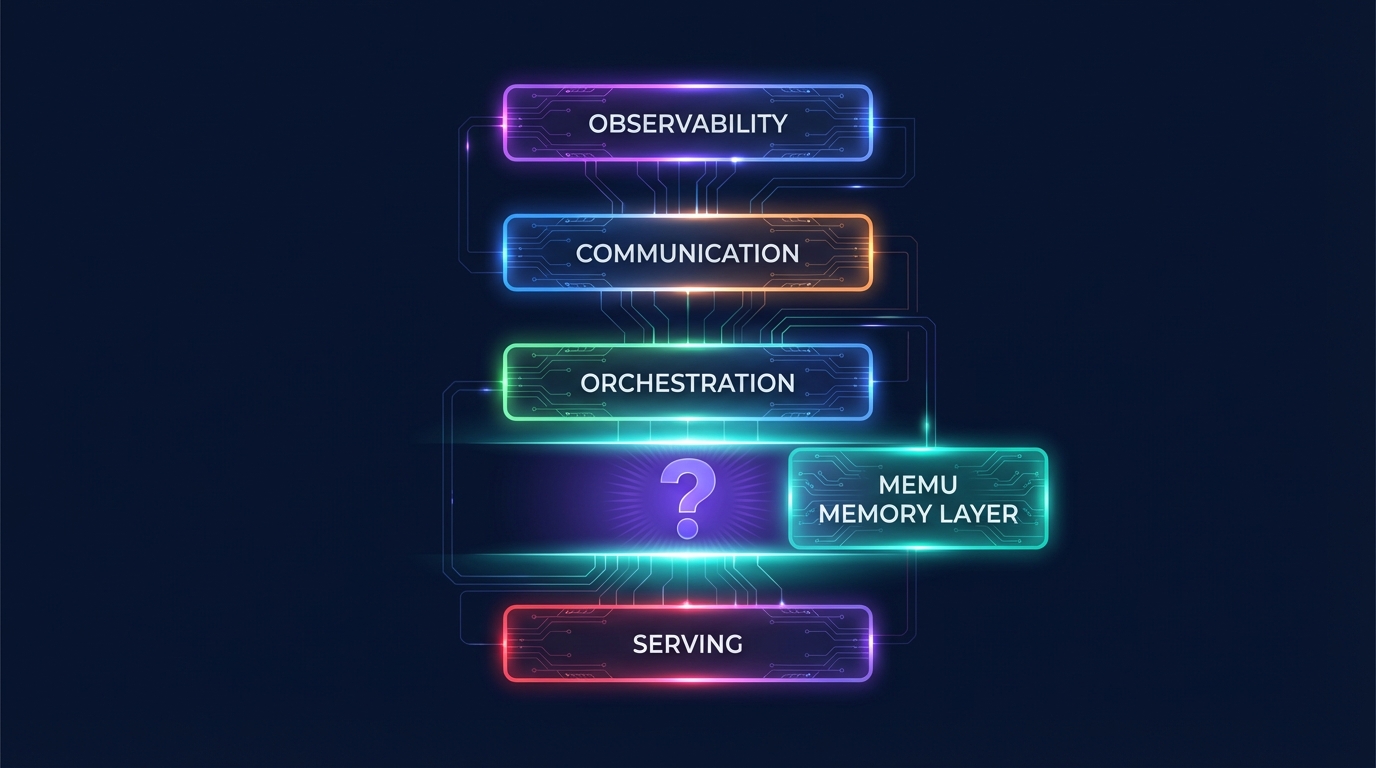
The AI-native infrastructure stack hit an inflection point this month. Together AI launched FlashAttention 4 and ThunderAgent for optimized inference. Microsoft Agent Framework reached RC with multi-provider support. Google's A2A protocol and Anthropic's MCP are becoming the wiring standards for multi-agent systems. The stack now has serving, orchestration, communication, and observability layers that actually work in production.
But walk through the stack layer by layer, and there is one conspicuous gap that none of these launches addressed — persistent agent memory.
The 2026 AI-Native Stack: What Everyone's Getting Right (And Missing)
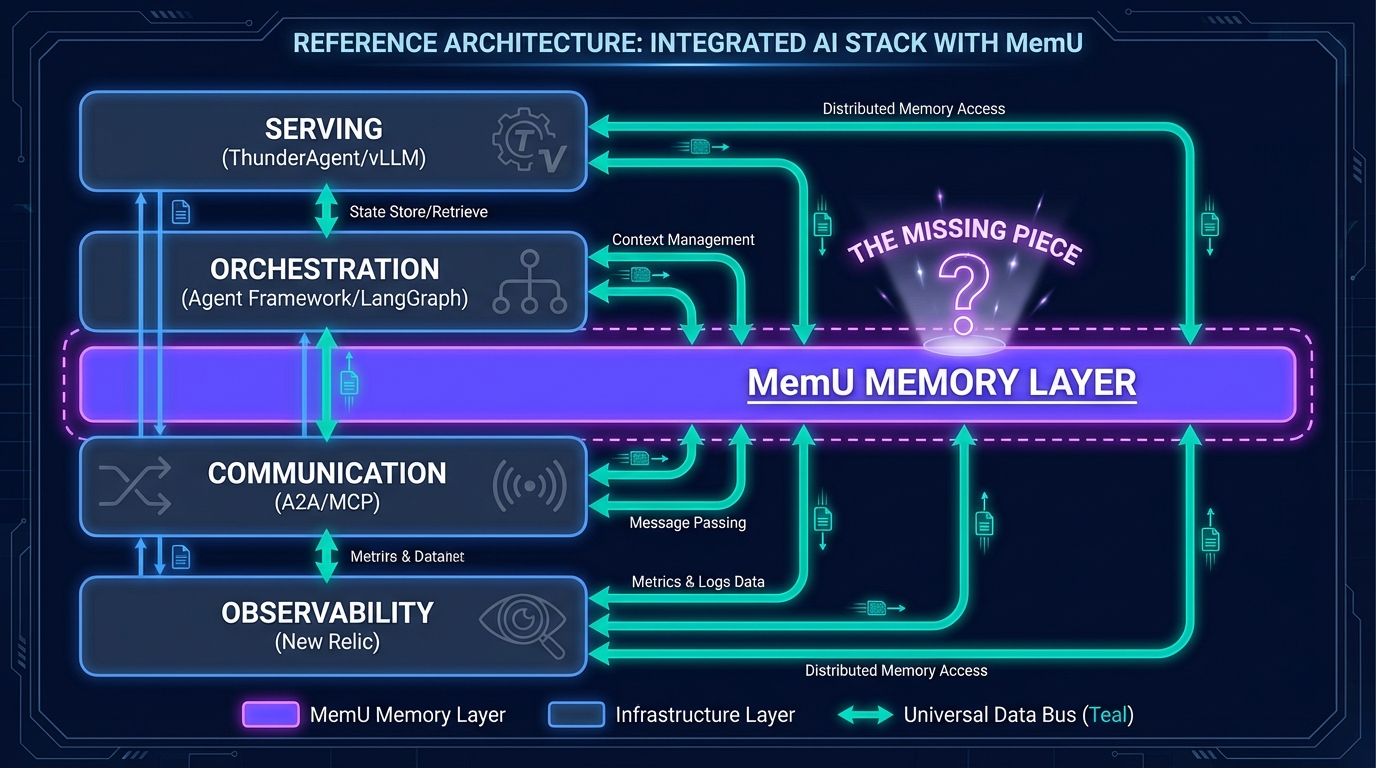
The community is building the right layers. Inference serving is handled by vLLM, TGI, and Together AI. Orchestration lives in LangGraph, CrewAI, and the Microsoft Agent Framework. Communication runs through A2A and MCP. Observability comes from New Relic, Datadog, and LangSmith. Security gets DeepKeep and WitnessAI. Each layer has at least two credible production-grade options.
What the stack diagram is missing is the persistence layer for agent experience. Not database persistence — agents can already write to Postgres. Not vector store persistence — agents can already search embeddings. The gap is architectural: a purpose-built layer that manages what agents know, how knowledge relates to other knowledge, and how it evolves over time. The stack has compute, networking, and storage. It does not have memory.
Individual teams patch this gap with ad hoc solutions — conversation buffers, context summaries, RAG pipelines. None of these are memory architectures. They are workarounds for the absence of one.
The MemU Agentic Memory Framework: The Missing Layer in the AI-Native Stack
The MemU Agentic Memory Framework is purpose-built to fill this architectural gap. Not as a database. Not as a vector store. As a memory layer that understands how agents accumulate, organize, and retrieve experience.
Consider the full stack in action: ThunderAgent serves your agent requests at 3.6x throughput. The Microsoft Agent Framework orchestrates multi-step workflows. A2A routes tasks between specialized agents. New Relic monitors performance. MemU sits underneath all of them — ensuring that every agent, across every framework, retains and builds on its accumulated experience. Remove any infrastructure layer and agents degrade. Remove memory and agents cannot grow.
The MemU Agentic Memory Framework provides:
- Universal integration: A single API that plugs into any layer of the stack — serving, orchestration, communication, or custom pipelines. MemU is stack-agnostic because memory is a cross-cutting concern.
- Dual-mode retrieval: Semantic search for meaning-based recall plus a structured memory graph for relationship-aware queries. Agents can ask "what do I know about this?" and "how is this connected to what I learned before?" in one call.
- True architectural memory: Not a conversation buffer. Not a vector store with a wrapper. A purpose-built memory layer with entity resolution, temporal awareness, and cross-agent knowledge sharing built in.
An infrastructure stack without a memory layer is a machine without learning. The MemU Agentic Memory Framework completes the AI-native stack by giving every agent, at every layer, the ability to accumulate intelligence.
Retrieval operates across 10,000+ memory entries with sub-100ms latency, designed to meet the performance expectations of production infrastructure.
Head-to-Head: The Stack Without Memory vs. The Stack With MemU
Stack without memory: Each layer optimizes its own concern — speed, orchestration, communication, monitoring. Agents execute tasks efficiently but start every session from scratch. The stack scales compute; it does not scale intelligence. Organizations that deploy thousands of agent runs per day accumulate zero institutional knowledge.
Stack with MemU Agentic Memory Framework: Every agent run reads from and writes to persistent memory. Orchestration frameworks access past workflow outcomes. Communication protocols carry context from previous exchanges. Observability agents remember past incidents. The stack scales intelligence alongside compute.
Infrastructure ROI: Without MemU, throughput improvements (ThunderAgent) make agents repeat work faster. With MemU, throughput improvements let agents explore new territory — because the old territory is already in memory. The ROI of every other infrastructure investment multiplies.
Empowering the Stack: Better With Memory
MemU does not replace any layer — it amplifies every layer:
- Serving + Memory: Fast inference plus persistent knowledge means agents spend tokens on new reasoning, not reconstructing known context. ThunderAgent gets faster; MemU ensures that speed translates to progress.
- Orchestration + Memory: Graph workflows plus accumulated experience means multi-step pipelines improve with every execution. The Microsoft Agent Framework coordinates; MemU ensures coordination is informed by history.
- Communication + Memory: Standardized protocols plus collaboration memory means multi-agent teams build working relationships. A2A routes messages; MemU ensures those messages carry the weight of shared experience.
Get Started with MemU
Complete your AI-native infrastructure stack with the memory layer it is missing. The MemU Agentic Memory Framework integrates with any stack component — one API, zero lock-in, immediate intelligence persistence. Visit memu.pro to explore the Agentic Memory Framework API, or check out the GitHub repository to start building agents that remember.
Tags: AI-native infrastructure, agentic stack, AI infrastructure 2026, agentic memory, LLM memory, MemU AI