94% of Enterprises Fail at AI Production Deployment — The Missing Layer Between Pilot and Production Is Memory

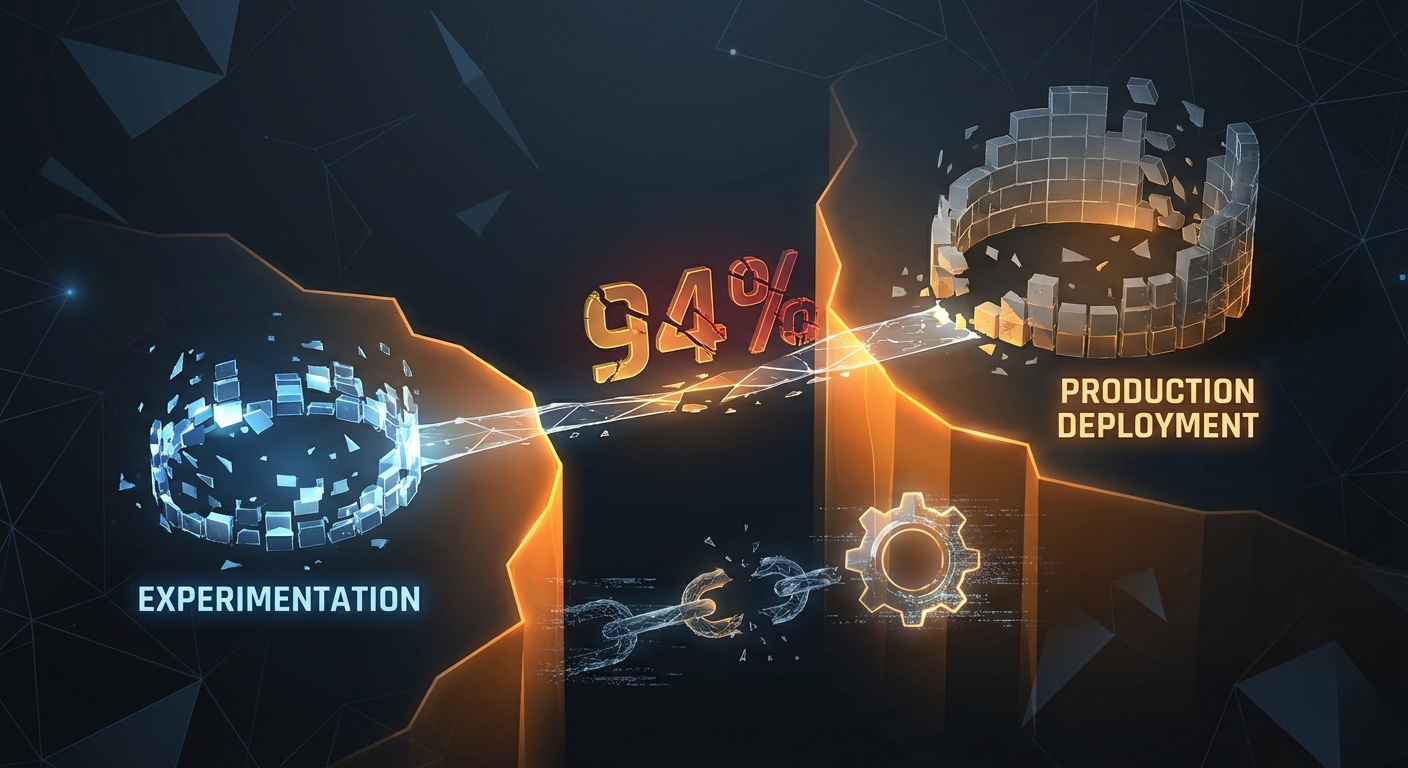
Despite $200 billion in global AI investment, only 6% of organizations report meaningful bottom-line impact from their AI initiatives. Nearly 90% of companies use AI in at least one business function, yet most remain trapped in "pilot purgatory" — endless proof-of-concept cycles that never scale to production. The 2026 Deloitte State of AI report confirms the pattern: enterprises are narrowing AI access while increasing spend, pivoting from broad experimentation to focused production deployments. The conversation has shifted from "What can AI do?" to "What delivers measurable value?"
The agent revolution has intensified this dynamic. A CrewAI survey shows 65% of large enterprises already use AI agents, with 81% reporting adoption is fully scaled or actively expanding. Companies have automated 31% of workflows using agentic AI and expect another 33% increase in 2026. But the top concern remains: 34% cite security and governance, 30% cite integration complexity, and 24% cite reliability. Only one in five companies has mature governance models for autonomous agents.
The pattern is clear: enterprises can build AI pilots. They can even deploy agents. What they can't do is make those deployments consistently effective enough to justify production-scale investment — because stateless agents don't accumulate the knowledge that makes them valuable over time.
Why Pilots Succeed and Production Fails
AI pilots succeed because they operate in controlled environments with motivated teams. A pilot team hand-crafts prompts, manually provides context, and closely monitors outputs. The AI looks impressive because humans are doing the memory work — reminding the model of relevant context, correcting misunderstandings, and building on previous interactions through manually maintained documentation.
Production removes these human scaffolds. The AI agent must handle thousands of interactions without a dedicated team providing context for each one. The prompts can't be hand-crafted for every scenario. The context that made the pilot effective — accumulated understanding of the domain, the users, and the business processes — must come from somewhere other than a human operator's memory.
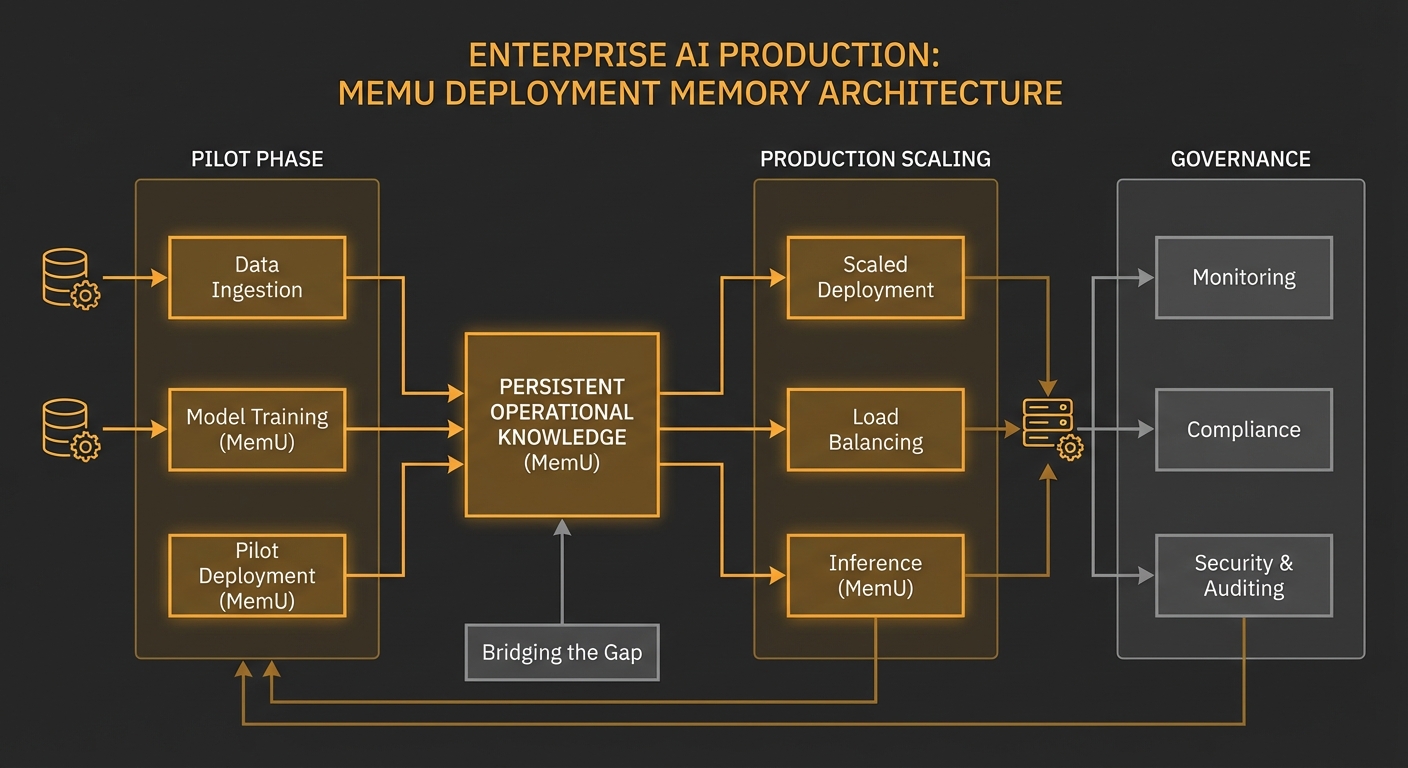
This is why AI production ROI is so elusive. The pilot demonstrated what AI can do with perfect context. Production reveals what AI does without it. The gap between the two is the memory gap — and it explains why 94% of enterprises can't bridge from pilot to production value.
The 31% Automation Number Is Misleading
When enterprises report automating 31% of workflows with AI agents, the natural conclusion is that AI is working. But automation rate and value delivery are different metrics. An automated workflow that produces mediocre results is technically automated but doesn't deliver the ROI that justified the investment. The question isn't how many workflows are automated — it's how effectively.
Consider a customer service workflow automated by an AI agent. The agent handles 1,000 tickets per day — impressive automation. But each ticket is handled without knowledge of the customer's history, without accumulated understanding of common issues, and without learned resolution strategies. A human agent with six months of experience handles the same tickets dramatically better — not because they're smarter, but because they remember.
The real-world examples showing 40-95% reductions in query response times are impressive. But response time and response quality are different metrics. An agent that responds instantly with a generic answer is fast but not effective. An agent that responds with contextually appropriate, personalized guidance — because it remembers the customer and the domain — is both fast and valuable.
Memory Bridges the Production Gap
The enterprises in the successful 6% share a common pattern: they've found ways to give their AI systems operational context that persists across interactions. Some use extensive prompt engineering with manually maintained knowledge bases. Others have built custom RAG systems tuned to their specific domains. A few have invested in memory infrastructure. All have recognized that stateless AI can't deliver production value.
The difference between pilot and production AI is the difference between a new hire and a veteran employee. The new hire has all the skills — they passed the interview, completed the training, and can perform the tasks. But they lack the institutional knowledge that makes a veteran effective: customer relationships, process shortcuts, domain expertise, and learned judgment. Memory is what transforms raw capability into institutional value.
How MemU Closes the Production Gap
MemU provides the persistent memory layer that bridges the pilot-to-production gap. AI agents in production write their experiences to MemU: customer interactions, resolution strategies, discovered patterns, and domain insights. Before each new interaction, agents retrieve relevant memories, starting with accumulated operational knowledge rather than blank-state capability.
Over time, the agent's effectiveness compounds. The first week in production looks like a pilot. The first month looks like a trained employee. After six months, the agent operates with institutional knowledge that no individual human could maintain. This compounding effect is what transforms AI from a cost center into a value driver — and it requires memory.
The 94% failure rate isn't about technology capability. It's about memory infrastructure. MemU provides the missing layer between pilot and production that turns capable AI into effective AI.
Get Started
Bridge your AI production gap with persistent memory. Explore MemU at memu.pro and on GitHub.