Alludium Launches a No-Code AI Agent Operating System — But Agents Built Through Conversation Still Forget Every Conversation


Alludium Agent Operating System: What the No-Code Revolution Gets Right and What It Misses
The Alludium no-code AI agent operating system launched publicly on March 12, 2026, with a proposition that cuts to the heart of enterprise AI adoption friction: build and deploy custom AI agents through conversation, no coding required. In an industry where agent frameworks typically demand Python fluency and infrastructure expertise, Alludium removes the technical barrier entirely — users describe what they need in plain language, and the platform assembles a working agent from pre-built components, multi-tool integrations, and foundation model connections.
This is not a toy. The Alludium no-code AI agent platform runs on Claude, GPT, and Gemini simultaneously, connecting agents to Gmail, Slack, Google Calendar, and dozens of enterprise tools. Backed by Sure Valley Ventures and Catenai, and showcased at Web Summit 2025 in partnership with Google, Alludium has positioned itself as the operating system for teams that want AI agents without AI engineers. The pre-built agents gallery lets teams deploy solutions for VC deal flow, marketing automation, customer success workflows, product management, RevOps, and sales operations in minutes rather than months.
Team collaboration features add shared governance — multiple stakeholders can refine agent behavior together, set permissions, and manage deployments across desktop and mobile. Automated scheduling means agents run workflows on cadence without manual triggers. For organizations that have watched the AI agent revolution from the sidelines because they lacked engineering capacity, this no-code AI agent platform genuinely lowers the barrier to entry.
But lowering the barrier to building agents is not the same as making agents effective over time. And that distinction matters more than most no-code platforms acknowledge.
What Alludium Does With Agent Memory Today
The Alludium no-code AI agent operating system excels at agent creation and orchestration. Users describe a workflow — “Monitor my inbox for investor updates, extract key metrics, and update the deal tracking spreadsheet” — and the platform assembles the right model, tool connections, and execution logic. The agent runs, processes data, and delivers results.
What happens to the intelligence generated during that execution? The agent that processed 200 investor updates learns nothing from the experience. It does not recognize that certain fund managers consistently report metrics in non-standard formats requiring specific parsing approaches. It does not remember that the spreadsheet schema changed last month and which field mappings resolved the resulting errors. It does not retain that emails from three specific senders always contain attachments that need OCR rather than text extraction.
Every session starts fresh. The no-code AI agent that ran flawlessly yesterday approaches today’s identical task with zero accumulated knowledge. For simple, repetitive workflows this is tolerable. For complex enterprise processes where context compounds — deal evaluation, customer success management, marketing campaign optimization — memoryless agents hit a ceiling that no amount of prompt engineering can breach.
The irony is architectural. Alludium lets users build agents through conversation, a modality that is inherently contextual and cumulative. But the agents themselves cannot carry context between their own operational conversations with enterprise data. Teams that built their agents through iterative dialogue discover that their agents cannot iterate on their own performance.
This is not unique to Alludium. Every no-code AI agent platform — from Coze to aiXplain to Microsoft Copilot Studio — faces the same structural limitation. The no-code movement democratized agent creation without solving agent cognition.
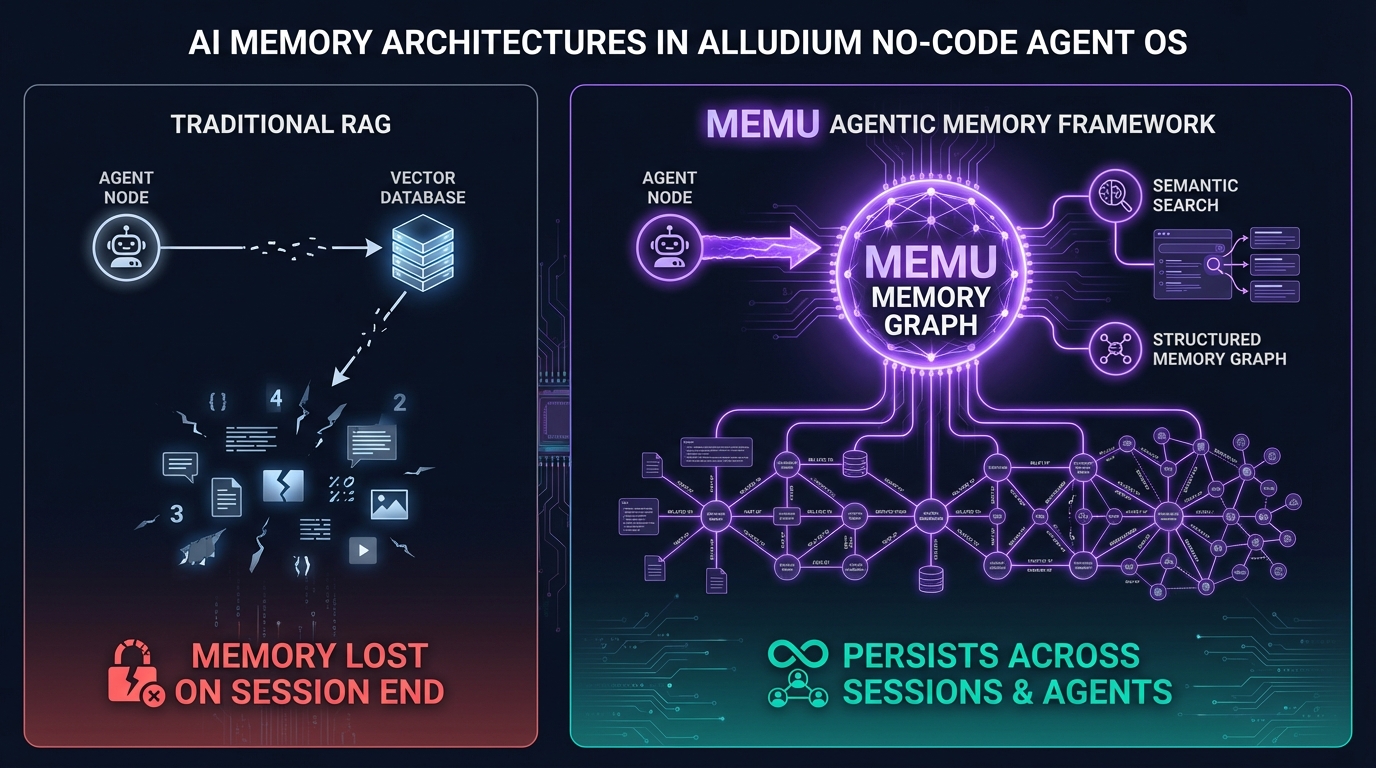
The MemU Agentic Memory Framework: Persistent Intelligence for No-Code Agents
The MemU Agentic Memory Framework provides the persistent memory layer that no-code agent platforms like Alludium need to move from task execution to compounding intelligence. Where Alludium handles agent creation and orchestration, MemU handles what agents learn and retain.
Building agents without code is a breakthrough. But agents that cannot remember what they have learned are perpetual beginners, regardless of how elegantly they were assembled. No-code agent platforms need persistent memory to deliver on the promise of AI that improves with use.
Consider a VC team using Alludium to build a deal screening agent. With the MemU Agentic Memory Framework, the agent remembers that SaaS companies with ARR growth above 150% but net retention below 100% historically received pass decisions from the team. When a new pitch deck arrives matching that pattern, the agent surfaces the historical context immediately — no re-analysis required. The agent’s judgment compounds with every deal it evaluates.
The MemU Agentic Memory Framework integrates via REST API alongside any agent runtime. Key capabilities for no-code agent ecosystems:
- Workflow pattern memory: When agents discover effective sequences — checking calendar availability before drafting meeting requests, or validating contact data before CRM updates — those patterns persist as retrievable strategies. New agents built on Alludium inherit operational wisdom from day one.
- Cross-agent knowledge sharing: The marketing agent’s discovery that LinkedIn posts with specific formatting drive 3x engagement becomes available to the sales agent composing outreach sequences. No-code agents across the Alludium agent operating system share a collective intelligence layer.
- Exception and resolution memory: Every error an agent encounters and resolves — a Slack API rate limit, a Gmail authentication refresh, a calendar timezone conflict — is stored as a resolution pattern. Agents that encounter the same exception retrieve the fix instantly rather than failing and requiring human intervention.
Head-to-Head: Alludium Alone vs. MemU-Backed No-Code Agents
Alludium no-code AI agent operating system alone: Powerful agent creation through conversation. Multi-model support across Claude, GPT, and Gemini. Pre-built agents gallery for rapid deployment. Team collaboration with shared governance. Multi-tool integration spanning Gmail, Slack, Calendar, and enterprise systems. Automated scheduling for hands-off operation. The platform solves the creation problem — anyone can build a capable no-code AI agent. But each agent session starts from zero. The deal screening agent that evaluated 500 pitches remembers none of them. The customer success agent that resolved 200 tickets cannot leverage a single resolution pattern from that history.
Alludium + MemU Agentic Memory Framework: The same frictionless agent creation, now enriched with persistent operational intelligence. Every workflow execution feeds a knowledge graph of patterns, exceptions, and outcomes. Agents built through conversation become agents that learn from conversation — both the human conversations that created them and the data conversations that define their work. The MemU Agentic Memory Framework transforms no-code agents from disposable executors into accumulating assets.
Empowering Alludium: Better Together
Combining Alludium’s no-code agent creation with the MemU Agentic Memory Framework unlocks capabilities that neither system delivers independently:
- Self-improving VC workflows: Deal screening agents built on Alludium accumulate pattern recognition across hundreds of evaluations through MemU. Scoring models evolve based on historical outcomes — which early signals correlated with successful portfolio companies — without any code changes to the underlying agent.
- Marketing campaign intelligence: No-code marketing agents retain performance data across campaigns. When building a new email sequence, the agent retrieves that subject lines with specific emotional triggers produced 2.4x open rates in the previous quarter. Campaign strategy compounds automatically.
- Customer success continuity: Agents handling customer interactions maintain relationship memory across sessions. When a customer contacts support for the third time about integration issues, the agent retrieves the full resolution history, attempted fixes, and escalation context — delivering continuity that memoryless agents cannot provide.
- RevOps pipeline optimization: Sales agents built through Alludium’s conversational interface track deal progression patterns through MemU. The system learns that deals stalling at proposal stage for specific industries benefit from technical deep-dive meetings, surfacing that insight proactively for new deals matching the pattern.
Get Started with MemU
The Alludium no-code AI agent operating system removes the engineering barrier from agent creation — and that matters enormously for enterprise AI adoption. What it does not yet solve is the memory barrier that prevents those agents from compounding their operational intelligence. The MemU Agentic Memory Framework adds the persistent learning layer that transforms no-code agents from stateless tools into evolving team members.
Visit memu.pro to explore the Agentic Memory Framework API, or check out the GitHub repository to give your no-code AI agents the persistent memory they need to get smarter with every workflow they execute.
Tags: Alludium, no-code AI agents, agent operating system, agentic memory, no-code agent builder, MemU AI, persistent agent memory, AI agent platform