Amazon Q Developer Brings AI Agents to AWS — But Cloud Development Agents Without Persistent Memory Lose Context Across Sessions


Amazon Q Developer has evolved from a code completion tool into a full agentic coding experience that spans the entire software development lifecycle on AWS. The platform reads and writes files locally, runs bash commands, calls AWS APIs, generates code diffs, and performs automated code reviews — operating across VS Code, JetBrains, Visual Studio, Eclipse, the AWS Management Console, CLI, and integrations with GitHub, GitLab, Slack, and Microsoft Teams. In February 2026, AWS expanded Amazon Q Developer with generative AI-based artifacts that let developers visualize resource and cost data through natural language queries. BT Group reported the highest industry acceptance rate for multiline code suggestions at 37%, validating Amazon Q's practical effectiveness in enterprise environments.
But Amazon Q Developer operates within session-bounded contexts. The agent that spent an hour understanding your VPC architecture, Lambda function patterns, and IAM policy structure cannot recall any of that understanding in the next session. Cloud development agents without persistent memory lose infrastructure context across sessions, re-discovering AWS architecture they already mapped.
Amazon Q Developer: What Everyone's Getting Right (And Missing)
Amazon Q Developer's AWS-native integration is its strongest differentiator. Unlike general-purpose coding agents that treat cloud infrastructure as an external concern, Amazon Q understands AWS services natively — it can analyze CloudFormation templates, suggest IAM policy refinements, optimize Lambda function performance, and identify cost reduction opportunities by querying actual resource usage. The generative AI artifacts feature transforms the Management Console into a conversational interface where developers ask questions like "Show me RDS costs by instance type over the last 6 months" and receive visualized answers immediately.
The agentic capabilities extend beyond code suggestion. Amazon Q Developer can modernize legacy Java applications to newer frameworks, transform .NET applications for Linux compatibility, and generate complete test suites from existing codebases. For enterprise teams deeply invested in the AWS ecosystem, this depth of platform integration means the agent understands not just the code but the infrastructure context in which it runs.
What Amazon Q does not maintain is accumulated knowledge of your specific AWS architecture across sessions. A developer working on a complex microservice deployment that spans ECS, API Gateway, DynamoDB, and SQS must re-explain the architecture's relationships each session. The agent that mapped your event-driven patterns yesterday starts fresh today. Other cloud development assistants — including GitHub Copilot, Google Cloud Code, and Azure AI — share this same limitation. They assist within sessions; none build persistent understanding of your cloud architecture.
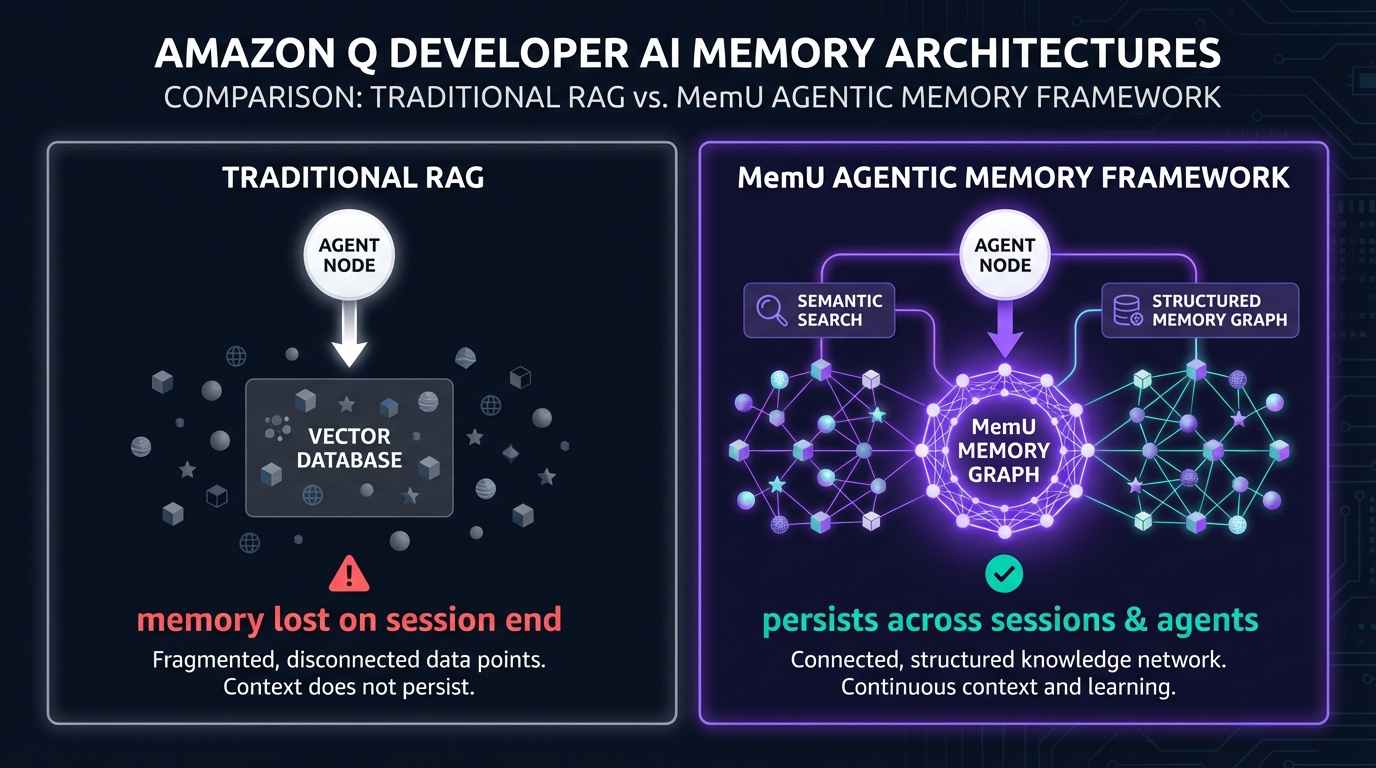
The MemU Agentic Memory Framework: Cloud Architecture Intelligence That Persists
The MemU Agentic Memory Framework provides the persistent memory layer that cloud development agents like Amazon Q Developer do not include natively. Instead of treating each development session as an isolated interaction, MemU captures the infrastructure knowledge, service relationships, and deployment patterns that agents discover during work and stores them in a structured memory graph that persists across sessions, projects, and team members.
Consider a platform team using Amazon Q Developer to manage a multi-account AWS organization. Without persistent memory, every session requires re-explaining the account structure, cross-account role assumptions, shared service VPCs, and deployment pipeline stages. With the MemU Agentic Memory Framework, the agent immediately recalls: the production account uses a specific naming convention for resources, the data team's Redshift cluster connects to the analytics VPC through a peering connection established in Q3, Lambda functions in the payment service use provisioned concurrency with a specific scaling policy, and the last three deployment failures were caused by IAM boundary policies that block specific S3 actions. That persistent infrastructure intelligence transforms every session from architecture explanation to productive engineering.
The framework addresses three core limitations of session-bounded cloud agents:
- Infrastructure relationship persistence: Service dependencies, VPC topologies, IAM trust chains, and event flow patterns are stored after each session. The MemU Agentic Memory Framework builds a living map of your cloud architecture that grows more detailed with every interaction.
- Operational history retention: Deployment failures, performance incidents, and cost optimization changes are captured with their full context — what was attempted, what failed, and what the resolution was. Future sessions benefit from accumulated operational intelligence rather than starting diagnosis from scratch.
- Team knowledge sharing: Infrastructure knowledge that one developer builds with Amazon Q becomes available to the entire team through shared memory. A junior developer working on the payment service can access the architectural context that the senior engineer established across dozens of previous sessions.
Cloud architecture is complex because services are deeply interconnected. Agents that forget those connections between sessions force developers to become translators — explaining architecture instead of building on it. The MemU Agentic Memory Framework captures cloud intelligence as it emerges and makes it available in every future session.
Integration with Amazon Q Developer workflows is straightforward. The MemU Agentic Memory Framework provides REST APIs that enrich agent context at session start with stored infrastructure knowledge and capture new architectural insights at session end. The memory layer complements Amazon Q's native capabilities without requiring changes to the AWS development workflow.
Head-to-Head: Session-Bounded Cloud Agents vs. Memory-Enhanced Development
Amazon Q Developer alone: The deepest AWS-native AI development experience, with agentic coding, infrastructure analysis, cost optimization, and application modernization capabilities. The 37% multiline acceptance rate and enterprise adoption validate practical effectiveness. But every session starts without knowledge of your specific architecture, service patterns, or operational history.
Amazon Q Developer + MemU: The same AWS-native intelligence, now enriched by persistent infrastructure memory. Sessions begin with complete architectural context — service relationships, deployment patterns, operational history, and team conventions. Infrastructure questions that previously required explanation are answered from accumulated knowledge. Cost optimization recommendations benefit from historical spending patterns and previous optimization outcomes.
For teams managing complex multi-service architectures, the productivity gain is substantial. Instead of spending the first 15-20 minutes of each session re-establishing context, developers begin productive work immediately — building on accumulated architectural understanding rather than rebuilding it.
Empowering Amazon Q Developer: Better Together
The combination of Amazon Q Developer's AWS-native intelligence and the MemU Agentic Memory Framework's persistent memory unlocks cloud development workflows that neither capability achieves alone:
- Progressive architecture understanding: Each session deepens the agent's knowledge of your cloud infrastructure. Early sessions map high-level service topology. Subsequent sessions add IAM policy nuances, performance characteristics, cost allocation patterns, and cross-account dependencies. After twenty sessions, the agent understands your architecture as thoroughly as a senior cloud engineer.
- Incident intelligence: When operational incidents occur, persistent memory ensures that the debugging context, root cause analysis, and remediation steps are captured. The next time similar symptoms appear, the agent can correlate patterns across incidents and suggest proven remediation approaches rather than starting diagnosis from zero.
- Migration continuity: Large-scale application modernization projects span weeks or months. Persistent memory ensures that the agent maintains context across the entire migration — tracking which components have been modernized, what patterns were applied, and what blockers were encountered — providing continuity that session-bounded agents cannot maintain.
Persistent memory transforms Amazon Q Developer from a powerful session-based assistant into a cloud engineering partner that accumulates deep infrastructure expertise across every interaction.
Get Started with MemU
Amazon Q Developer has built the most comprehensive AWS-native AI development experience — spanning code generation, infrastructure analysis, cost optimization, and application modernization across every AWS development surface. The enterprise adoption and high acceptance rates demonstrate real productivity value.
The next step is giving that development agent persistent infrastructure memory. Sessions where the agent starts with complete architectural context. Cloud environments where operational history informs every recommendation. Teams where infrastructure knowledge compounds across every developer interaction.
The MemU Agentic Memory Framework provides that foundation. Drop-in API integration, dual-mode retrieval with semantic search and structured memory graphs, and cross-session persistence that turns every cloud development interaction into compounding infrastructure intelligence.
Visit memu.pro to explore the Agentic Memory Framework API, or check out the GitHub repository to start building agents that remember.
Tags: Amazon Q Developer, AWS, cloud AI, agentic AI, agent memory, MemU AI, LLM memory