Yann LeCun Raises $1B for AMI Labs Visual Intelligence — But Even World Models Need Memory That Persists

Yann LeCun has raised $1.03 billion in seed funding for AMI Labs, with Temasek and Sea leading the round. The Singapore-based venture, founded by Meta's former chief AI scientist, aims to develop advanced machine intelligence trained on visual data to learn real-world representations similar to human reasoning. AMI Labs represents one of the largest seed rounds in AI history, reflecting deep conviction that visual intelligence — understanding the physical world through observation and prediction — is the next frontier beyond large language models.
The thesis is compelling. Humans develop world models primarily through visual and sensory experience, not through text. AMI Labs is building systems that learn physical intuitions — object permanence, spatial relationships, causal dynamics — from visual data. These world models could power robotics, autonomous systems, and embodied agents that reason about the real world with human-like spatial understanding.
But world models, no matter how sophisticated, face the same architectural gap that limits every AI system today: without persistent memory, each interaction starts from scratch. AMI Labs can build agents that understand physics; without memory, those agents cannot remember what happened yesterday.
AMI Labs: What Everyone's Getting Right (And Missing)
AMI Labs gets the research direction right. LeCun has argued for years that autoregressive language models are a dead end for general intelligence — that true understanding requires grounded world models trained on sensory data. AMI Labs operationalizes this thesis with $1B in capital and a team focused on visual intelligence AI systems that learn structured representations of reality. The approach targets what language models fundamentally lack: physical intuition.
The advanced machine intelligence that AMI Labs aims to build would represent objects, spaces, and causal relationships as structured internal models rather than statistical text patterns. For robotics and autonomous systems, this is essential. An agent that understands "this container will fall if pushed" through a learned world model is fundamentally more capable than one that generates text predicting the same outcome.
What AMI Labs has not yet addressed is the temporal persistence problem. World models represent how the physical world works in general. But an agent operating in the real world also needs to remember what specifically happened — which objects were moved, which routes were blocked, which strategies worked in this particular environment last week. Visual intelligence AI without persistent memory produces agents that understand physics but have amnesia about their own history.
What AMI Labs Does With Memory Today
AMI Labs is in early-stage development, but the architectural trajectory follows LeCun's published research on Joint Embedding Predictive Architecture (JEPA) and hierarchical world models. These architectures maintain internal state representations during inference — the model tracks scene dynamics, predicts future states, and updates its internal world model as new visual data arrives. Within a single episode, this produces coherent temporal reasoning.
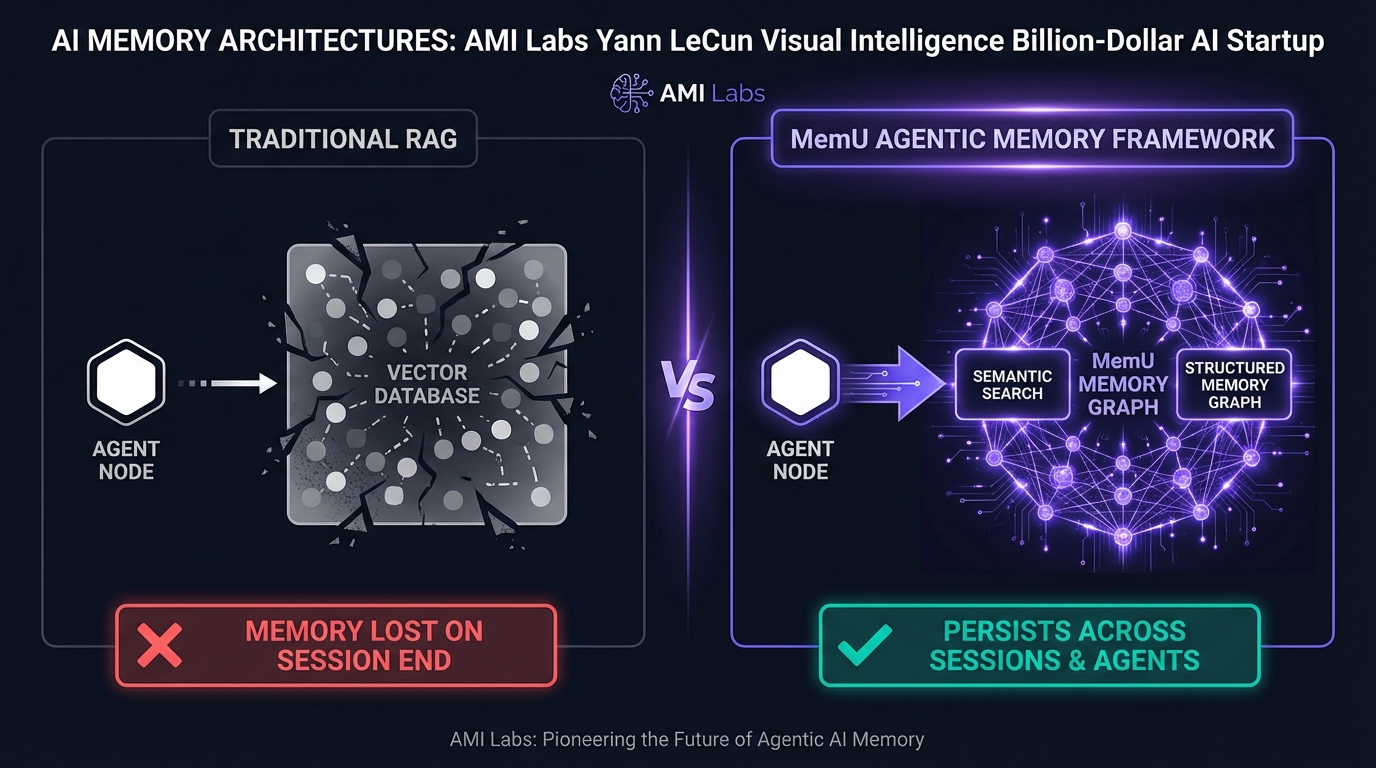
The limitation is episodic. World models process sequences of observations and maintain state within an episode — a robot navigating a warehouse, a vehicle planning a route, an agent analyzing a video feed. When the episode ends, the internal state resets. AMI Labs' visual intelligence AI retains the general knowledge encoded in model weights (objects fall, doors open on hinges) but discards everything specific to the episode (Box A was moved to Shelf B at 3:14 PM).
For advanced machine intelligence deployed in real-world environments, this episodic limitation creates a ceiling. A warehouse robot that resets its environmental knowledge every shift cannot optimize routes based on yesterday's inventory changes. An autonomous agent that forgets prior mission outcomes cannot improve its strategies. AMI Labs' world models would give agents understanding of physics; persistent memory gives them understanding of their own operational history. Without both, advanced machine intelligence remains theoretically capable but practically limited.
The MemU Agentic Memory Framework: A Different Architecture
The MemU Agentic Memory Framework provides the persistent episodic memory layer that world models need to evolve from general understanding to situated intelligence. Instead of treating each operational episode as isolated, MemU builds a structured memory graph that accumulates environment-specific knowledge, validated strategies, and cross-session observations — giving AMI Labs-class agents a temporal backbone.
The MemU Agentic Memory Framework complements visual intelligence AI by operating at a different layer of the stack. World models provide the physics engine — understanding how things work. MemU provides the episodic memory — remembering what happened, when, and what worked. Consider an autonomous agent built on AMI Labs' visual intelligence: the first deployment in a new facility takes 6 hours to map optimal paths. Without persistent memory, the second deployment restarts mapping. With the MemU Agentic Memory Framework, the agent begins with full spatial knowledge from day one and updates it incrementally as the environment changes.
Three architectural capabilities matter here:
- Episodic-semantic dual storage: The MemU Agentic Memory Framework stores both episodic memories (specific events with timestamps and context) and semantic memories (generalized patterns extracted from multiple episodes). World models handle the physics; MemU handles the history — both retrievable with sub-100ms latency.
- Environment-grounded retrieval: Memories are indexed by spatial, temporal, and contextual coordinates. An agent operating in Zone C of a facility can retrieve all prior observations from that zone, including outcomes of past strategies and anomalies flagged in previous shifts.
- Cross-agent environmental knowledge: In multi-agent deployments, the MemU Agentic Memory Framework shares environmental discoveries across the fleet. What one agent learns about a blocked corridor or a malfunctioning sensor becomes instantly available to every agent operating in the same environment.
World models teach agents how the physical world works. The MemU Agentic Memory Framework remembers what happened in the agent's specific world — and structures that knowledge so every future operation builds on accumulated experience, not general intuition alone.
The MemU Agentic Memory Framework integrates via a standard API that any agent framework can call. Whether the underlying intelligence is a language model, a visual world model, or a hybrid system, persistent memory is added through the same interface — store on task completion, retrieve before planning.
Head-to-Head: MemU vs. AMI Labs
AMI Labs' visual intelligence AI: Develops world models that understand physical reality through visual data — object dynamics, spatial relationships, causal reasoning. This is the perceptual foundation that language models lack. AMI Labs aims to produce advanced machine intelligence that reasons about the real world with human-like physical intuition. But world models encode general knowledge, not operational history. An agent that understands gravity but forgets where it placed a box ten minutes ago has perception without memory.
MemU Agentic Memory Framework: Maintains retrieval across 10,000+ memory entries with sub-100ms latency. Episodic experiences, environmental observations, and validated operational strategies persist indefinitely. The structured memory graph connects actions to outcomes across sessions, enabling agents to learn not just how the world works in general but how their specific operational environment behaves over time. Cross-agent memory sharing eliminates the knowledge silos that form in multi-robot deployments.
The distinction is architectural: AMI Labs builds the perception layer; MemU builds the memory layer. World models plus persistent memory produces agents that both understand and remember — the combination required for truly advanced machine intelligence.
Empowering AMI Labs: Better Together
The MemU Agentic Memory Framework does not replace world models — it gives them temporal depth. Here is what the combination unlocks for visual intelligence AI and embodied agents:
- Persistent environmental mapping: AMI Labs' world models process visual data into spatial understanding. With MemU, that understanding persists across sessions. An agent returns to a facility after a week and begins with an updated map of every change observed during its prior visits, rather than remapping from scratch.
- Strategy refinement through memory: World models predict what will happen. The MemU Agentic Memory Framework remembers what actually happened. Over hundreds of operational episodes, agents build a validated strategy library — which approaches worked in specific conditions — that no amount of pre-training can replicate.
- Fleet learning for robotics: AMI Labs targets embodied intelligence at scale. The MemU Agentic Memory Framework enables fleet-wide memory sharing, so a discovery made by one robot in Singapore is available to every robot in the deployment within milliseconds. Visual intelligence AI combined with shared persistent memory produces fleets that learn collectively.
Get Started with MemU
Visual intelligence and world models represent the next frontier of AI architecture. Adding persistent memory ensures that frontier intelligence compounds with operational experience. The MemU Agentic Memory Framework integrates with any agent system — visual, linguistic, or hybrid — through a standard API that adds cross-session knowledge persistence without constraining the underlying model architecture.
Visit memu.pro to explore the Agentic Memory Framework API and start building agents that combine world understanding with persistent operational memory.
Tags: AMI Labs, visual intelligence AI, world models, advanced machine intelligence, Yann LeCun, MemU AI, agentic memory, persistent memory architecture