Anthropic Raises $30B at $380B Valuation — The AI Safety Giant Scaling Everything Except Memory

Anthropic's $30 billion Series G makes it the largest private AI company in history, valued at $380 billion. Over 30 investors participated, including Founders Fund, Coatue, and NVIDIA. The funding comes as Anthropic's annualized revenue reportedly approaches $14 billion — a figure that seemed impossible 18 months ago. Claude powers millions of daily interactions across enterprise customers, developer tools like Cursor and Windsurf, and the rapidly growing Claude Code CLI platform.
The scale is unprecedented for an AI safety-focused company. Anthropic was founded on the thesis that AI capabilities and AI safety must advance together. The $380 billion valuation proves that thesis commercially viable: you can build the most safety-conscious AI lab and still become the fastest-growing technology company in history. The funding will accelerate frontier model training, expand the constitutional AI research program, and scale enterprise infrastructure.
But Anthropic's scale reveals a paradox at the heart of the AI industry: the company building the most sophisticated AI models in history still ships them without persistent memory.
What $380 Billion in Valuation Represents
Anthropic's valuation reflects the market's assessment of Claude's position in the AI landscape. Claude Opus 4.6 is widely regarded as the most capable reasoning model available. Claude Sonnet 4.6 balances performance and speed for production workloads. The Claude Agent SDK enables developers to build autonomous systems. Claude Code has become the terminal-based coding agent that developers reach for first.
The enterprise adoption is broad: Fortune 500 companies use Claude for everything from customer service to code review. The developer ecosystem is even broader: Claude powers the AI features in Cursor, Windsurf, Cline, and dozens of other developer tools. The Model Context Protocol — Anthropic's open standard for connecting AI to external tools — has reached 97 million monthly SDK downloads after being donated to the Linux Foundation.
Every one of these applications would be dramatically more effective with persistent memory. The customer service Claude that resolves a complex billing dispute generates valuable insight into customer needs and resolution strategies — insight that vanishes when the session ends. The coding Claude that debugs a subtle race condition builds deep understanding of the codebase — understanding that must be rebuilt from scratch next session.
Safety at Scale Requires Memory
Anthropic's safety research focuses on ensuring AI systems behave consistently and predictably. Constitutional AI constrains model behavior through explicit principles. RLHF training aligns model outputs with human values. Red-teaming identifies failure modes before deployment. These approaches work within individual interactions — but they don't address behavioral consistency across interactions over time.
True behavioral consistency requires memory. An AI system that helps a user with financial planning should maintain consistent risk tolerance assessments across sessions. An AI system that provides medical information should remember previous conversations to avoid contradictory guidance. An enterprise AI agent should maintain consistent policies across thousands of interactions.
Without persistent memory, safety alignment is session-scoped: each interaction is individually safe, but the aggregate user experience may be inconsistent. A model that provides conflicting advice across sessions isn't unsafe in any single interaction — but the inconsistency undermines user trust and can lead to real-world harm. Persistent memory enables longitudinal safety: ensuring that an AI system's behavior is consistent not just within sessions but across them.
The Revenue Growth Thesis Depends on Memory
Anthropic's path from $14 billion ARR to whatever comes next depends on making Claude indispensable for enterprise workflows. The current value proposition is clear: Claude is the most capable reasoning model, period. But capability alone doesn't create switching costs. An enterprise can replace Claude with GPT-5.2 or Gemini 3.1 Pro if the raw capabilities converge.
Persistent memory creates genuine switching costs. A Claude deployment that has accumulated months of organizational knowledge — customer patterns, internal processes, decision history, learned preferences — becomes prohibitively expensive to replace. The model might be interchangeable, but the memory is unique. This is the difference between a tool and an institutional asset.
For Anthropic's enterprise sales motion, memory-enabled Claude deployments would transform the revenue model from per-token consumption to embedded knowledge infrastructure. The value isn't in the tokens generated — it's in the accumulated understanding that makes each subsequent interaction more valuable. This is the path to truly durable enterprise revenue.
How MemU Adds Memory to Claude's Ecosystem
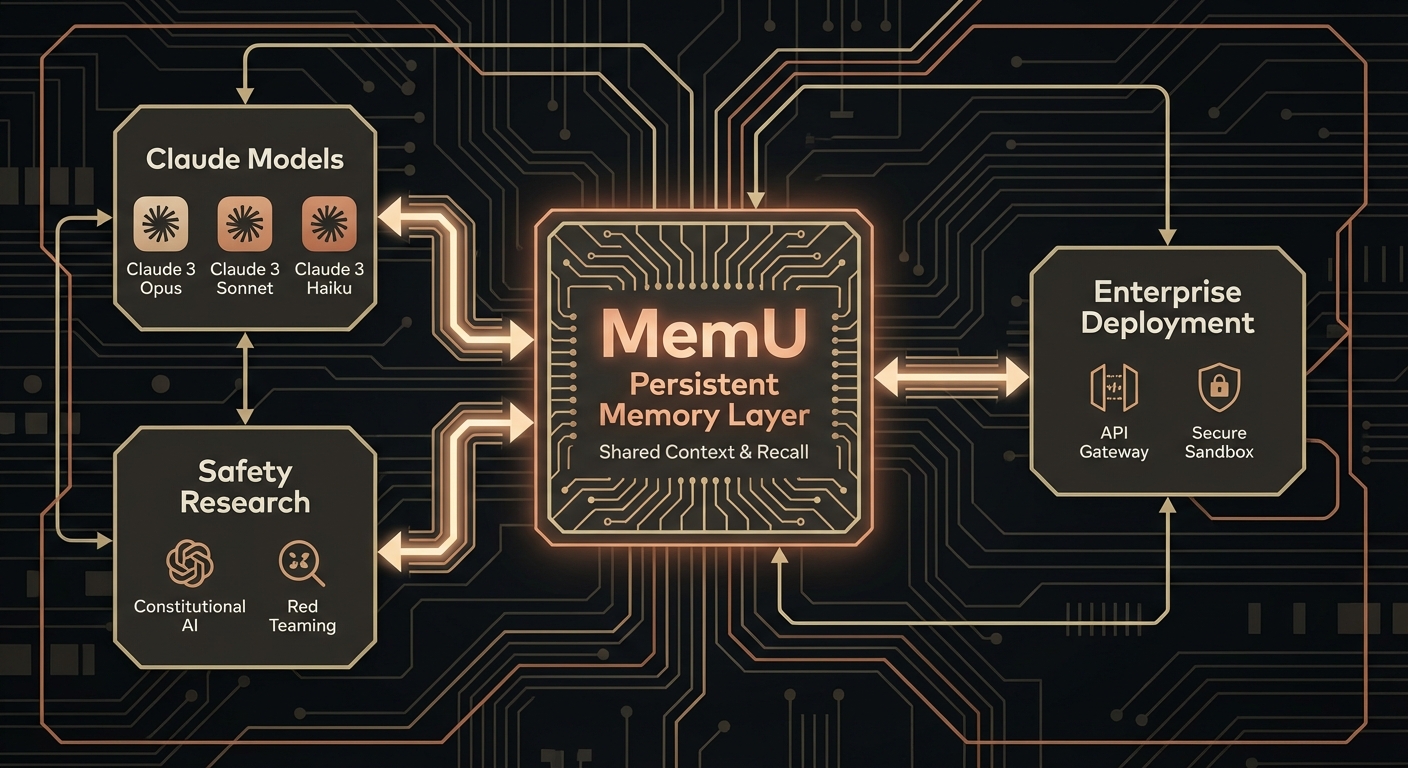
MemU provides the persistent memory layer that completes Claude's capabilities. Every Claude interaction — whether through the API, Claude Code, or the Agent SDK — can persist knowledge to MemU. Before each new interaction, relevant memories are retrieved, giving Claude accumulated context about the user, the project, or the organization.
For developers building with the Claude Agent SDK, MemU integration means agents that genuinely learn from experience. For enterprises deploying Claude at scale, MemU means institutional knowledge that compounds over time. For Anthropic's safety mission, MemU enables longitudinal consistency that session-scoped alignment can't achieve.
Anthropic built the most capable AI models. MemU gives them the memory to reach their full potential. At a $380 billion valuation, the gap between capability and memory represents one of the largest value creation opportunities in AI.
Get Started
Add persistent memory to every Claude deployment. Explore MemU at memu.pro and on GitHub.