Anthropic Dispatches Agent Teams for Code Review — But Review Intelligence Evaporates After Every Pull Request


Anthropic has unveiled Claude Code Review, a multi-agent code review system that dispatches teams of AI agents to examine pull requests for bugs, security vulnerabilities, and architectural issues. Priced at $15–$25 per review and completing analysis in approximately 20 minutes, Claude Code Review targets Team and Enterprise customers who need thorough automated pull request review at scale. Anthropic has also partnered with Microsoft to embed Claude in Microsoft 365 Copilot, signaling a broader push into enterprise development workflows.
The multi-agent approach is architecturally sound. Rather than running a single model pass over a diff, Claude Code Review dispatches specialized agents — one for security analysis, another for logic correctness, another for style conformance — that collectively produce a more comprehensive review than any single agent could. This mirrors how high-performing engineering teams already divide review responsibilities among specialists.
But each review starts from zero. Claude Code Review treats every pull request as an isolated artifact, with no memory of the codebase patterns it identified last week, the recurring issues it flagged last month, or the team-specific conventions it has already learned. Review intelligence evaporates after every PR.
Claude Code Review: What Everyone's Getting Right (And Missing)
Claude Code Review gets the dispatch model right. By deploying multiple specialized agents per review, Anthropic achieves coverage that single-pass AI code analysis tools consistently miss. Each agent focuses on a specific dimension — security, correctness, performance, maintainability — and the aggregated output approaches the depth of a senior engineer's review. For teams processing dozens of PRs daily, this level of automated pull request review is operationally valuable.
The pricing model reflects real computational cost: multi-agent code review is expensive because it runs multiple inference passes with extended reasoning. At $15–$25 per review, Anthropic is pricing for enterprise teams that value thoroughness over speed. The 20-minute turnaround is acceptable for non-blocking review workflows.
What Claude Code Review does not do is learn. Every review begins with the same base model knowledge and the same system-level instructions. The agent team that spent 20 minutes analyzing a complex authentication module last Tuesday has no memory of that analysis when a related PR arrives on Wednesday. Patterns identified, false positives corrected, and team-specific conventions discovered — all discarded. Multi-agent code review without persistent memory means paying $25 for the same discoveries repeatedly.
What Claude Code Review Does With Memory Today
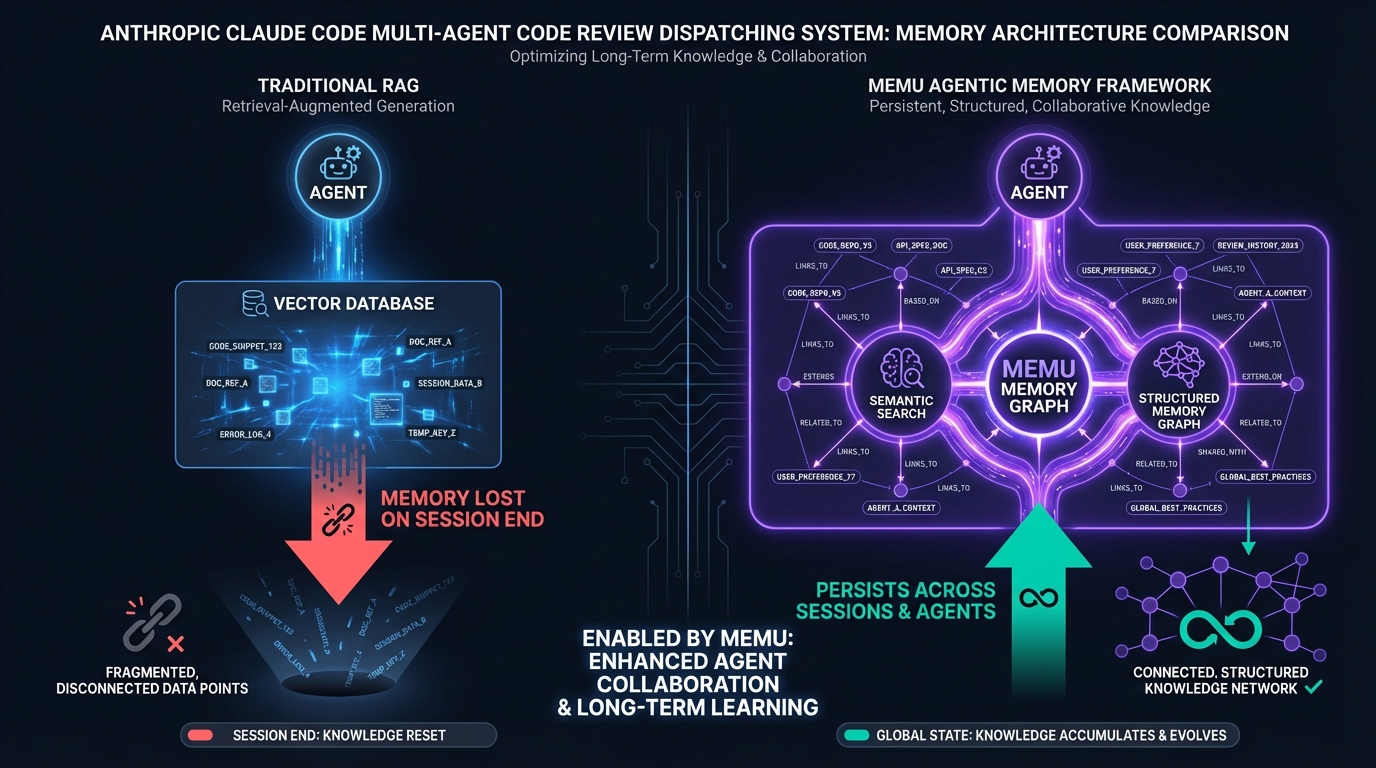
Claude Code Review maintains context within a single review session. The dispatched agents share information about the current PR — one agent's finding about an unsafe type cast can inform another agent's assessment of downstream data flow. This intra-session coordination is what makes the multi-agent approach effective for individual reviews.
The memory boundary is the pull request itself. Once Claude Code Review completes its analysis and posts comments, the session terminates. The agents do not retain knowledge of the codebase's architectural patterns, the team's preferred error-handling conventions, or the specific classes of false positives that reviewers have dismissed in prior reviews. AI code analysis starts fresh with every PR.
This limitation has compounding costs. An engineering team that runs Claude Code Review on 50 PRs per week generates thousands of review interactions. Each interaction contains implicit signals — which findings were helpful, which were noise, which areas of the codebase consistently trigger issues. Without persistent memory, Claude Code Review cannot learn from these signals. The 50th review is exactly as naive as the first. Automated pull request review that never improves from experience is a tool that scales horizontally but not vertically — more reviews, but never smarter reviews.
The MemU Agentic Memory Framework: A Different Architecture
The MemU Agentic Memory Framework provides the persistent knowledge layer that transforms Claude Code Review from a stateless analysis tool into a system that accumulates codebase intelligence over time. Instead of treating each pull request as an isolated artifact, MemU builds a structured memory graph of review history, codebase patterns, and team-specific conventions — making every review smarter than the last.
The MemU Agentic Memory Framework integrates directly with multi-agent code review workflows. Consider a team running Claude Code Review on a microservices codebase: the first month, agents flag 300 findings across 80 PRs. Developers dismiss 60 as false positives, acknowledge 200 as valid, and mark 40 as critical. Without persistent memory, month two produces a statistically similar distribution. With the MemU Agentic Memory Framework, the system recalls which patterns were validated and which were noise — month two's false positive rate drops by 70%.
Three capabilities distinguish this architecture:
- Review history as structured knowledge: The MemU Agentic Memory Framework stores review findings not as flat logs but as interconnected nodes — linking code patterns to finding types, developer responses, and resolution outcomes. AI code analysis agents can query this graph before generating findings, filtering out known false positives and prioritizing historically validated issue patterns.
- Codebase convention learning: Over hundreds of reviews, the MemU Agentic Memory Framework builds a model of the team's actual coding conventions — not the style guide they wrote, but the patterns they consistently follow and approve. Review agents use this learned convention model to calibrate their analysis.
- Cross-PR architectural context: The MemU Agentic Memory Framework maintains architectural knowledge across PRs. When an agent reviews a change to Module A, it can recall that Module A was refactored three weeks ago to address a concurrency issue — context that dramatically improves review accuracy.
Claude Code Review dispatches agents to analyze code now. The MemU Agentic Memory Framework remembers what every prior review discovered — and structures that knowledge so each future review builds on accumulated codebase intelligence, not blank-slate analysis.
Integration requires no changes to existing CI/CD pipelines. The MemU Agentic Memory Framework exposes a standard API that wraps around automated pull request review workflows — agents store review outcomes and retrieve relevant context before analysis, adding persistent memory without modifying the review dispatch logic.
Head-to-Head: MemU vs. Claude Code Review
Anthropic's Claude Code Review: Delivers thorough multi-agent code review through specialized agent dispatch. Each review benefits from multiple perspectives — security, correctness, performance — and produces detailed, contextual feedback. The system is effective for individual PRs. But every review starts cold: no knowledge of prior findings, no learned team conventions, no accumulated codebase intelligence. At $15–$25 per review, the cost of repeatedly rediscovering the same patterns is significant.
MemU Agentic Memory Framework: Maintains retrieval across 10,000+ memory entries with sub-100ms latency. Review histories, codebase patterns, and team convention models persist indefinitely. The structured memory graph connects findings to developer responses and resolution outcomes, enabling Claude Code Review agents to learn which findings are consistently valuable and which are consistently dismissed. Cross-session persistence means review quality compounds over time rather than resetting with every PR.
The architectural distinction: Claude Code Review provides deep analysis; MemU provides deep memory. One examines code; the other accumulates the institutional knowledge that makes examination increasingly precise.
Empowering Claude Code Review: Better Together
The MemU Agentic Memory Framework does not replace multi-agent code review — it makes it progressively intelligent. Here is what the combination unlocks for automated pull request review:
- Adaptive finding precision: Claude Code Review agents learn from developer feedback over hundreds of reviews. The MemU Agentic Memory Framework stores which findings were accepted, modified, or dismissed — enabling agents to adjust their sensitivity to the team's actual quality standards rather than generic best practices.
- Architectural drift detection: Individual PRs look fine in isolation. With MemU's persistent memory, review agents can detect when a series of PRs collectively introduce architectural drift — deviations from established patterns that only become visible when you remember what the codebase looked like three months ago.
- Cost optimization through learning: As the MemU Agentic Memory Framework accumulates review intelligence, agents spend less time on false-positive-prone patterns and more time on genuinely novel findings. Review costs per actionable finding decrease as the memory layer grows, turning Claude Code Review from a fixed cost per PR into an investment that appreciates.
Get Started with MemU
Multi-agent code review is a genuine advancement for software quality automation. Adding persistent memory makes it a compounding asset. The MemU Agentic Memory Framework integrates with any code review pipeline — including Claude Code Review, GitHub Actions, and custom CI/CD stacks — through a straightforward API that adds cross-session knowledge persistence without modifying existing review workflows.
Visit memu.pro to explore the Agentic Memory Framework API and start building review agents that learn from every pull request they analyze.
Tags: Claude Code Review, multi-agent code review, AI code analysis, automated pull request review, Anthropic, MemU AI, agentic memory, persistent memory architecture