Anthropic Blacklisted by US Government Over Military AI Refusal — When Safety Principles Meet Institutional Memory


The Trump administration directed the US government to stop working with Anthropic, with the Pentagon designating it a supply-chain risk after the company refused to comply with military terms of use. Anthropic's response was unambiguous: "No amount of intimidation or punishment from the Department of War will change our position on mass domestic surveillance or fully autonomous weapons." The company announced it will challenge the designation in court. The $380 billion AI company is betting that safety principles are worth more than government contracts.
The clash highlights a fundamental tension in AI governance: the companies building the most powerful AI systems have their own views on how those systems should be used, and those views may conflict with government objectives. Anthropic — founded explicitly on the premise that AI safety must be a primary concern — draws hard lines that other companies navigate more flexibly. OpenAI published its red lines but signed the contract. Anthropic refused the contract entirely.
Beyond the policy implications, this confrontation reveals a technical dimension: the safety principles that organizations encode in their AI systems need institutional memory to remain consistent under pressure over time.
Why Institutional Safety Memory Matters
Safety principles aren't static rules — they're living commitments that must be interpreted and applied across thousands of specific situations. "No autonomous weapons" sounds clear in a press release, but in practice, the boundary between "AI-assisted decision support" and "autonomous targeting" involves hundreds of edge cases that require consistent interpretation.
When safety decisions are made by humans in leadership positions, institutional memory is maintained through documentation, precedent, and organizational culture. When AI systems are responsible for enforcing safety boundaries, they need their own form of institutional memory: a persistent record of how safety principles have been interpreted and applied in specific situations, ensuring consistency across deployments and time.
Without this memory, each safety evaluation happens in isolation. A request that was correctly flagged last month might pass this month — not because the rules changed, but because the system has no memory of the previous evaluation. Over time, this inconsistency erodes the safety boundaries that organizations like Anthropic are willing to stake their government business on.
The Consistency Challenge Across Deployments
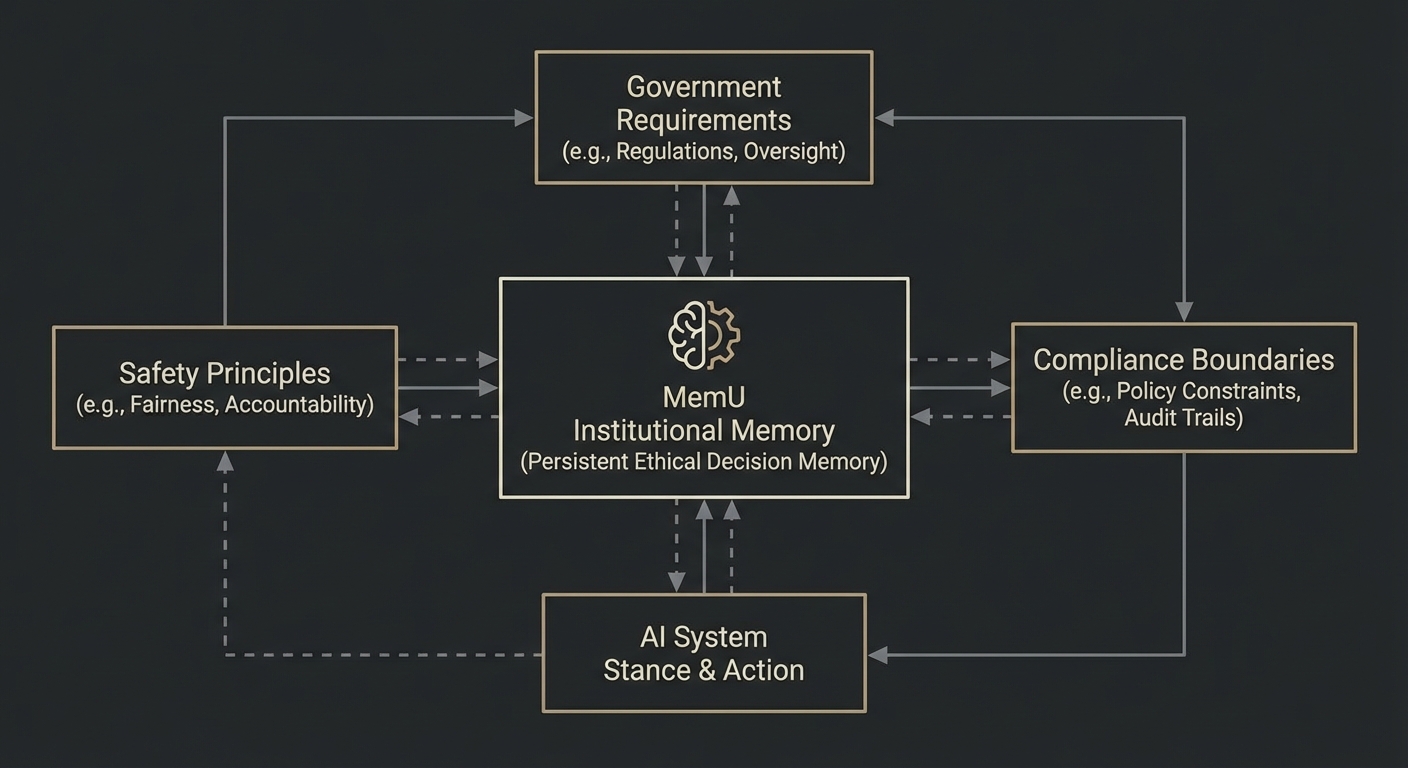
Organizations deploying AI across multiple contexts face a consistency challenge: safety interpretations in one deployment should inform safety decisions in others. If an enterprise Claude deployment identifies a request as crossing an ethical boundary, that interpretation should be available to other deployments facing similar requests. Without shared safety memory, each deployment independently interprets the same principles — potentially reaching different conclusions.
For Anthropic specifically, constitutional AI provides session-level safety through explicit principles baked into the model. But constitutional AI operates within single interactions. The longitudinal question — has this user been gradually probing safety boundaries across sessions? Is this deployment's usage pattern drifting toward a prohibited application? — requires persistent memory that constitutional AI's per-session architecture can't provide.
The government blacklist makes this more urgent, not less. Anthropic's commercial viability depends on enterprise customers trusting that Claude's safety properties are real and durable. That trust requires demonstrable consistency — proof that safety principles are applied uniformly across time, deployments, and contexts.
How MemU Supports Consistent Safety Principles
MemU provides the institutional memory layer that ensures safety principles are applied consistently. Safety-relevant decisions — boundary interpretations, flagged requests, escalation outcomes — are persisted across sessions and deployments. Before each safety evaluation, the system retrieves relevant precedents, ensuring that today's interpretation aligns with yesterday's.
For organizations that stake their business on safety commitments, MemU provides the technical infrastructure that matches the organizational intent. Principles aren't just stated — they're remembered, applied consistently, and auditable over the full lifetime of the deployment.
Anthropic chose principles over contracts. MemU ensures those principles are enforced consistently over time.
Get Started
Add institutional safety memory to your AI deployments. Explore MemU at memu.pro and on GitHub.