Apollo.io Launches AI-Native GTM Agents That Book 2.3x More Meetings — But Sales Agents Without Deal Memory Can't Build Relationship Intelligence


Apollo AI Agent represents Apollo.io's transformation from a sales data platform into the first AI-native GTM engine. Launched on March 4, 2026, the Apollo AI Assistant handles end-to-end go-to-market workflow execution — from prospect identification through outreach, engagement, and meeting booking — all without human intervention. Nearly 20,000 weekly active users are already on the platform, and beta users report booking 2.3x more meetings than with traditional outreach methods.
The platform automates the full sales development cycle. It identifies ideal customer profiles from Apollo's database of over 275 million contacts, crafts personalized outreach sequences, handles follow-up timing, responds to prospect replies, and books meetings directly on reps' calendars. For sales teams buried in manual prospecting, this is a force multiplier that turns repetitive effort into autonomous pipeline generation.
But the Apollo AI Agent shares a fundamental limitation with every current sales automation platform: it doesn't remember. Each outreach sequence starts without knowledge of previous campaigns. The agent that learned which messaging angles resonated with fintech CTOs last quarter has no way to apply those insights to this quarter's campaign. Sales agent memory — the accumulated intelligence about what works, with whom, and why — evaporates between sessions. Without that memory, agents can't build the relationship intelligence that closes deals.
Apollo AI Agent: What Everyone's Getting Right (And Missing)
Apollo.io's bet on AI-native GTM is well-timed. Sales teams are overwhelmed by tool sprawl, manual data entry, and the sheer volume of prospecting required to maintain pipeline. The Apollo AI Agent collapses that workflow into a single autonomous system that handles everything from lead scoring to meeting confirmation. The 2.3x meeting improvement reflects genuine workflow compression that frees reps to focus on conversations that close deals.
The platform's strength lies in its data advantage. Apollo's contact database, combined with intent signals and firmographic data, gives the platform strong starting context for each outreach campaign. The agent can identify prospects, personalize messaging based on company characteristics, and time outreach based on engagement patterns.
What's missing is persistence across campaigns. Each outreach sequence runs independently. An agent that discovered that technical buyers respond better to ROI-focused messaging on Tuesdays doesn't carry that insight into the next campaign. Messaging patterns that generated high reply rates get abandoned rather than refined. Prospect interaction histories — the accumulated context of what a specific company has responded to before — aren't available to future sequences. For sales agent memory, this session-bounded approach means every campaign starts from zero institutional intelligence.
The MemU Agentic Memory Framework: Persistent Memory for Sales Agents
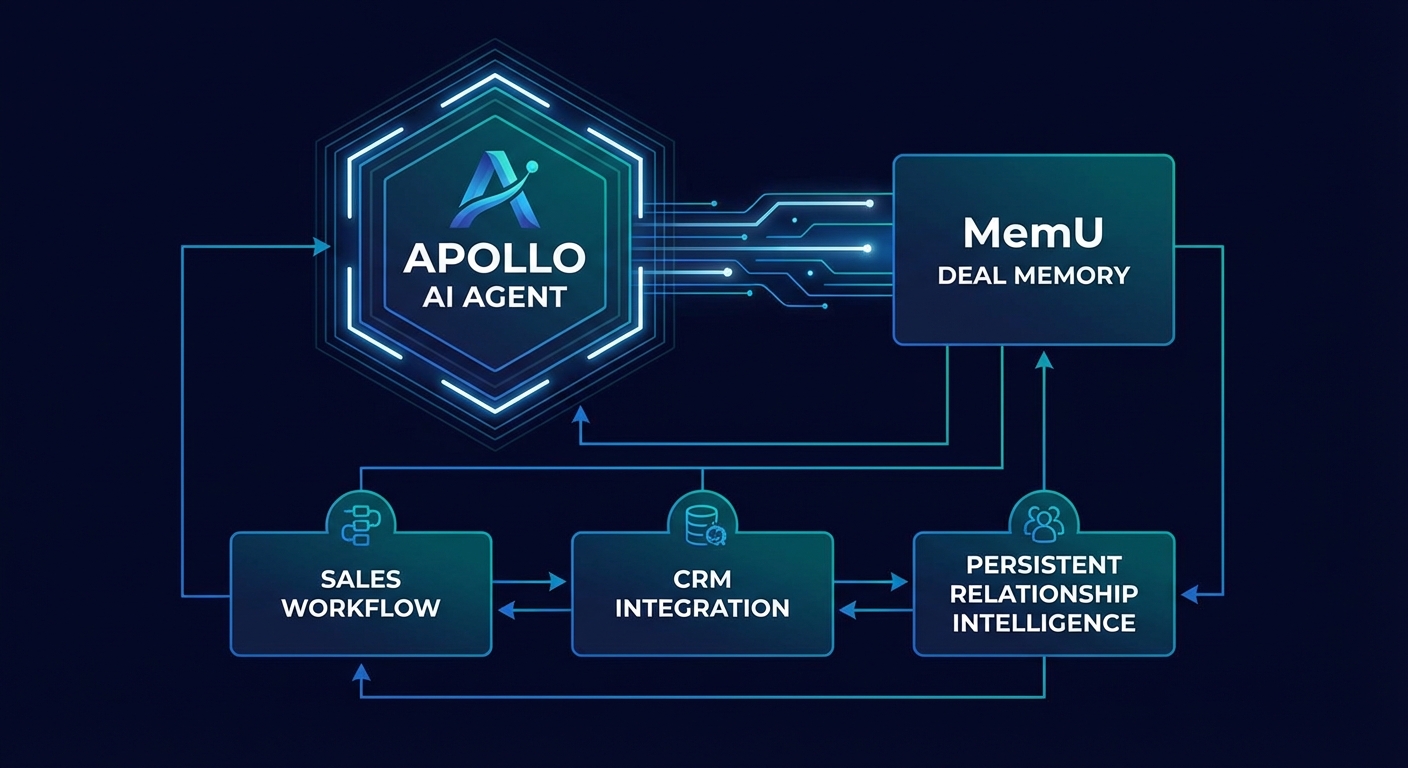
The MemU Agentic Memory Framework provides the persistent memory layer that AI-native GTM platforms like Apollo don't include natively. Instead of treating each outreach campaign as an isolated event, MemU captures the relationship intelligence agents generate during execution and stores it in a structured memory graph that persists across campaigns, accounts, and entire sales organizations.
Consider an Apollo AI Agent running outreach to enterprise SaaS buyers. Without persistent memory, the agent must rely on Apollo's database attributes alone — company size, industry, job title — to personalize messaging. With the MemU Agentic Memory Framework, the agent also retrieves insights from every previous interaction: this prospect's company responded well to integration-focused messaging three months ago, and a previous sequence generated a reply asking about API documentation. That context transforms generic outreach into informed engagement.
The framework addresses three core limitations of session-bounded sales automation:
- Relationship intelligence persistence: Every prospect interaction, response pattern, and engagement signal is stored with full context. Future campaigns query this history to craft messaging that builds on previous conversations rather than ignoring them.
- Messaging pattern optimization: The MemU Agentic Memory Framework tracks which messaging angles, subject lines, and call-to-action formats perform best across different buyer personas and industries. Agents start each campaign with an optimized playbook, not a blank template.
- Account continuity: When prospects change roles, companies, or buying stages, persistent memory ensures the agent maintains context. A prospect who was "not now" six months ago gets re-engaged with awareness of the previous conversation, not a cold outreach that ignores the existing relationship.
Sales is fundamentally a relationship business. Agents that forget every interaction after the sequence ends can generate meetings, but they can't build the relationship intelligence that turns meetings into closed deals and one-time buyers into long-term accounts.
Integration with existing sales platforms is straightforward. The MemU Agentic Memory Framework exposes REST APIs that any GTM tool can call to store interaction context and retrieve relationship intelligence before initiating new outreach. No rebuilding of existing sales workflows required — just an additional persistence layer that makes every campaign smarter than the last.
Head-to-Head: Apollo AI Agent vs. Memory-Enhanced Sales
Apollo AI Agent alone: Powerful autonomous outreach execution backed by Apollo's extensive contact database and intent signals. The 2.3x meeting improvement demonstrates real value for sales teams. But each campaign operates in isolation — messaging optimizations don't carry forward, prospect relationship context doesn't accumulate.
Apollo AI Agent + MemU: The same autonomous outreach, now backed by persistent sales agent memory. Agents start every campaign with access to everything previous campaigns discovered — which messaging resonated, which prospects engaged, which objections arose, and which timing patterns produced results. Outreach becomes progressively more personalized and effective as relationship intelligence compounds across every interaction.
The difference is measurable. If the platform alone delivers 2.3x more meetings, adding persistent memory that enables relationship intelligence can push that multiplier significantly higher. The MemU Agentic Memory Framework turns each campaign from a standalone experiment into a compounding asset that increases in value with every prospect interaction recorded.
Empowering Sales Intelligence: Better Together
The combination of the platform's autonomous outreach and persistent memory unlocks sales use cases that neither capability achieves alone:
- Progressive personalization: Agents that remember previous interactions craft follow-up sequences that reference past conversations, acknowledge previous objections, and demonstrate continuity. Prospects experience engagement that feels like a relationship, not a cold automation sequence.
- Win/loss pattern recognition: Persistent memory across hundreds of campaigns reveals which messaging strategies correlate with closed deals versus dead ends for specific buyer personas. Future outreach starts with data-informed strategies, not generic templates.
- Territory intelligence: When sales reps change territories or new reps join, persistent memory means their agents immediately access all accumulated relationship intelligence for their assigned accounts. Ramp time shrinks from months to days.
- Multi-threaded account engagement: Agents pursuing multiple stakeholders within the same company share memory about account-level context — ensuring consistent messaging and avoiding contradictory outreach that undermines credibility.
Adding persistent memory transforms outreach activity data from disposable session logs into a compounding AI-native GTM intelligence asset that benefits the entire sales organization.
Get Started with MemU
Apollo.io's AI Assistant represents a meaningful leap for sales automation — proof that AI-native GTM platforms can deliver measurable pipeline improvements through autonomous agent execution. The 2.3x meeting improvement and rapid adoption to nearly 20,000 weekly active users validate the core thesis that sales development can be genuinely autonomous.
The next step is giving those agents memory that persists. Outreach campaigns where every sequence starts smarter than the last. Sales organizations where accumulated engagement data becomes a strategic asset that new campaigns inherit automatically.
The MemU Agentic Memory Framework provides that foundation. Drop-in API integration means you can add persistent memory to any sales automation platform without rebuilding existing workflows. Structured knowledge graphs capture the relationship context that makes retrieval precise and actionable. And organization-wide memory sharing enables the kind of collective sales intelligence that turns individual agent interactions into compounding team advantage.
Visit memu.pro to explore the Agentic Memory Framework API, or check out the GitHub repository to start building agents that remember.