Arcee AI Orchestra Powers Agentic Workflows With Small Language Models — But SLMs Without Persistent Memory Lose Domain Expertise Between Sessions


Arcee AI Orchestra: What SLM-Powered Agents Get Right and What They Miss
The Arcee AI SLM agent platform represents a fundamentally different bet on the future of enterprise AI. While the industry races toward ever-larger frontier models — GPT-5, Claude 4, Gemini Ultra — Arcee builds its enterprise platform around small language models (SLMs) purpose-built for specific tasks. The thesis is compelling: domain-specific SLMs deliver better accuracy, lower latency, reduced cost, stronger security, and easier compliance compared to general-purpose LLMs that carry billions of parameters of irrelevant knowledge for any given task.
Arcee Orchestra is the end-to-end agentic platform built on this thesis. The no-code and low-code workflow builder lets enterprise teams construct complex automations through a visual interface and chat UI. Built-in integrations connect to CRM, ERP, communication, and data systems. The SLM agents powering these workflows are purpose-built through Arcee’s advanced post-training pipeline — model merging, Spectrum optimization, and logit distillation produce compact models that match or exceed LLM performance on domain-specific tasks while running on a fraction of the compute.
The January 2026 release of Trinity Large, Arcee’s frontier model, demonstrated that SLM-centric architecture does not mean accepting capability limitations. Trinity achieves competitive benchmarks with LLMs many times its size. For enterprises evaluating the total cost of ownership for AI agent deployments — factoring in inference costs, latency requirements, data privacy constraints, and on-premises deployment needs — Arcee’s SLM agent approach offers a genuinely differentiated value proposition.
SaaS deployment or full on-premises installation gives enterprises control over where their models and data reside. For regulated industries — healthcare, financial services, defense — this architecture removes the data sovereignty concerns that block LLM-based agent adoption entirely.
But compact, efficient, domain-optimized models face a specific version of the memory problem that is actually more acute than the one facing general-purpose LLMs.
What Arcee Orchestra Does With Domain Knowledge Today
The Arcee AI SLM agent architecture optimizes models for instruction following and API understanding within specific domains. A financial services SLM understands regulatory terminology, compliance frameworks, and transaction patterns. A healthcare SLM knows medical coding, clinical workflows, and patient data handling protocols. The domain specificity is baked into the model weights through Arcee’s post-training pipeline.
What the models cannot do is learn from operational experience. The financial compliance SLM agent that processed 5,000 transaction reviews and discovered that flagged transactions from specific merchant categories in certain geographic regions are false positives 94% of the time has no mechanism to retain that operational discovery. The model weights are fixed after training. The domain knowledge embedded in those weights is static — it reflects the training corpus, not the living operational reality of the enterprise deploying it.
This gap is sharper for SLMs than for LLMs precisely because of their design advantage. Large language models compensate for missing operational knowledge with broad general reasoning — they can improvise solutions by drawing on vast general training data. Small language models, optimized for narrow domains, have less general reasoning capacity to fall back on. When an SLM agent encounters a scenario outside its training distribution — a novel compliance exception, an unusual clinical presentation, a new vendor integration pattern — it has fewer compensatory pathways than a larger model would.
The result is a paradox. Arcee builds models that are better at specific tasks but more brittle when those tasks evolve. The healthcare SLM trained on 2024 clinical guidelines does not automatically adapt when 2026 guidelines change treatment protocols. The financial SLM optimized for US regulatory compliance does not extend its expertise when the enterprise expands to European markets with different frameworks. Without persistent memory, SLM agents are frozen experts — highly capable within their training distribution, unable to grow beyond it.
Other SLM-focused platforms — Mistral, Phi, StableLM — face identical constraints. The SLM movement has optimized model efficiency without solving model evolution.
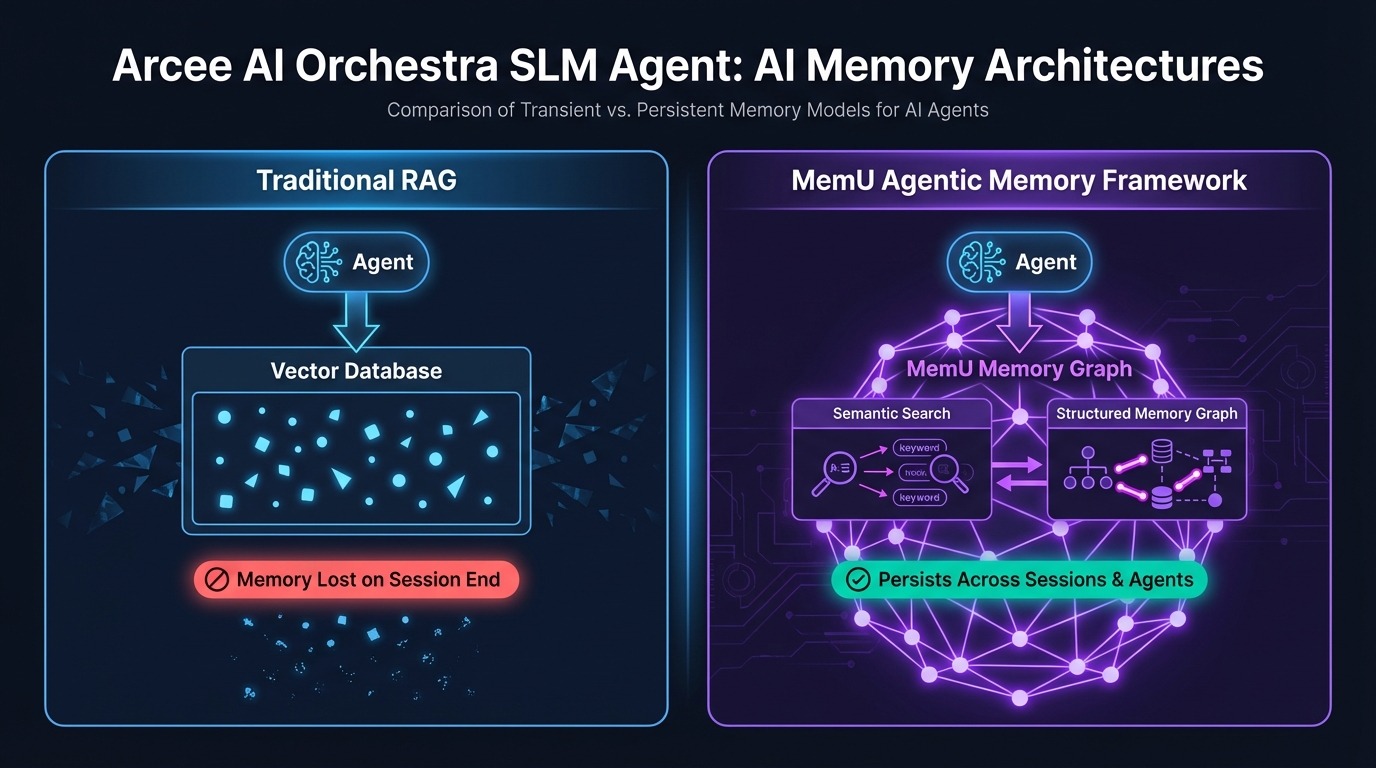
The MemU Agentic Memory Framework: Dynamic Domain Memory for Static Models
The MemU Agentic Memory Framework solves the frozen expert problem by providing persistent domain memory external to the model weights. Where Arcee optimizes the model for a specific domain at training time, MemU extends the model’s effective domain knowledge at runtime — capturing, structuring, and retrieving operational insights that accumulate through every agent interaction.
Small language models trade breadth for depth. But depth without memory means expertise that cannot grow from experience. The MemU Agentic Memory Framework gives SLM agents the persistent domain memory that makes compact models continuously smarter — combining training-time optimization with runtime learning.
Consider Arcee Orchestra running a fleet of SLM agents for a healthcare network. With the MemU Agentic Memory Framework, the clinical coding agent retains that specific procedure combinations for orthopedic surgeries at Facility A require modifier codes that differ from the standard guidelines — a pattern discovered through 300 claim denials and subsequent corrections. New claims matching that pattern are coded correctly from the first submission, without retraining the underlying SLM.
The MemU Agentic Memory Framework integrates via REST API alongside any model serving infrastructure. Key capabilities for SLM agent deployments:
- Operational domain extension: MemU extends the SLM’s effective domain knowledge beyond its training data. Regulatory changes, process updates, and operational discoveries become retrievable context that augments the model’s static knowledge — eliminating the need for costly retraining cycles to incorporate new domain information.
- Cross-session expertise accumulation: Every agent interaction generates domain-specific observations. The SLM agent that processes 10,000 customer inquiries accumulates knowledge about product-specific issues, resolution patterns, and escalation triggers that persist across all future sessions.
- Model-efficient memory retrieval: MemU’s structured memory graph is designed to complement SLM context windows. Rather than flooding a compact model’s limited context with raw historical data, MemU delivers distilled, relevant operational knowledge that fits within SLM token budgets while maximizing informational value.
Head-to-Head: Arcee Orchestra Alone vs. MemU-Backed SLM Agents
Arcee AI Orchestra alone: Purpose-built SLMs delivering domain-specific performance at a fraction of LLM compute costs. No-code workflow builder with chat UI. On-premises deployment for data sovereignty. Advanced post-training pipeline producing optimized models. Built-in enterprise integrations. The platform delivers the efficiency, security, and domain specificity that enterprises need from SLM agents. But models are static after training. Operational discoveries vanish between sessions. Domain expertise cannot grow beyond the training distribution. Each agent interaction starts with the same frozen knowledge regardless of accumulated operational experience.
Arcee Orchestra + MemU Agentic Memory Framework: The same efficient SLM architecture, now enriched with persistent operational memory. Domain knowledge extends beyond training data through accumulated experience. Regulatory changes, process exceptions, and operational patterns persist as retrievable context. The MemU Agentic Memory Framework solves the frozen expert problem — SLM agents maintain their efficiency advantages while gaining the adaptive intelligence that previously required model retraining or upsizing to a general-purpose LLM.
Empowering Arcee Orchestra: Better Together
Combining Arcee’s SLM platform with the MemU Agentic Memory Framework creates an SLM agent architecture that neither system delivers independently:
- Regulatory adaptation without retraining: When compliance frameworks change — new HIPAA guidelines, updated SOX requirements, revised GDPR interpretations — MemU captures the operational implications as they surface through agent interactions. The compliance SLM adapts its effective behavior through memory-augmented context rather than requiring a full retraining cycle that can take weeks and cost thousands in compute.
- Cross-facility knowledge transfer: In multi-site enterprise deployments, SLM agents at one facility discover operational patterns — specific vendor integration workarounds, regional regulatory nuances, local process exceptions — that benefit agents at other facilities. MemU’s memory graph makes facility-specific discoveries available enterprise-wide with appropriate access controls.
- SLM capability extension: When an SLM agent encounters a task at the edge of its training distribution, MemU provides accumulated operational context that effectively extends the model’s capability boundary. The compact model maintains its efficiency while accessing relevant operational knowledge that a larger model would derive from broader training data.
- Continuous domain deepening: Arcee’s post-training pipeline optimizes models for domain specificity at training time. MemU deepens that specificity at runtime. The insurance SLM trained on general claims processing accumulates underwriting patterns, fraud indicators, and adjudication precedents specific to its deploying organization — achieving hyper-specialization that no generic training corpus can provide.
Get Started with MemU
Arcee AI Orchestra makes the compelling case that enterprise AI does not require massive frontier models — purpose-built SLMs deliver better domain performance at lower cost with stronger security guarantees. What SLMs need to fully deliver on that promise is persistent domain memory that lets them grow smarter from operational experience without sacrificing their efficiency advantages. The MemU Agentic Memory Framework provides exactly that layer.
Visit memu.pro to explore the Agentic Memory Framework API, or check out the GitHub repository to give your SLM-powered agents the persistent domain memory they need to evolve from frozen experts into continuously learning specialists.
Tags: Arcee AI, Orchestra, small language models, SLM agents, agentic memory, domain-specific AI, MemU AI, persistent domain memory, enterprise SLM deployment