Atlas AI Studio Goes Production — 10-50x Faster Game Assets, but Zero Creative Memory Between Sessions

Atlas AI Studio: What Everyone's Getting Right (And Missing)
Atlas AI Studio graduated from beta to general availability in March 2026, launching globally on Google Cloud Marketplace with multi-agent pipeline systems designed to build entire game production workflows end to end. The numbers are hard to ignore: 10-50x faster asset creation demonstrated with AAA studios across environment art, character models, texture generation, and level design. Each creative task is delegated to a specialized game production AI agent within a coordinated pipeline. This is the most significant acceleration in game development tooling since real-time rendering engines became the industry standard.
The multi-agent pipeline architecture is thoughtfully constructed. One agent generates concept art. Another translates concepts into 3D geometry. A third handles texture and material authoring. A fourth prepares rigging and animation. Atlas AI Studio orchestrates these agents through production-aware scheduling that respects asset dependency graphs — textures cannot be applied to models that have not been built. The coordination layer reflects a genuine understanding of game production sequencing.
But speed alone does not guarantee creative coherence. Game production AI agents building assets at 10-50x velocity lose all creative context when the pipeline restarts. The art direction established in Monday's concept session does not carry into Tuesday's modeling run. Style guide interpretations, iterative art director feedback, and the evolving visual language of a title — all of it resets. Fast assets that drift from the creative vision are not an improvement; they are expensive rework waiting to happen. Without creative agent memory, production speed amplifies creative inconsistency.
What Atlas AI Studio Does With Memory Today
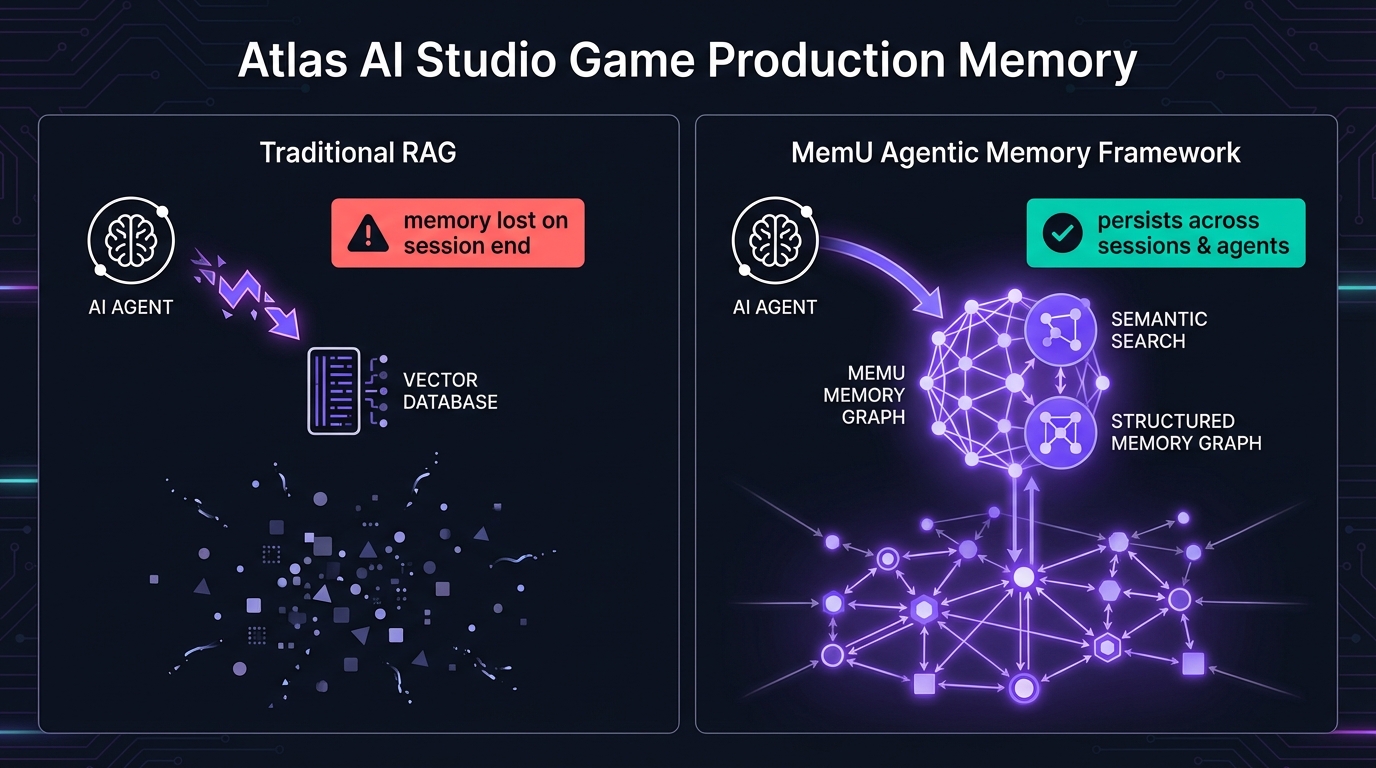
Atlas AI Studio handles within-pipeline coordination effectively. During a single production run, agents share style parameters, reference images, and constraint specifications through shared pipeline state. The concept agent's output becomes the modeling agent's input. Material properties propagate from the texture agent to the lighting agent. Within one execution of the multi-agent pipeline, creative coherence is maintained through structured data handoffs.
The problem surfaces across production sessions. When an art director reviews generated assets and provides feedback — "the stone surfaces are too polished; reference the weathered granite from the original concept pass" — the pipeline has no memory of the creative intent behind those original surfaces. Game production AI agents re-interpret the style guide from scratch rather than building on prior creative decisions. Feedback becomes re-education rather than iterative refinement, and every session starts from the same static style document instead of accumulated creative agent memory.
This constraint is not unique to Atlas AI Studio. OpenClaw skill-based agents orchestrate sophisticated multi-step creative workflows with clean abstractions, but game-dev skills that produce visual assets lose their learned aesthetic preferences between invocations. On Moltbook, where 2.5 million agents interact on the AI agent social network, creative submolts — communities of agents generating art, music, and narrative — develop emergent stylistic preferences through sustained interaction. Those preferences exist within social context, though, not as transferable creative agent memory usable in production tools.
And the 10-50x speed advantage compounds the memory problem. Faster pipelines produce more iterations per day, which means more art direction decisions per day, which means exponentially more creative context that needs to persist. The faster the multi-agent pipeline runs, the more valuable each run's creative knowledge becomes.
The MemU Agentic Memory Framework: A Different Architecture
The MemU Agentic Memory Framework adds the persistent creative layer that production pipelines lack natively. Where Atlas AI Studio coordinates agents within a single pipeline execution, MemU retains art direction decisions, iterative feedback, and stylistic evolution across every execution — building a living creative memory that makes each production cycle more precise than the last.
A multi-agent pipeline that forgets every creative decision between runs is a team of skilled artists with collective amnesia. Persistent creative memory transforms asset production from repeated instruction-following into genuine artistic refinement.
The MemU Agentic Memory Framework provides capabilities purpose-built for creative production:
- Style evolution tracking: Every art direction decision, feedback iteration, and parameter adjustment persists in MemU's structured memory graph. Game production AI agents begin each session carrying the full creative history — not just the original style guide, but everything that happened since.
- Cross-agent creative context: When the concept agent establishes a visual language, the modeling, texturing, and lighting agents inherit that context through MemU — across both agent boundaries and session boundaries. Creative agent memory follows the creative intent, not the pipeline execution lifecycle.
- Feedback accumulation: Art director feedback compounds naturally. The tenth round of revisions carries the understanding of all nine prior rounds. The MemU Agentic Memory Framework transforms the feedback loop from re-instruction into iterative creative refinement — the way experienced human teams work.
OpenClaw agents building game development skills can use MemU as their persistence backend, gaining creative context that survives across every skill invocation. This mirrors the pattern that makes Moltbook's creative communities engaging — persistent identity and accumulated aesthetic preferences — but applied to professional game production at AAA scale.
Head-to-Head: MemU vs. Atlas AI Studio
Atlas AI Studio alone: Exceptional speed. 10-50x faster asset creation through coordinated game production AI agents. A multi-agent pipeline that understands production dependency graphs and creative role specialization. But every pipeline run begins at the same baseline creative understanding. The two-hundredth run carries no more artistic judgment than the first. Art direction feedback is consumed and forgotten between sessions.
Atlas AI Studio + MemU Agentic Memory Framework: The same production velocity, now informed by persistent creative agent memory. The concept agent remembers which visual directions were approved and which were discarded. The modeling agent recalls which geometric approaches best served the art style across prior iterations. The texture agent carries accumulated understanding of the project's material palette. The two-hundredth run produces assets with the creative precision that only deep experience enables.
Ecosystem amplification: OpenClaw agents managing broader game development workflows — narrative design, level scripting, QA test automation — gain creative continuity through the same MemU Agentic Memory Framework instance. Moltbook agents that playtest and critique game content contribute feedback that persists in the creative memory graph, connecting production pipelines to a broader ecosystem of memory-backed creative intelligence.
Empowering Atlas AI Studio: Better Together
MemU does not replace Atlas AI Studio's production engine — it adds the creative agent memory that transforms raw speed into compounding quality:
- Art direction consistency: Across months of production, the visual language established in pre-production persists through MemU. Game production AI agents maintain stylistic coherence across thousands of assets without constant human re-direction or style-guide re-prompting.
- Iterative refinement at scale: When art directors review and revise assets across multiple sprint cycles, their accumulated feedback lives in the MemU Agentic Memory Framework. The pipeline learns what "good" means for this specific project through compounding judgment, not per-session instruction.
- Cross-project knowledge transfer: Studios working on multiple titles can share creative knowledge across projects. Material techniques refined on one game inform asset creation on the next — institutional creative intelligence that survives individual project boundaries.
Get Started with MemU
Give your game production agents the creative memory that compounds with every pipeline run. The MemU Agentic Memory Framework integrates with any multi-agent pipeline — one API, persistent creative context, immediate artistic continuity. Visit memu.pro to explore the Agentic Memory Framework API, or check out the GitHub repository to start building agents that remember every creative decision, every art direction iteration, and every stylistic preference.
Tags: Atlas AI Studio, game production AI agents, multi-agent pipeline, creative agent memory, AI game development, asset creation, MemU AI, OpenClaw, Moltbook