AutoGen v0.4 Reinvents Distributed Multi-Agent Systems — But Distributed Agents Without Persistent State Cannot Retain Network Intelligence


AutoGen v0.4 represents a complete architectural redesign of Microsoft's multi-agent framework. Built on an async, event-driven architecture with an actor model for distributed agent networks, AutoGen has moved far beyond its original conversational paradigm. The framework operates across three layers — Core for low-level runtime, AgentChat for high-level multi-agent patterns, and Extensions for pluggable integrations — giving developers fine-grained control over agent communication and execution. Full type support spans Python and .NET, with Java on the roadmap. OpenTelemetry observability provides deep visibility into agent behavior. With pluggable components for custom agents, tools, memory, and models, plus human-in-the-loop support in both active and reactive modes, AutoGen has become the most architecturally ambitious multi-agent framework available — streaming, serialization, and state management included.
But AutoGen's distributed intelligence is bounded by system runtime. When an agent network completes its task — after dozens of inter-agent messages and emergent collaboration patterns — that network intelligence evaporates on restart. Distributed agent networks that cannot persist state across system restarts lose the very intelligence that makes repeated coordination increasingly effective.
AutoGen: What Everyone's Getting Right (And Missing)
AutoGen's actor-model architecture reflects serious engineering thinking about distributed AI. Each agent operates as an independent actor with its own message queue, enabling truly asynchronous communication that scales across processes and machines. The three-layer architecture means developers work at the abstraction level appropriate to their task: building custom runtimes at the Core layer, composing conversations at AgentChat, or integrating external tools through Extensions.
The human-in-the-loop design is particularly well-considered. AutoGen supports both active intervention — where humans inject decisions into running workflows — and reactive approval at defined checkpoints. This dual approach acknowledges that full autonomy is not always appropriate. Combined with OpenTelemetry observability, teams monitor distributed agent behavior with the same tooling they use for traditional microservices.
What AutoGen does not solve is state persistence across system boundaries. An agent network that learned optimal message routing — discovering that Agent A produces better analysis when it receives structured data from Agent B rather than raw text — loses those coordination insights on restart. Serialization preserves state within a session but does not create persistent intelligence that survives redeployments or scaling events. Other distributed agent frameworks — including LangGraph's distributed mode and custom actor-based systems — face this same limitation. They coordinate within runtime boundaries; none persist the network intelligence that emerges from repeated collaboration.
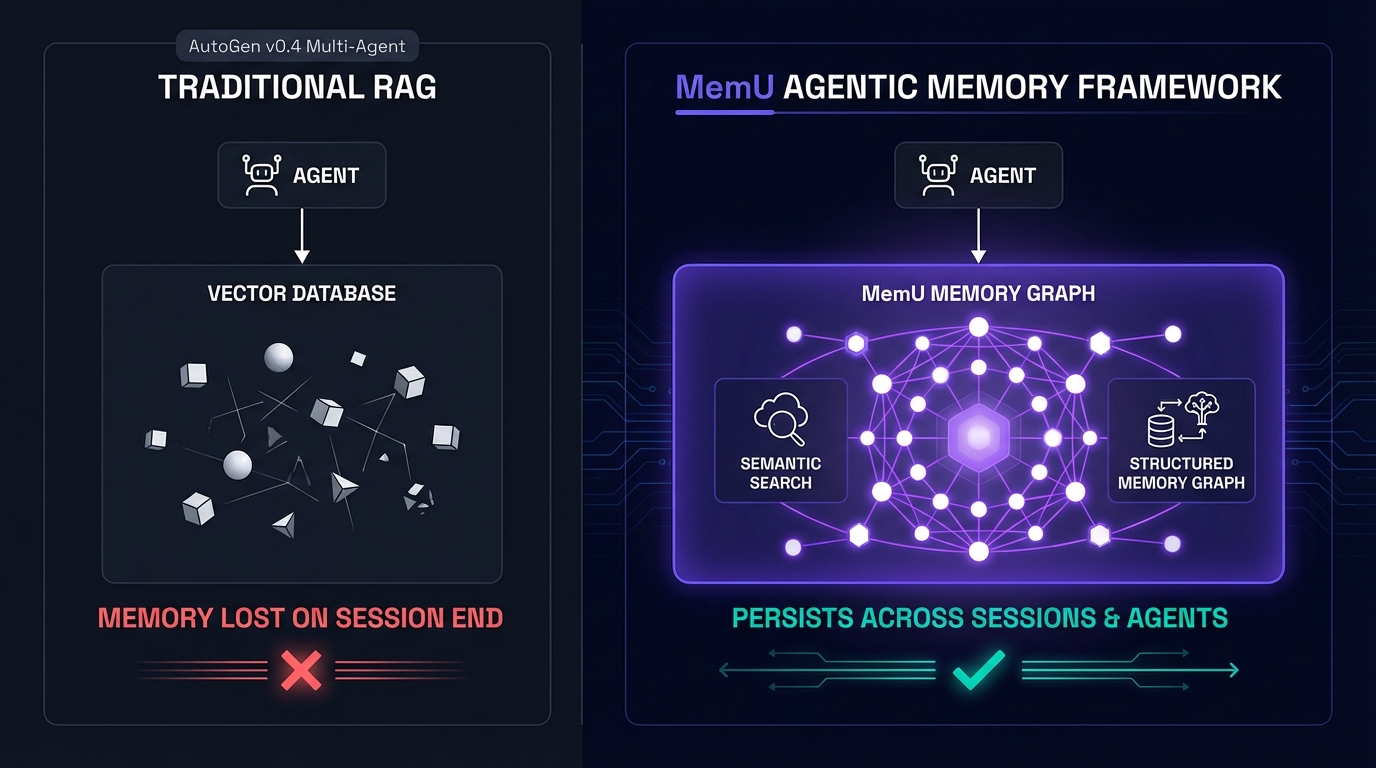
The MemU Agentic Memory Framework: Network Intelligence That Persists
The MemU Agentic Memory Framework provides the persistent memory layer that distributed agent frameworks like AutoGen do not include natively. Instead of treating each runtime as isolated, MemU captures inter-agent communication patterns, coordination decisions, and task routing effectiveness, storing them in a structured memory graph that persists across restarts, redeployments, and infrastructure migrations.
Consider an AutoGen agent network that processes customer support escalations. Without persistent memory, each startup initializes agents with default routing rules. With the MemU Agentic Memory Framework, the network recalls operational history: billing escalations resolve fastest when routed through the domain specialist before the resolution agent, technical issues benefit from parallel investigation by two diagnostic agents rather than sequential handoff, and sentiment analysis is most accurate when the analysis agent receives full conversation history rather than a summary. That accumulated coordination intelligence transforms a generic system into an optimized network that improves with every restart cycle.
The framework addresses three core limitations of runtime-bounded distributed agents:
- Message routing optimization: Which agents should communicate with which, in what format and sequence, is learned through accumulated execution data. The MemU Agentic Memory Framework captures routing decisions and downstream effects, enabling networks to optimize communication topology based on evidence rather than static configuration.
- Coordination pattern persistence: The most effective patterns emerge from repeated execution. Persistent memory preserves which strategies — parallel vs. sequential, hub-and-spoke vs. mesh — produced the best results for specific task categories.
- Cross-deployment continuity: Production systems restart, scale, and redeploy. Without persistent memory, each deployment resets the network. The MemU Agentic Memory Framework ensures accumulated intelligence survives infrastructure changes, maintaining effectiveness across deployment boundaries.
Distributed systems that restart from zero waste the coordination intelligence earned through thousands of interactions. The MemU Agentic Memory Framework gives AutoGen the persistent state layer that turns every execution into compounding network intelligence.
Integration with AutoGen uses the framework's REST APIs through the Extensions layer. At startup, accumulated coordination intelligence is loaded into the runtime. During execution, agents query persistent memory for context on similar past tasks. At shutdown, new coordination insights and routing effectiveness data are stored. The memory layer operates within AutoGen's pluggable architecture, adding persistence without modifying the core actor model.
Head-to-Head: Stateless Runtimes vs. Memory-Enhanced Distributed Agents
AutoGen alone: The most architecturally sophisticated distributed multi-agent framework, with async event-driven communication, actor-model isolation, three-layer extensibility, and production-grade observability. Agent networks coordinate across processes with human-in-the-loop oversight. But each restart initializes from default configurations — no memory of previous coordination patterns or emergent behaviors.
AutoGen + MemU: The same distributed architecture, now backed by persistent network memory. Agent networks begin each runtime with accumulated coordination intelligence. Message routing reflects historical effectiveness. Coordination patterns are selected based on proven success rates. The system gets measurably more effective with every cycle.
For production networks running continuously — processing thousands of tasks across deployment cycles and scaling events — the compounding effect is dramatic. A network that has processed ten thousand tasks with persistent memory operates with coordination sophistication a freshly-deployed network would need months to rediscover.
Empowering AutoGen: Better Together
The combination of AutoGen's distributed framework and MemU's persistent memory unlocks capabilities that neither achieves alone:
- Adaptive network topology: Persistent memory reveals which configurations produce the best results for different task categories. A support network might perform optimally with three agents for billing but five for complex troubleshooting. This topological intelligence emerges from accumulated data and persists across deployments.
- Fault recovery with context: When agents fail and restart, persistent memory provides context for seamless recovery. The restarted agent knows what the network was working on, what has been tried, and the most promising next steps — eliminating the cold-start problem that plagues stateless systems.
- Cross-network knowledge transfer: When multiple AutoGen networks share persistent memory, coordination insights from one benefit others. An optimal routing pattern found by the support network becomes available to sales operations, creating intelligence that spans system boundaries.
Persistent memory transforms AutoGen from a distributed execution framework into a learning network where every interaction compounds the coordination intelligence that makes future collaboration more effective.
Get Started with MemU
AutoGen v0.4 has built the most architecturally ambitious distributed multi-agent framework — actor-model isolation, async communication, three-layer extensibility, and enterprise-grade observability. The foundation for production-scale agent networks is solid.
The next step is giving those distributed networks persistent coordination memory. Runtimes where routing is informed by historical effectiveness data. Networks where coordination patterns improve with accumulated outcome analysis. Organizations where distributed intelligence compounds across every deployment cycle.
The MemU Agentic Memory Framework provides that foundation. Extension-based integration within AutoGen's pluggable architecture, dual-mode retrieval with semantic search and structured memory graphs, and cross-deployment persistence that turns distributed multi-agent systems into compounding network intelligence.
Visit memu.pro to explore the Agentic Memory Framework API, or check out the GitHub repository to start building agents that remember.
Tags: AutoGen, distributed agents, multi-agent systems, agent memory, MemU AI, LLM memory, Microsoft AI