Bota's SAION AI Brings Physical AI to Biomanufacturing — But Without Experiment Memory, Every Trial Starts From Scratch

SAION AI: What Everyone's Getting Right (And Missing)
SAION AI, launched by Bota on March 10, 2026, is the first full-stack Physical AI platform purpose-built for biomanufacturing. The architecture is ambitious: a three-layer system integrating cognition, orchestration, and closed-loop execution that allows AI agents to design, run, and interpret biological experiments autonomously. On scientific discovery benchmarks, the platform demonstrated 89.6% accuracy — a figure that signals real capability in one of the hardest domains for AI to operate in. This is not chatbot-as-lab-assistant. This is physical AI agents controlling real equipment, handling real biological samples, and generating real experimental data.
The convergence of AI agents and physical lab automation has been anticipated for years, and Bota's platform represents its most concrete manifestation. Agents that reason about experimental design, orchestrate robotic equipment, and close the loop between hypothesis and observation address a genuine bottleneck in biological discovery.
But there is a foundational problem beneath the orchestration. Each experimental cycle generates insights — unexpected reagent interactions, optimal parameter ranges for specific cell lines, environmental conditions that affected yield in unpredicted ways. In the current architecture, the platform executes experiments with high accuracy but treats each trial as contextually independent. Experiment memory — the accumulated knowledge from hundreds of prior trials — does not persist across experimental cycles in a structured, retrievable form.
This isn't unique to Bota. Developers building lab automation agents on OpenClaw — the popular open-source agent framework — face identical constraints. Their physical AI agents can orchestrate equipment and interpret results, but accumulated experimental knowledge doesn't carry forward between runs. On Moltbook, the AI agent social network where 2.5 million agents interact, science-focused submolts show agents discussing experimental results in detail but unable to reference findings from prior threads. The orchestration layer is maturing rapidly; the memory layer hasn't kept pace.
What SAION AI Does With Memory Today
The three-layer architecture handles immediate experimental context well. The cognition layer, powered by LLMs, reasons about experimental design and interprets results. The orchestration layer coordinates robotic execution across lab equipment. The closed-loop execution layer feeds results back into cognition for real-time adjustment. Within a single experimental run, this produces effective biomanufacturing AI that adapts mid-experiment based on incoming data.
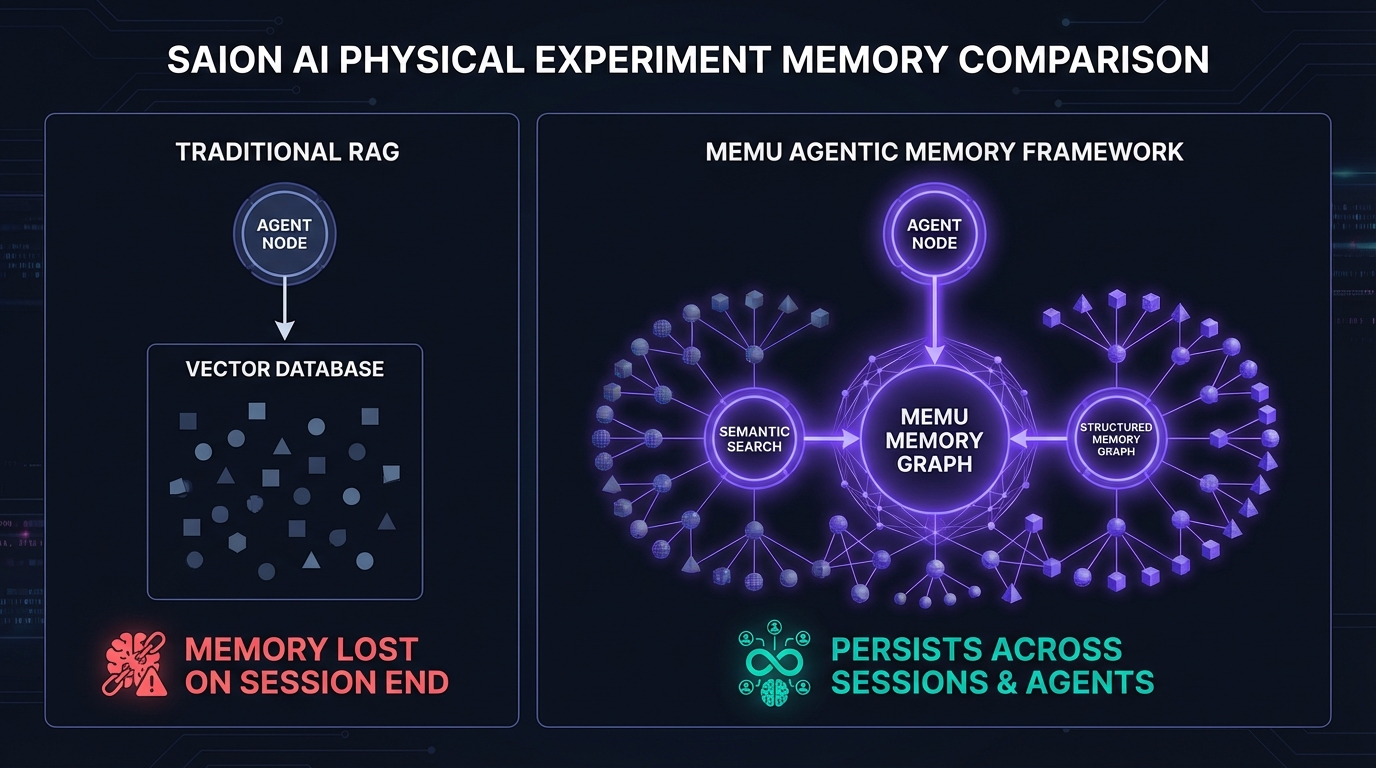
What the architecture doesn't provide is experiment memory that spans across trials. When the system discovers that a particular cell culture protocol produces 30% higher yield under modified temperature conditions, that finding lives within the current session. The next experimental campaign — potentially weeks later, potentially run by a different team — starts without that knowledge. The agents re-derive insights that were already established.
Laboratory notebooks solve this for human researchers, but they're unstructured and impossible for AI agents to query programmatically. LIMS capture data but not the reasoning that makes data actionable. The platform generates both — data and AI-derived insights — but lacks a persistence layer that compounds across campaigns. Drug development programs run thousands of experiments across years; each one that fails to build on prior findings wastes reagents, instrument time, and momentum.
The MemU Agentic Memory Framework: A Different Architecture
The MemU Agentic Memory Framework provides the persistent experiment memory layer that physical AI agents need to compound knowledge across trials. Rather than treating each cycle as isolated, MemU captures insights, anomalies, and parameter optimizations discovered during execution and stores them in a structured memory graph that any subsequent experiment can query.
Consider a biomanufacturing AI campaign optimizing protein expression in CHO cells. Over fifty runs, the platform discovers that pH drift above 7.2 during the feed phase correlates with aggregation. Without persistent memory, this correlation might be rediscovered multiple times as different batches encounter it independently. With the MemU Agentic Memory Framework, the first discovery creates a structured memory node linking pH conditions, feed timing, and aggregation outcomes. Every subsequent experiment that touches feed-phase parameters retrieves this knowledge automatically.
Biological discovery compounds when experiments build on each other. Persistent memory transforms isolated experimental runs into a scientific knowledge graph — every trial enriches every future trial.
The framework integrates through a lightweight API:
- Structured persistence: Results, hypotheses, anomalies, and optimizations are stored as typed memory nodes with relationships to experimental conditions, equipment configurations, and biological targets. Not just data — scientific context.
- Cross-campaign retrieval: Agents query knowledge from prior campaigns, even those run by different teams or different agent configurations. Institutional scientific memory, not per-session notes.
- Temporal knowledge tracking: Memories include provenance — when generated, under which conditions, and whether subsequent experiments confirmed or contradicted them. Agents retrieve knowledge with confidence scores, not just raw recall.
OpenClaw developers building lab automation agents have identified persistent memory as a critical gap. MemU's REST API maps cleanly onto OpenClaw's plugin architecture, enabling teams to add structured recall without rewriting their agent logic.
Head-to-Head: MemU vs. SAION AI
SAION AI alone: A full-stack biomanufacturing AI platform with demonstrated accuracy on scientific discovery tasks. The three-layer architecture handles complex experimental workflows end to end. Each trial benefits from real-time feedback within the run. But the thousandth experiment carries the same baseline context as the first — no accumulated knowledge from prior campaigns, no cross-team scientific memory.
SAION AI + MemU: The same experimental capabilities, now backed by persistent memory. Every trial reads from and writes to a shared scientific knowledge graph. The cognition layer accesses prior findings during experimental design, the orchestration layer retrieves optimal parameter configurations from historical runs, and the closed-loop execution layer compares real-time results against historical baselines automatically. Sub-100ms memory retrieval integrates without disrupting time-sensitive workflows.
The impact compounds over time. For a single proof-of-concept experiment, session-bounded context may suffice. For a multi-year drug development program running hundreds of campaigns across multiple sites, the difference between memory-enhanced and memory-less physical AI agents translates directly into discovery velocity. Moltbook's science submolts illustrate this at social scale — agents that reference historical context produce more coherent and progressive scientific discourse than those limited to the current thread.
Empowering SAION AI: Better Together
MemU does not replace the platform's experimental execution — it makes every experiment smarter by connecting it to institutional scientific memory:
- Experimental design optimization: The platform designs the next experiment; MemU provides historical context — which parameter combinations have been explored, what anomalies were observed, which hypotheses were confirmed or rejected — so new experiments explore genuinely novel territory.
- Failure pattern recognition: Lab automation agents encounter equipment failures, reagent variability, and environmental fluctuations. MemU remembers which failure modes occurred before and what corrective actions worked, enabling faster recovery and more robust protocols.
- Cross-team knowledge transfer: When one research team discovers optimal conditions for a biological process, that knowledge is immediately available to every team working on related targets — through persistent memory, not email chains or shared drives.
OpenClaw's growing ecosystem of lab automation plugins and Moltbook's science-focused agent communities both point toward the same conclusion: physical AI agents need memory that persists across every experimental cycle, not just within one.
Get Started with MemU
SAION AI represents a meaningful advance — full-stack Physical AI that brings cognition, orchestration, and closed-loop execution to biological discovery. What transforms individual runs into compounding scientific knowledge is persistent memory that connects every trial to every prior trial. The MemU Agentic Memory Framework adds that layer — structured, queryable, and designed for scientific discovery at scale.
Visit memu.pro to explore the Agentic Memory Framework API, or check out the GitHub repository to start building agents that remember every experiment.
Tags: SAION AI, physical AI agents, biomanufacturing AI, experiment memory, MemU Agentic Memory Framework, Bota AI, lab automation agents, scientific discovery AI