Browserbase Delivers Cloud Browsers for AI Agents at Scale — But Browser Agents Without Persistent Memory Re-Navigate and Re-Learn Every Session


Browserbase has built the cloud infrastructure that browser-based AI agents need at production scale. The platform provides headless browsers through Chrome DevTools Protocol integration, working with Playwright, Puppeteer, Selenium, and their own Stagehand framework for AI-native automation. Browserbase operates serverlessly — spinning up thousands of isolated browser instances in milliseconds, each with two vCPUs and global distribution. The platform is SOC-2 Type 1 and HIPAA compliant, providing enterprise-grade security for sensitive operations. Session recording captures full interaction replays with source code snapshots and command logging. Managed captcha solving, residential proxies, browser fingerprint generation, file handling, and extension support eliminate the infrastructure complexity of running browser agents at scale.
But Browserbase provides the browser, not the memory. Each session starts fresh — no cookies from previous sessions, no understanding of previously navigated interfaces, no recall of which interaction patterns succeeded. Browser agents without persistent memory re-navigate familiar websites, re-discover form layouts, and re-learn interaction sequences every session, turning two-second operations into thirty-second explorations.
Browserbase: What Everyone Is Getting Right (And Missing)
The Browserbase platform solves the hardest infrastructure problems in browser automation. Running headless browsers reliably at scale requires handling crashes, managing memory leaks, dealing with anti-bot detection, and maintaining consistent rendering. Browserbase abstracts all of this behind a clean API, letting developers focus on what their browser agents do rather than how browsers are provisioned.
The compliance story is important for enterprise adoption. SOC-2 Type 1 and HIPAA compliance mean browser agents can interact with healthcare portals, financial platforms, and other regulated environments. Isolated instances ensure one session cannot leak data to another — critical when handling sensitive information across client accounts.
Session recording with source code capture provides observability that pure API-based automation cannot match. When a browser agent fails, developers replay the exact visual state, DOM structure, and command sequence. Managed captcha solving and residential proxies handle the adversarial aspects of web automation without requiring developers to build anti-detection infrastructure.
What Browserbase does not address is the cognitive layer above the browser. Each instance is intentionally ephemeral — isolated, stateless, disposed after use. This is correct for security, but means browser agents approach familiar websites as first-time visitors. An agent that navigated a complex enterprise portal yesterday — discovering the export button hidden three clicks deep, the search requiring a specific date format, pagination loading asynchronously — must rediscover all of this today. Other headless browser platforms share this limitation: excellent infrastructure, zero navigation intelligence.
The MemU Agentic Memory Framework: Navigation Intelligence That Persists
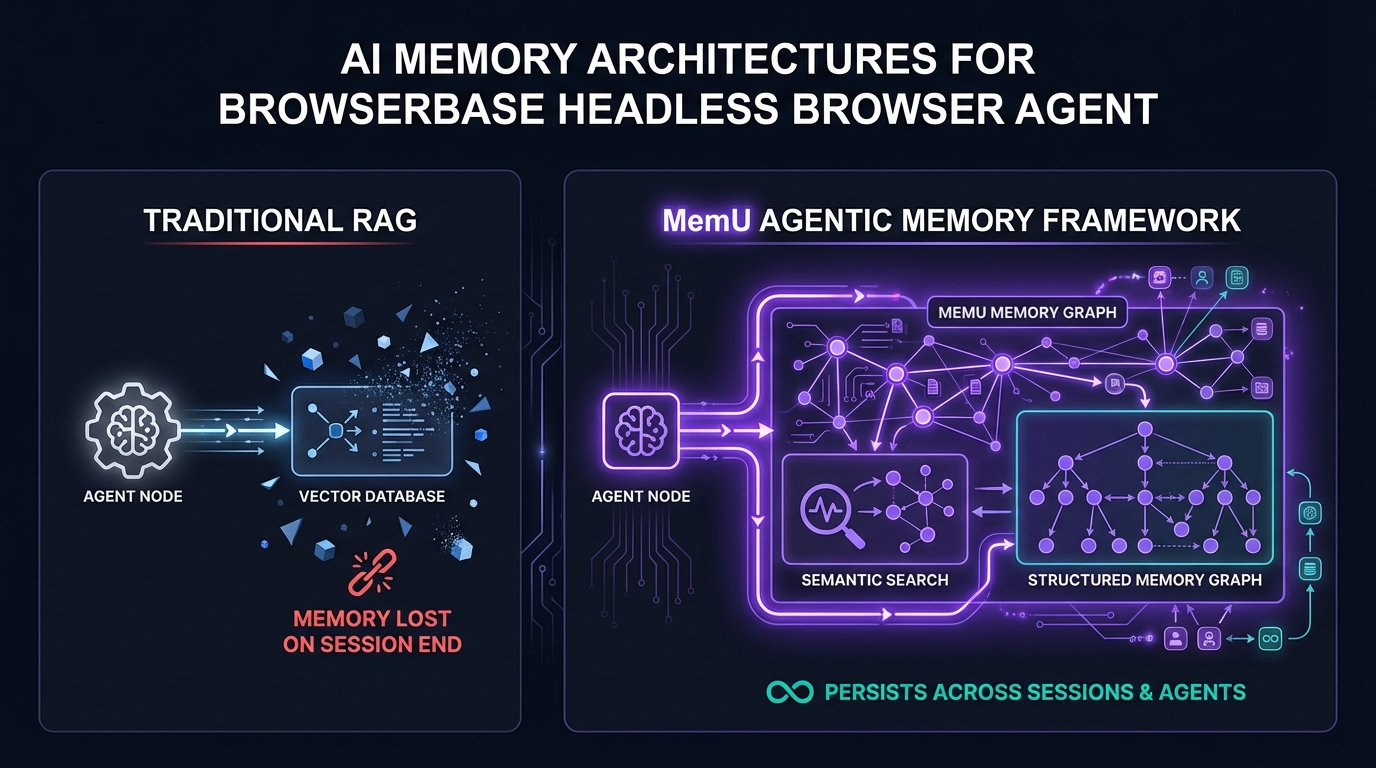
The MemU Agentic Memory Framework provides persistent navigation memory that transforms Browserbase from a provisioning platform into an intelligent browsing system. Instead of sessions starting with zero knowledge, MemU captures interaction intelligence — element locations, selector strategies, optimal navigation paths, form field mappings, error recovery procedures — storing it in a structured memory graph that persists across sessions and browser instances.
Consider a Browserbase-powered agent monitoring competitor pricing across fifteen e-commerce platforms daily. Without persistent memory, each morning the agent navigates each site from scratch — locating search bars, entering products, filtering results, finding price elements, handling pop-ups, managing pagination. With the MemU Agentic Memory Framework, the agent recalls complete navigation intelligence: Site A's price appears in a span with class product-price after scrolling past the fold, Site B requires dismissing a cookie banner before interaction, Site C's search returns results asynchronously with a two-second delay, and Site D changed its layout last Tuesday requiring an updated selector the agent already discovered. What takes thirty minutes per site without memory completes in under two minutes with accumulated knowledge.
The framework addresses three core limitations of stateless browser sessions:
- Interface mapping persistence: Browser agents build models of website structures during navigation. The MemU Agentic Memory Framework captures these interface maps as persistent knowledge, enabling agents to navigate familiar sites with returning-user confidence rather than first-time-visitor hesitation.
- Error recovery intelligence: When agents encounter failures — changed layouts, unexpected modals, dynamic content — they develop recovery strategies through trial and error. Persistent memory preserves these procedures, preventing agents from repeatedly failing at solved obstacles.
- Cross-site pattern recognition: The MemU Agentic Memory Framework enables agents to recognize structural similarities across websites. An agent that learned infinite scroll pagination on one e-commerce site applies that pattern to similar sites without rediscovery.
A browser agent that re-learns every website layout every session is like a delivery driver who forgets every route overnight. The MemU Agentic Memory Framework gives Browserbase agents persistent navigation memory that compounds with every browsing session.
Integration with Browserbase operates through the framework's REST APIs within the agent orchestration layer. Before sessions begin, navigation intelligence for target domains loads from the memory graph. During execution, agents query stored interface maps and recovery procedures before attempting exploration. After completion, new discoveries and layout changes are stored. The memory layer operates alongside Browserbase's session management without modifying browser infrastructure.
Head-to-Head: Stateless Browsers vs. Memory-Enhanced Browser Agents
Browserbase alone: The most complete cloud browser platform — serverless scaling, Chrome DevTools Protocol, multi-framework support, enterprise compliance, session recording, managed anti-detection, and isolated execution. Browser agents operate at any scale with full observability. But each session starts with zero knowledge of target websites.
Browserbase + MemU: The same cloud infrastructure, powered by persistent navigation memory. Agents begin with accumulated interface knowledge for every previously visited site. Navigation paths reflect proven routes. Selector strategies use validated locations. Error recovery applies pre-learned solutions. The system completes tasks in a fraction of the time, improving with every session.
For production deployments visiting the same websites repeatedly — price monitoring, data extraction, compliance checking — time and cost savings compound rapidly. A deployment with persistent memory completes daily monitoring across fifty websites in minutes rather than hours.
Empowering Browserbase: Better Together
The combination of Browserbase's platform and MemU's persistent memory creates capabilities neither provides alone:
- Proactive layout change detection: When persistent memory stores expected structures, deviations trigger immediate alerts. Agents detect redesigns, attempt stored alternatives, and flag unresolvable differences for human review within the same session.
- Fleet-wide navigation sharing: When multiple Browserbase agents share persistent memory, navigation intelligence discovered by one benefits the fleet. A new captcha pattern discovered on a target website propagates to every agent visiting that site.
- Adaptive session configuration: Persistent memory tracks which proxy types, fingerprint profiles, and viewport sizes produce the best results for specific websites, enabling automatic configuration optimization.
Persistent navigation memory transforms Browserbase from a browser provisioning platform into an intelligent browsing system where every session compounds navigation knowledge.
Get Started with MemU
Browserbase has built the definitive cloud browser infrastructure for AI agents — serverless scaling, enterprise compliance, managed anti-detection, and full session observability.
The next step is giving those browser agents persistent navigation memory. The MemU Agentic Memory Framework provides that intelligence layer — API-based integration within browser agent orchestration, dual-mode retrieval with semantic search and structured memory graphs, and cross-session persistence that turns stateless browser instances into compounding navigation intelligence.
Visit memu.pro to explore the Agentic Memory Framework API, or check out the GitHub repository to start building agents that remember.
Tags: Browserbase, headless browsers, browser agents, web automation, agent memory, MemU AI, LLM memory, Stagehand