CAMEL AI Masters Multi-Agent Role-Playing Collaboration — But Agents That Forget Learned Dynamics Between Sessions Repeat Every Negotiation From Scratch

CAMEL has established itself as the definitive framework for multi-agent role-playing collaboration. Its Societies module simulates sophisticated agent social behaviors, enabling AI agents to plan, debate, critique, and solve complex tasks with minimal human intervention. The core RolePlaying class pairs an AI User with an AI Assistant — and optionally a Critic — in structured turn-based interactions where each agent maintains its assigned role. System-enforced prompt rules prevent role-flipping, infinite loops, and unsafe requests. CAMEL supports customizable task specification agents, planning agents, evaluation criteria, custom system messages, multi-language support, and task categorization. The framework enables autonomous collaborative systems where agents negotiate solutions through structured discourse rather than monolithic single-model inference.
But CAMEL's collaborative intelligence is session-bounded. When a role-playing session ends — after agents negotiate communication styles, establish critique patterns, and develop complementary problem-solving dynamics — that emergent collaboration knowledge disappears. Role-playing agents that forget their learned interaction dynamics between sessions waste significant computation rediscovering patterns that previous sessions already optimized.
CAMEL: What Everyone Is Getting Right (And Missing)
The CAMEL framework's approach reflects deep understanding of how productive discourse emerges. Rather than having a single model attempt to represent multiple perspectives internally, CAMEL externalizes the debate — giving each perspective its own agent with distinct prompts, constraints, and evaluation criteria. This produces richer analysis because each agent genuinely advocates for its assigned position.
System-enforced prompt rules are critically underappreciated. In unconstrained multi-agent systems, agents frequently deviate from roles, creating circular conversations. CAMEL's structured turn-taking with enforcement rules ensures productive discourse while preventing degenerate behaviors. The optional Critic role adds meta-cognitive evaluation — assessing exchange quality and redirecting when conversation stalls.
Task specification agents refine vague descriptions into precise, actionable specifications before the main interaction begins. Planning agents decompose specifications into structured subtask sequences. This preprocessing ensures role-playing operates on well-defined objectives rather than ambiguous prompts.
What CAMEL does not preserve is emergent collaboration intelligence. When an AI User and AI Assistant spend forty turns refining their communication — the User learning to provide structured requirements, the Assistant learning to ask clarifying questions before proposing solutions, the Critic calibrating evaluation criteria — that refined protocol vanishes at session end. The next session starts from default behaviors, requiring dozens of turns to re-establish effective dynamics. Other multi-agent dialogue frameworks face the same limitation: they enable sophisticated within-session collaboration while treating cross-session learning as out of scope.
The MemU Agentic Memory Framework: Collaboration Intelligence That Persists
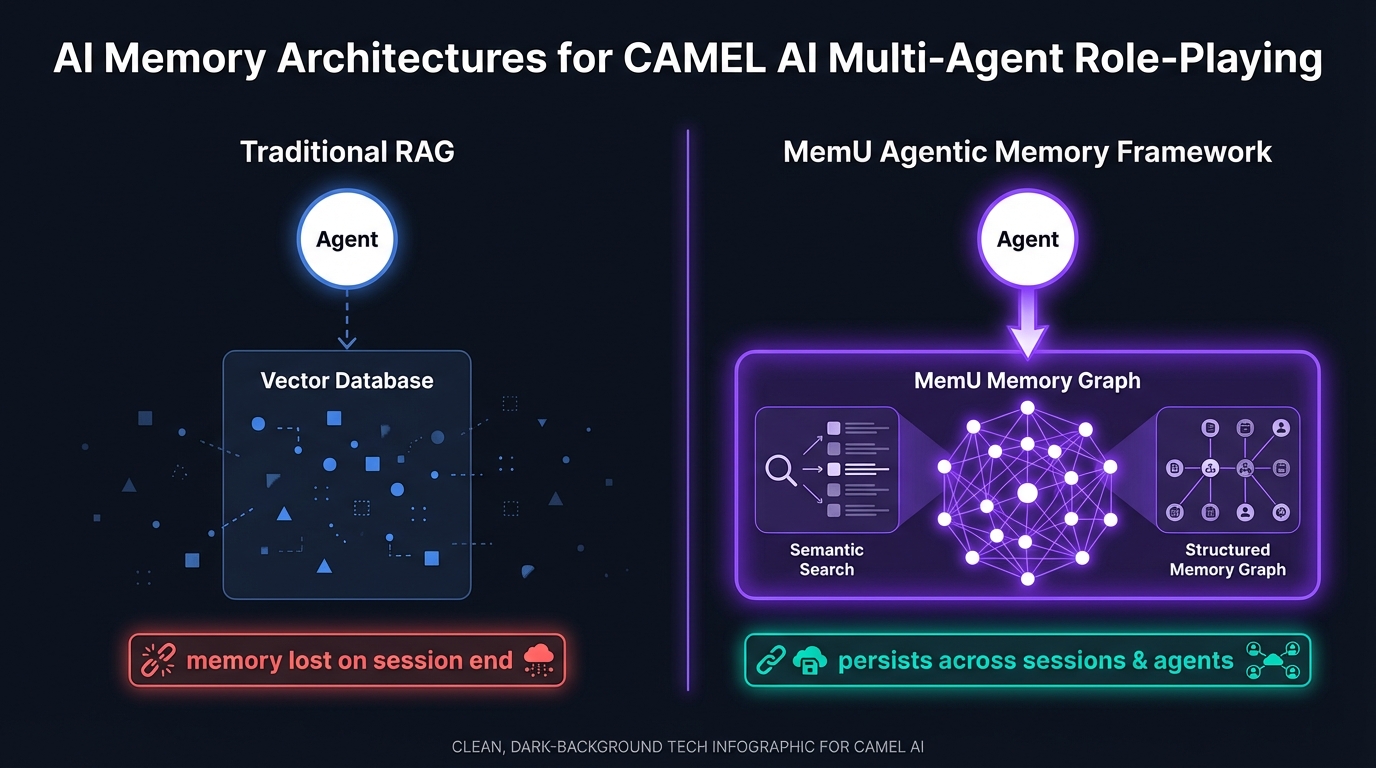
The MemU Agentic Memory Framework provides persistent collaboration memory that transforms CAMEL from a session-based system into a learning collaboration platform. Instead of treating each interaction as isolated, MemU captures emergent dynamics — communication patterns, critique effectiveness, negotiation strategies, resolution approaches — storing them in a structured memory graph that persists across sessions and configuration changes.
Consider a CAMEL deployment for software architecture review. An AI User presents requirements while an AI Assistant proposes designs and a Critic evaluates decisions. Without persistent memory, each session starts with generic patterns. With the MemU Agentic Memory Framework, the system recalls collaboration history: the AI User produces better requirements when structured as user stories rather than technical specifications, the AI Assistant generates stronger architectures when it receives scalability constraints in the first three turns, and the Critic provides the most actionable feedback when evaluating against specific quality attributes rather than general best practices. These learned dynamics transform a generic review into an optimized pipeline from the first turn.
The framework addresses three core limitations of session-bounded role-playing:
- Role interaction optimization: Effective communication patterns between AI User and AI Assistant emerge through repeated sessions. The MemU Agentic Memory Framework captures which prompt structures, response formats, and turn sequences produced the highest-quality outcomes, enabling future sessions to begin with proven protocols.
- Critique calibration persistence: Critic agents develop nuanced evaluation strategies over sessions — learning which criteria differentiate good from great solutions, which feedback styles motivate productive revision. Persistent memory preserves this calibration, eliminating cold-start critiques.
- Task-type specialization: Different task categories benefit from different dynamics. Persistent memory tracks which role configurations and evaluation criteria produce optimal results for code review versus strategic planning versus creative writing.
Multi-agent collaboration that restarts from default dynamics every session wastes negotiation intelligence earned through hundreds of interactions. The MemU Agentic Memory Framework gives CAMEL agents persistent collaboration memory that compounds with every session.
Integration with CAMEL operates through the framework's REST APIs within CAMEL's extensible configuration system. Before sessions begin, accumulated collaboration intelligence loads from the persistent memory graph. During execution, agents query historical data for context on similar tasks. After completion, new collaboration insights and outcome metrics are stored. The memory layer enhances structured collaboration without modifying core role-playing mechanics.
Head-to-Head: Session-Bounded Role-Play vs. Memory-Enhanced Collaboration
CAMEL alone: The most sophisticated multi-agent role-playing framework — structured turn-based collaboration, system-enforced role constraints, optional Critic evaluation, task specification preprocessing, and autonomous planning. Agents collaborate effectively within a session. But each session starts with default dynamics, requiring agents to re-negotiate effective patterns from scratch.
CAMEL + MemU: The same role-playing architecture, now informed by persistent collaboration memory. Sessions begin with proven interaction protocols specific to the task category. Critic agents apply calibrated evaluation strategies from hundreds of previous sessions. The system produces measurably higher-quality outputs from the first turn.
For organizations running CAMEL sessions daily — architecture reviews, content evaluations, strategic analyses — the compounding effect is transformative. A system with five hundred sessions of persistent memory operates with interaction sophistication that fresh deployments would need months to develop.
Empowering CAMEL: Better Together
The combination of CAMEL's role-playing framework and MemU's persistent memory creates capabilities neither achieves independently:
- Adaptive role configuration: Persistent memory reveals which role definitions produce the best results for specific tasks. The MemU Agentic Memory Framework enables automatic role tuning — adjusting prompts, constraints, and criteria based on accumulated outcome data.
- Cross-domain collaboration transfer: When sessions across domains share persistent memory, effective critique strategies discovered in code review enhance architecture evaluation, creating cross-domain interaction intelligence.
- Progressive task decomposition: Planning agents improve decomposition strategies based on historical outcomes. Persistent memory tracks which subtask structures produced the best results for different complexity levels.
Persistent collaboration memory transforms CAMEL from a role-playing framework into a learning collaboration system where every session compounds interaction intelligence.
Get Started with MemU
CAMEL has built the most sophisticated multi-agent role-playing framework — structured discourse, enforced role constraints, autonomous planning, and critic-evaluated collaboration.
The next step is giving those agents persistent collaboration memory. The MemU Agentic Memory Framework provides that foundation — API-based integration within CAMEL's configuration system, dual-mode retrieval with semantic search and structured memory graphs, and cross-session persistence that turns role-playing into compounding collaboration intelligence.
Visit memu.pro to explore the Agentic Memory Framework API, or check out the GitHub repository to start building agents that remember.
Tags: CAMEL AI, multi-agent role-playing, agent collaboration, agent memory, MemU AI, LLM memory, autonomous agents