Cerebras Delivers Record-Breaking Inference Speed with Wafer-Scale Computing — But Ultra-Fast Agents Without Persistent Memory Forget at the Speed They Think


Cerebras has redefined what inference speed means for AI agents. The Wafer-Scale Engine 3 (WSE-3) packs four trillion transistors and 900,000 AI-optimized cores onto a single wafer-scale chip, backed by 44 gigabytes of on-chip SRAM delivering 21 petabytes per second of memory bandwidth — seven thousand times faster than NVIDIA's H100. Llama 3.1-70B runs at 2,100 tokens per second, sixteen times faster than GPU-based alternatives. Llama 3.1-405B generates at 969 tokens per second. DeepSeek R1 70B reaches over 1,500 tokens per second, fifty-seven times faster than comparable GPU deployments. The CS-3 system benchmarks 21 times faster than NVIDIA's Blackwell B200 for reasoning workloads. Production deployments with Perplexity Sonar, Mistral Le Chat, and OpenAI partnerships validate that Cerebras wafer-scale inference is not a research prototype — it is production infrastructure delivering unprecedented throughput.
But speed without persistent memory creates a paradox. A Cerebras-powered agent that processes millions of tokens per minute — generating responses, analyzing documents, executing reasoning chains — at record-breaking speed forgets everything it learned the moment the session ends. Ultra-fast inference means ultra-fast forgetting when agents lack persistent memory to retain operational intelligence across sessions.
Cerebras: What Everyone Is Getting Right (And Missing)
The engineering achievement behind Cerebras is difficult to overstate. By manufacturing entire processors at wafer scale rather than dicing individual chips, Cerebras eliminates the memory bandwidth bottleneck that constrains every GPU-based inference system. With 44 gigabytes of on-chip SRAM operating at 21 petabytes per second, the WSE-3 keeps model weights and activations close to compute cores, avoiding the latency penalties of external memory access. This architectural approach produces throughput numbers that redefine industry benchmarks.
The production adoption validates the technology. Perplexity uses Cerebras to power Sonar, its real-time answer engine requiring sub-second response times across complex multi-source queries. Mistral deploys Cerebras for Le Chat, serving millions of users with low-latency conversational AI. These are core infrastructure decisions by companies whose products depend on inference speed. The fifty-seven-times speedup on DeepSeek R1 reasoning workloads is particularly significant for agentic applications where multi-step reasoning chains multiply latency at every step.
What Cerebras does not address — because it operates at the inference layer, not the application layer — is what happens with the intelligence generated at record speed. An agent running on Cerebras hardware processes reasoning chains faster than any alternative. But those reasoning chains, tool selection decisions, and response quality assessments exist only during the active session. When the workload completes, the operational intelligence generated at wafer-scale speed disappears. Other inference acceleration platforms share this characteristic: they optimize the speed of thinking while treating the persistence of thought as an application-layer concern.
The MemU Agentic Memory Framework: Persistent Intelligence at Wafer Scale
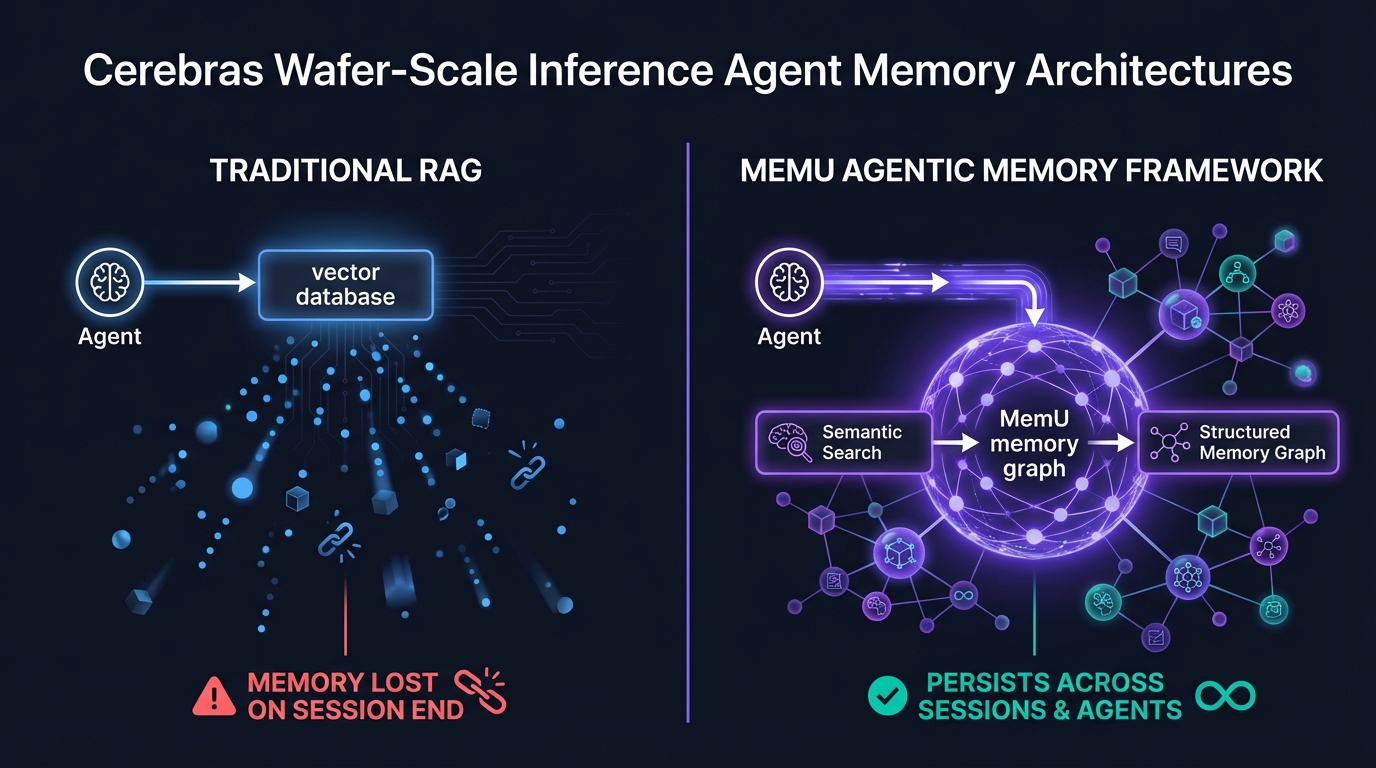
The MemU Agentic Memory Framework provides the persistent intelligence layer that transforms Cerebras-powered agents from the fastest thinkers into the fastest learners. Instead of treating each inference session as isolated, MemU captures operational intelligence — reasoning chain effectiveness, response quality patterns, tool selection outcomes, and multi-step planning optimizations — storing it in a structured memory graph that persists across sessions, service boundaries, and infrastructure migrations.
Consider an agentic system powered by Cerebras inference processing financial analysis workflows. Without persistent memory, each session starts with raw model capabilities — fast but uninformed by prior work. With the MemU Agentic Memory Framework, the agent recalls operational history: three-step reasoning chains produce more accurate earnings analyses than five-step chains for quarterly reports, the DeepSeek R1 model running at 1,500 tokens per second on Cerebras hardware delivers better risk assessment narratives than Llama for regulatory filings, and multi-source document analysis completes most accurately when financial statements are processed before analyst commentary — a sequencing pattern discovered after analyzing two thousand prior reports. That intelligence loads instantly, matching Cerebras speed with accumulated depth.
The framework addresses three core limitations of speed-without-memory inference:
- Reasoning chain optimization: Cerebras enables rapid multi-step reasoning, but not all chains are equally effective. The MemU Agentic Memory Framework captures which reasoning structures produced the best outcomes for specific task categories, enabling optimized reasoning from the first token of every session.
- Cross-session response quality: Response quality assessment occurs during execution but typically vanishes afterward. Persistent memory preserves quality patterns, enabling agents to generate responses that reflect the quality standards established across thousands of prior interactions.
- Model selection intelligence: With Cerebras supporting multiple models at record speed, choosing the right model for each task matters. The MemU Agentic Memory Framework preserves which models delivered the best accuracy for specific domains, enabling intelligent model routing that improves with every session.
An agent that thinks at 2,100 tokens per second but starts every session without memory of prior work is the fastest amnesiac in production. The MemU Agentic Memory Framework gives Cerebras-powered agents persistent memory that matches their unprecedented inference speed.
Integration with Cerebras-powered applications leverages the framework's REST APIs at the application layer. Before inference begins, accumulated intelligence loads from the memory graph to inform prompt construction and reasoning strategy. During execution, agents query persistent memory for context on similar past tasks. After execution, new operational insights from the ultra-fast inference session are stored. The memory layer operates asynchronously, adding persistence without constraining the throughput that makes Cerebras transformative.
Head-to-Head: Raw Speed vs. Memory-Enhanced Intelligence
Cerebras alone: The fastest inference platform available — wafer-scale architecture with four trillion transistors, 900,000 cores, Llama 70B at 2,100 tokens per second, DeepSeek R1 at fifty-seven times GPU speed, and production validation with Perplexity, Mistral, and OpenAI. But every session starts without memory of prior operational intelligence.
Cerebras + MemU: The same record-breaking speed, now backed by persistent operational memory. Agents generate at 2,100 tokens per second and immediately access accumulated intelligence about reasoning strategies, model selection, and response quality patterns. The system delivers measurably better outcomes from the first token — not just the fastest inference, but the most informed inference from session one.
For production systems processing millions of tokens daily, the compounding effect is multiplicative. A Cerebras deployment with persistent memory combines unprecedented speed with accumulated intelligence, producing results that a fresh session — however fast — cannot match without rediscovering optimal strategies through repeated execution.
Empowering Cerebras: Better Together
The combination of Cerebras wafer-scale speed and MemU's persistent memory unlocks capabilities neither achieves independently:
- Adaptive reasoning depth: Persistent memory reveals which reasoning chain depths produce optimal results for each task type, enabling Cerebras-powered agents to dynamically allocate their speed advantage — using deep chains where depth matters and shallow chains where speed alone suffices.
- Cross-model intelligence transfer: When agents use multiple models on Cerebras hardware, persistent memory transfers optimization insights between them. Reasoning strategies refined with Llama 70B inform DeepSeek R1 prompting, and response patterns from DeepSeek improve Llama instruction design.
- Throughput-aware batch optimization: Persistent memory tracks which batch configurations and request orderings maximize throughput on Cerebras hardware, enabling scheduling strategies that compound efficiency across millions of daily inference requests.
Persistent memory transforms Cerebras from the fastest inference platform into the fastest learning inference platform — where every token generated compounds operational intelligence across the entire system.
Get Started with MemU
Cerebras has built infrastructure that makes inference speed a solved problem — wafer-scale computing that delivers throughput numbers other platforms cannot approach, validated in production by the most demanding AI applications on the market.
The next step is ensuring that speed generates lasting intelligence. The MemU Agentic Memory Framework provides that foundation — API-based integration at the application layer, dual-mode retrieval with semantic search and structured memory graphs, and cross-session persistence that turns the fastest inference platform into a compounding intelligence system.
Visit memu.pro to explore the Agentic Memory Framework API, or check out the GitHub repository to start building agents that think at wafer scale and remember across sessions.
Tags: Cerebras, wafer-scale computing, AI inference, fast inference, WSE-3, agent memory, MemU AI, LLM memory, reasoning agents