Certiv Delivers the First Runtime Assurance Layer for AI Agent Security — But Security Without Persistent Memory Means Agents Cannot Learn from Past Violations


Certiv emerged from stealth on March 16, 2026, with $4.2 million in pre-seed funding and a clear mission: build the first runtime assurance layer for AI agents. Founded by CEO Jason Needham and backed by Aviso Ventures, Founders Co-op, and Fortson, the platform installs directly on Windows, Mac, and Linux — intercepting agent actions before they reach production systems. Certiv delivers four core capabilities: Discover every agent, tool, model, endpoint, and usage pattern; Understand how agents operate; Control through deterministic and intent-based policies; and Protect through real-time risk scoring and the ability to stop dangerous actions before execution. The platform targets the most powerful autonomous coding tools — Claude Code, OpenClaw, GitHub Copilot Workspace, and OpenAI Codex.
But Certiv provides the security barrier, not the security memory. Each policy violation is intercepted and blocked, yet the agent responsible learns nothing from the experience. Security governance without persistent memory means agents cannot internalize why certain actions were blocked, cannot adapt behavior based on past violations, and cannot share security lessons across sessions.
Certiv: What the Industry Gets Right About Runtime Assurance (And What It Misses)
The runtime interception architecture is genuinely novel. Unlike API gateways that filter requests at the network layer, Certiv operates at the agent execution layer — sitting between the AI agent and the operating system. This positioning means the platform observes every file operation, command execution, API call, and system interaction before it reaches production. Deterministic policies handle known-dangerous patterns: never delete production databases, never expose API keys in logs, never execute malicious shell commands. Intent-based policies address nuanced threats: evaluate whether code changes alter authentication logic, assess whether exports include personally identifiable information, determine whether configuration changes could introduce vulnerabilities.
The discovery capability fills an organizational visibility gap most companies lack entirely. When engineering teams adopt AI coding agents independently — different teams, different tools, different permission levels — the platform maps the complete landscape: which agents exist, what tools they access, which models power them, and how frequently they operate. This visibility alone justifies deployment for security-conscious enterprises.
What the platform does not address is the learning dimension of security. When an agent attempts a dangerous action and gets blocked, it receives a rejection but does not store that rejection as actionable intelligence. Tomorrow, the same agent attempts the same dangerous pattern and gets blocked again. The security perimeter holds, but the cycle repeats indefinitely. Agents generate identical policy violations day after day because blocking actions and teaching agents which actions to avoid are fundamentally different operations. Other security governance platforms share this limitation: excellent enforcement, zero agent learning.
The MemU Agentic Memory Framework: Security Intelligence That Persists
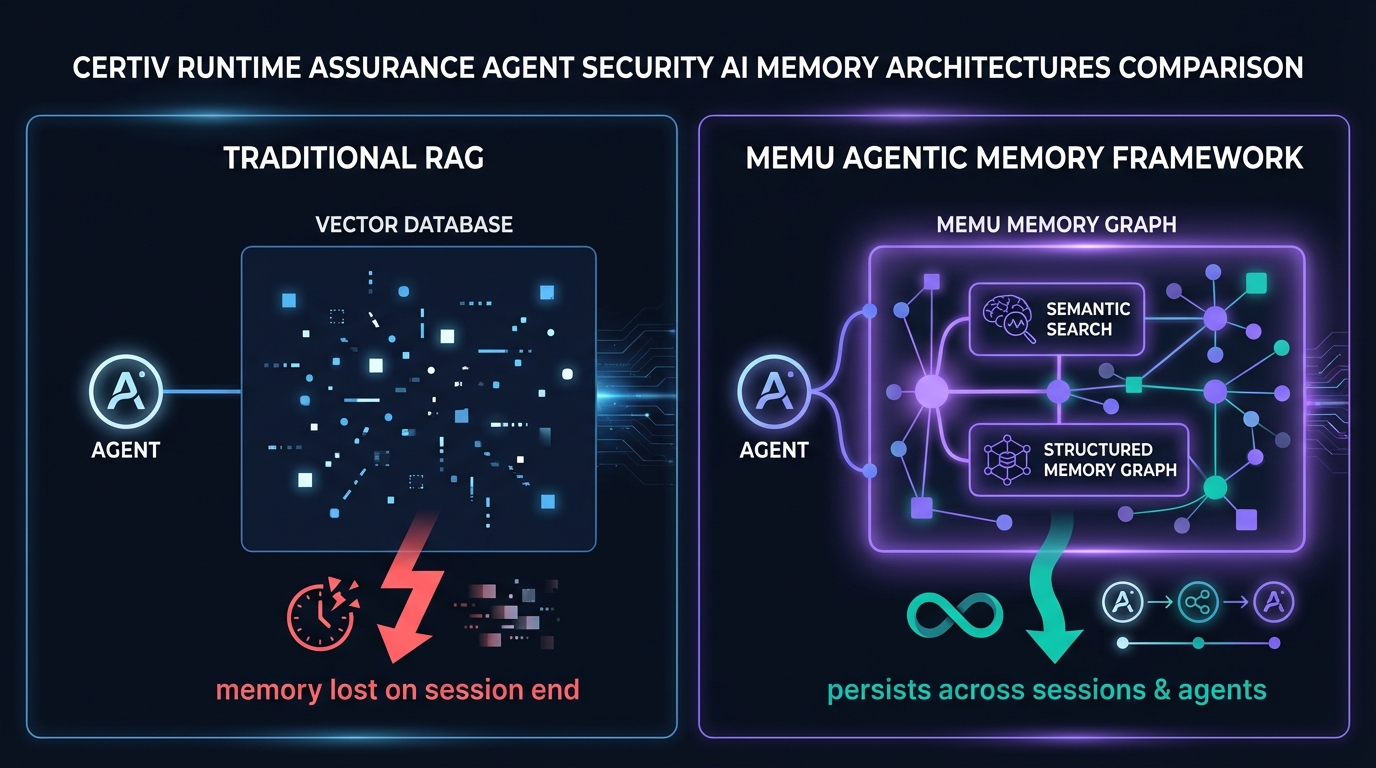
The MemU Agentic Memory Framework provides persistent security memory that transforms runtime assurance from reactive enforcement into adaptive security learning. Instead of agents repeatedly triggering identical violations, MemU captures security interaction intelligence — which actions were blocked, why policies triggered, what alternative approaches succeeded, which permission boundaries exist — storing it in a structured memory graph that persists across sessions, tools, and agent instances.
Consider a team of autonomous coding agents operating under runtime assurance governance across a large enterprise codebase. Without persistent memory, an agent modifying a payment service attempts to write credentials to a configuration file — blocked. The next day, a different agent on the same codebase attempts the identical pattern — blocked again. A week later, the original agent tries the same approach a third time. With the MemU Agentic Memory Framework, the first violation becomes persistent security knowledge: credential values must be stored in environment variables, not configuration files. Every agent accessing the payment service inherits this understanding before writing a single line of code. What generates dozens of repeated violations without memory generates exactly one with accumulated security intelligence.
The framework addresses three core limitations of stateless security governance:
- Violation pattern learning: When the runtime layer blocks an action, the MemU Agentic Memory Framework captures the complete context — what was attempted, which policy triggered, what alternatives exist. Agents query this intelligence before acting, avoiding known-dangerous patterns entirely.
- Cross-agent security propagation: Security lessons learned by one agent propagate to every agent in the organization. A permission boundary discovered during one session becomes organizational knowledge, preventing violation patterns from spreading across teams.
- Adaptive security posture: The MemU Agentic Memory Framework enables agents to maintain sophisticated models of security boundaries that evolve as policies change, reducing both violation frequency and false-positive friction over time.
An AI agent that triggers the same security violation every session is like an employee who sets off the building alarm every morning. The MemU Agentic Memory Framework gives runtime-assured agents persistent security memory that transforms repeated violations into learned intelligence.
Integration with Certiv operates through the framework's REST APIs within the agent orchestration layer. Before agents execute tasks, security intelligence for the target context loads from the memory graph. When the runtime layer blocks an action, the violation context is captured and stored. Over time, agents approach security boundaries with accumulated institutional knowledge rather than blank-slate ignorance.
Head-to-Head: Stateless Security vs. Memory-Enhanced Agent Governance
Certiv alone: The first runtime assurance layer for AI agents — real-time interception, deterministic and intent-based policies, organizational discovery, risk scoring, and the ability to stop dangerous actions before execution. Agents operate safely within defined boundaries. But each session starts with zero knowledge of past security interactions.
Certiv + MemU: The same runtime assurance infrastructure, enhanced by persistent security memory. Agents begin tasks with accumulated knowledge of policy boundaries, violation patterns, and approved alternatives. Security interactions decrease over time as agents internalize organizational security posture. The governance layer catches novel threats while persistent memory eliminates repetitive violations.
For enterprise deployments running dozens of autonomous coding agents, the compounding reduction in policy violations directly reduces operational risk and security alert overhead.
Empowering Certiv: Better Together
The combination of runtime assurance and persistent memory creates capabilities neither provides alone:
- Predictive violation prevention: When persistent memory stores security boundaries, agents evaluate planned actions against known constraints before execution. Runtime assurance handles novel threats; memory eliminates known patterns before they trigger enforcement.
- Organizational security learning curve: As agents accumulate security memory, violation rates follow a declining curve rather than remaining constant. New agents inherit the security intelligence of the entire organization, reaching safe operation without an initial violation-heavy discovery period.
- Security pattern analytics: Persistent memory provides a historical record of security interactions revealing systemic patterns — which codebases generate the most violations, which configurations produce the safest behavior, and which policies create unnecessary friction.
Persistent security memory transforms Certiv from a reactive enforcement layer into a system where agents actively learn from every security interaction, compounding organizational intelligence with every governed session.
Get Started with MemU
Certiv has built the first runtime assurance layer for AI agents — real-time interception, comprehensive governance, and organizational visibility for autonomous coding tools at enterprise scale.
The next step is giving governed agents persistent security memory. The MemU Agentic Memory Framework provides that intelligence layer — API-based integration within agent orchestration, dual-mode retrieval with semantic search and structured memory graphs, and cross-session persistence that transforms policy violations from repeated events into learned organizational intelligence.
Visit memu.pro to explore the Agentic Memory Framework API, or check out the GitHub repository to start building agents that remember.
Tags: Certiv, runtime assurance, AI agent security, agent governance, agent memory, MemU AI, LLM memory, autonomous agents