ChatGPT Gov Reaches 3 Million Military Users — But Government AI Still Forgets Between Sessions


AI just got a government security clearance. ChatGPT Gov, deployed through the Pentagon's GenAI.mil platform, now serves 3 million military users alongside Google Gemini and xAI's Grok. The platform reached 1.1 million unique users within months of launch with no major technical issues. Across 3,500+ U.S. government agencies, over 90,000 users have sent 18 million messages through ChatGPT's government-specific deployment.
ChatGPT Gov runs on authorized government cloud infrastructure — Microsoft Azure Government — with compliance frameworks including FedRAMP High, IL5, CJIS, and ITAR. The platform provides enterprise features like administrative consoles, custom GPTs, and controlled data access. The Pentagon is pushing to extend AI tools to classified networks for mission-critical applications.
Government adoption of AI is accelerating. But every deployment faces the same fundamental constraint: AI assistants in government agencies forget everything between conversations.
ChatGPT Gov: What Secure Government AI Enables
The security architecture is the critical differentiator. ChatGPT Gov deploys within government cloud boundaries, meeting the compliance requirements that blocked standard ChatGPT from government use. Agencies self-host and manage their own security, privacy, and compliance — the data never leaves government-controlled infrastructure.
For government workflows, this unlocks substantial productivity gains. Policy analysts synthesize complex regulatory documents. Military planners draft operational briefs. Procurement officers analyze vendor proposals. Intelligence analysts process open-source information at scale. The 18 million messages across agencies demonstrate real, sustained usage — not pilot curiosity.
The Pentagon's push toward classified networks signals even deeper integration. Mission planning, logistics optimization, and operational analysis are all target use cases where AI assistance could dramatically accelerate government workflows.
The memory gap is acute in government contexts. A policy analyst using ChatGPT Gov to track a regulatory initiative across weeks of sessions must re-provide context every time. The procurement officer who spent three sessions analyzing a complex vendor proposal starts fresh in session four. Government work is inherently long-term and context-heavy — precisely the kind of work most harmed by session-scoped AI memory.
How ChatGPT Gov Handles Institutional Context
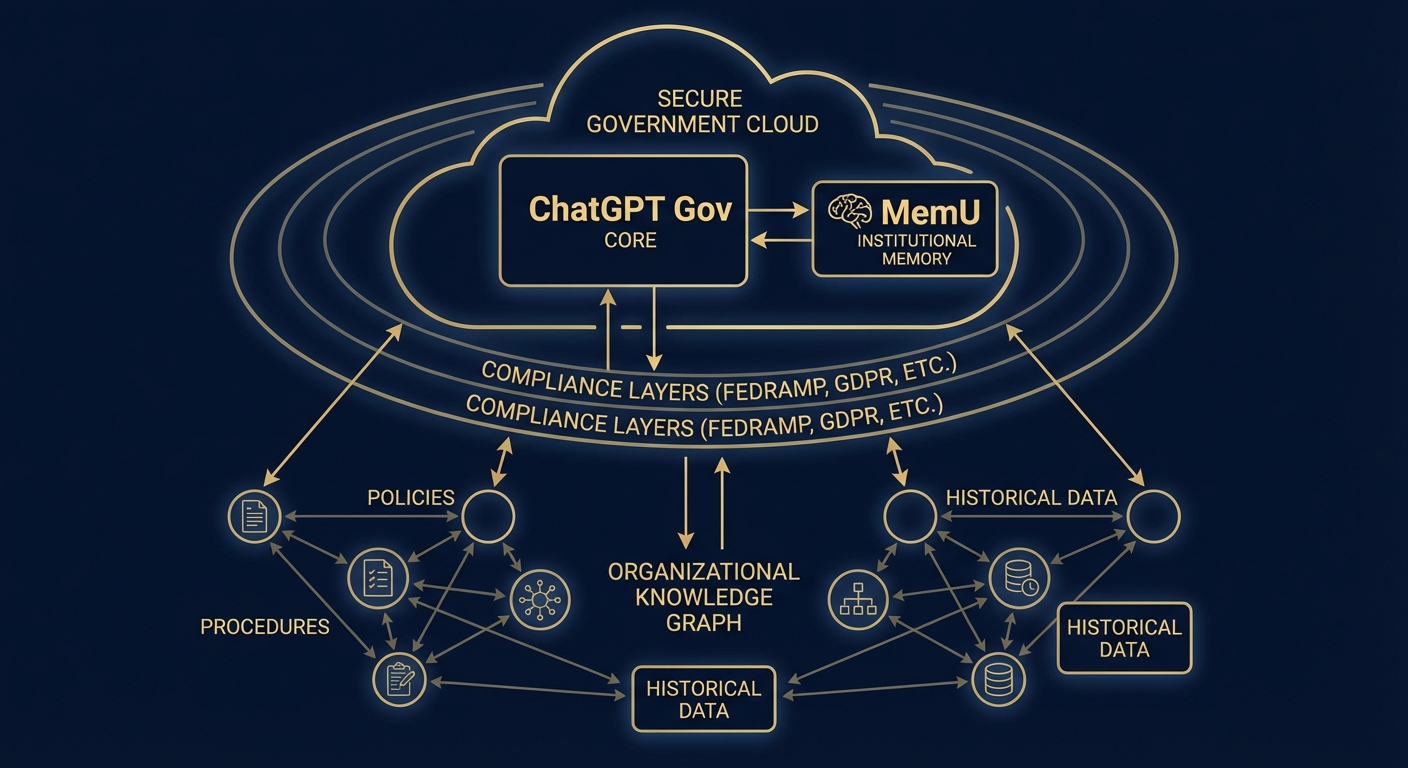
ChatGPT Gov provides the same session capabilities as ChatGPT Enterprise within government security boundaries. Within a conversation, the model maintains context, processes uploaded documents, and generates comprehensive responses. Custom GPTs allow agencies to create specialized assistants pre-configured for specific workflows.
Administrative controls enable IT teams to manage access, monitor usage, and enforce data handling policies. The compliance infrastructure ensures that interactions meet the stringent security requirements of government operations.
Cross-session institutional memory doesn't exist. The briefing context developed during Monday's session isn't available Thursday. The analysis approach that proved effective for one regulatory review must be re-specified for the next. Institutional knowledge — the accumulated understanding of how an agency handles specific types of work — lives in human analysts' minds, not in the AI system.
For military users, this constraint is particularly impactful. Operational context evolves continuously. The AI assistant that helped draft Tuesday's intelligence brief has no awareness of Monday's developments or Wednesday's updates. Each session exists in an operational vacuum.
The MemU Agentic Memory Framework: Secure Institutional Memory for Government AI
The MemU Agentic Memory Framework provides the institutional memory layer that government AI deployments critically need — with the security architecture to match government requirements.
Consider a defense logistics team using ChatGPT Gov for supply chain optimization. Week one's session analyzes current inventory levels. Week two evaluates supplier reliability. Week three models deployment scenarios. With ChatGPT Gov alone, each week requires re-establishing the analytical foundation. With the MemU Agentic Memory Framework, accumulated logistics intelligence carries forward — the model knows the inventory baseline, the supplier assessment, and the constraints already identified.
The architecture provides three capabilities for government contexts:
- Secure memory persistence: The MemU Agentic Memory Framework stores institutional knowledge within security boundaries, respecting the compliance requirements that government deployments demand.
- Analyst continuity: Government analysts working on long-term projects maintain context across sessions. Weeks of accumulated analysis inform current work rather than requiring manual re-specification.
- Organizational intelligence: When analysts rotate — as frequently happens in government — institutional knowledge persists. New team members inherit analytical context rather than starting from scratch.
MemU gives government AI the institutional memory that government work fundamentally requires — secure, persistent, and queryable.
Head-to-Head: Session-Scoped vs. Memory-Enhanced Government AI
ChatGPT Gov alone: Secure AI deployment with government compliance, administrative controls, and enterprise features. But each session is isolated — no institutional memory, no analytical continuity, no progressive knowledge accumulation.
ChatGPT Gov + MemU: Same security architecture plus persistent institutional memory. Long-term projects maintain context. Organizational knowledge accumulates. Sub-100ms retrieval means memory access never impedes response times. Government AI that actually supports the long-term, context-heavy nature of government work.
Get Started with MemU
ChatGPT Gov represents a milestone in government AI adoption. Three million military users and 3,500 agencies demonstrate that government-grade AI deployment is viable and valuable.
The MemU Agentic Memory Framework provides the institutional memory that makes government AI genuinely productive for long-term, context-dependent work. Analytical continuity across sessions. Organizational knowledge that survives analyst rotation. Secure persistence that matches government compliance requirements.
Visit memu.pro to explore the Agentic Memory Framework API, or check out the open-source repository on GitHub to start building institutional memory into your AI workflows today.