China Releases National Standards for 330+ Humanoid Robot Models — Standardized Bodies, No Standardized Memory

China just released its first national standard system for humanoid robotics and embodied AI, developed by over 120 research institutions and enterprises. The standards cover six key components including brain-like computing, safety requirements, and ethics frameworks. This follows explosive growth in China's humanoid robot industry: over 140 domestic manufacturers have released more than 330 models in 2025 alone. The national standardization effort signals that China is moving from experimental robotics to industrial-scale deployment.
The standards system addresses hardware design, software architecture, communication protocols, safety certification, and ethical guidelines. For manufacturers, this creates a common framework that enables interoperability between robots from different makers. For enterprises, it provides procurement criteria and deployment guidelines. For the industry, it establishes the foundation for a unified ecosystem where robots, tools, and infrastructure work together seamlessly.
But standardizing the body doesn't standardize the mind: 330+ robot models with standardized hardware and communication protocols still lack a standard for persistent memory — the accumulated operational knowledge that makes robots effective over time.
Why 330 Models Need Shared Memory Standards
China's humanoid robot ecosystem is remarkably diverse: 140+ manufacturers producing robots for manufacturing, logistics, healthcare, service, and agriculture. Standardized hardware and communication protocols mean these robots can work in the same environments and use the same tooling. But each robot model starts every deployment with zero operational knowledge — regardless of whether identical robots have already logged thousands of hours in similar environments.
Consider a hospital deploying robots from three different manufacturers for patient transport, supply delivery, and sanitization. With standardized communication protocols, the robots can coordinate their movements and share navigation data in real-time. But when the transport robot learns that a specific elevator is unreliable during peak hours, that knowledge exists only in the transport robot's current session — it doesn't persist to the next shift, doesn't transfer to the delivery robot, and doesn't reach the sanitation robot.
With 330+ models in production, the amount of operational knowledge being generated and lost is staggering. Every robot on every shift in every facility is discovering edge cases, developing efficient strategies, and learning about their environment — knowledge that could benefit every other robot in the ecosystem but currently benefits none.
From Hardware Interoperability to Knowledge Interoperability
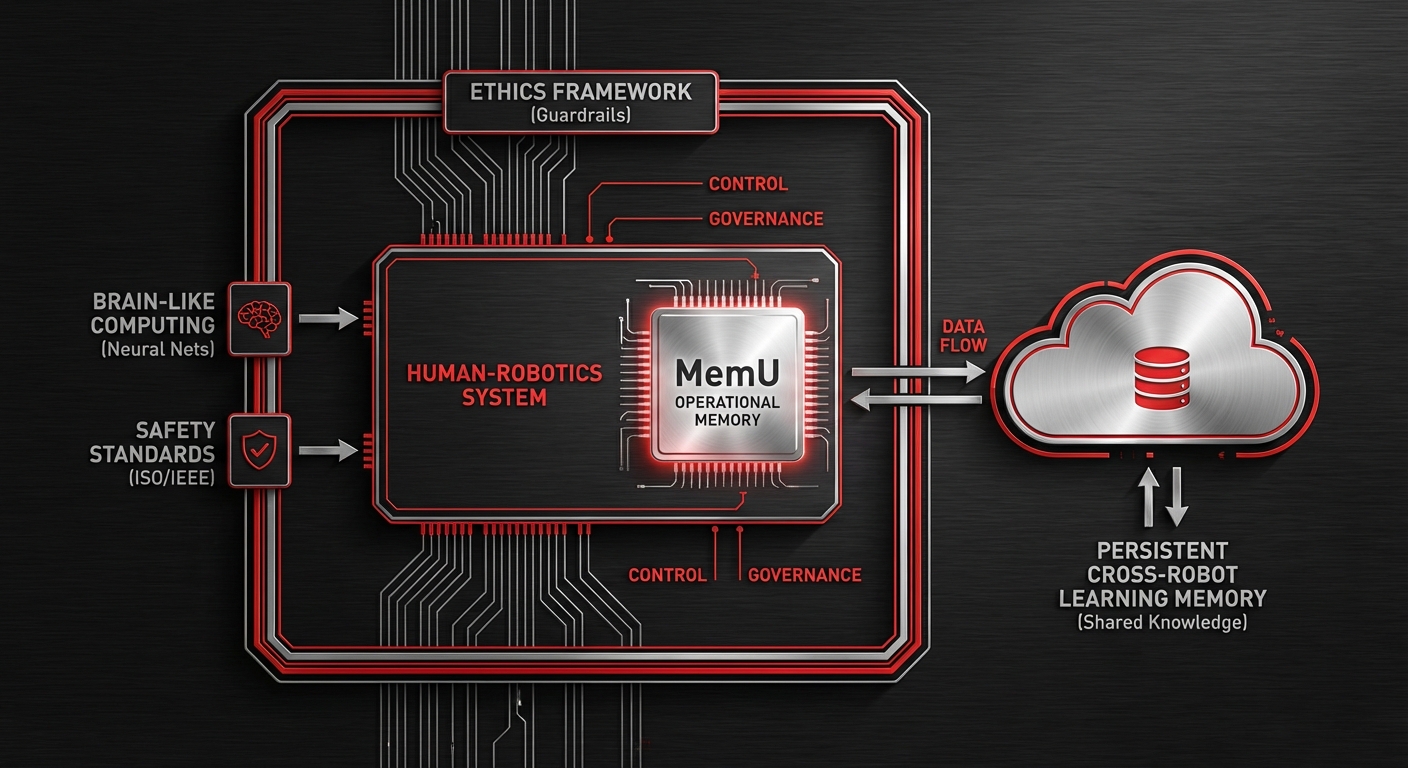
China's standards system establishes hardware interoperability: robots from different manufacturers can operate in the same facilities. The next frontier is knowledge interoperability: robots from different manufacturers can learn from each other's experiences. A manufacturing robot that learns an efficient handling technique should be able to share that technique with any other robot capable of the same physical actions — regardless of manufacturer.
The brain-like computing standard component is particularly relevant. If the standard defines common representations for perceptual data, motor planning, and decision-making, then persistent memory of these representations becomes transferable across robot models. A memory created by Manufacturer A's robot becomes usable by Manufacturer B's robot — not because the robots are identical, but because they share common cognitive representations.
This is the equivalent of what MCP did for AI agents: a universal protocol for connecting to external resources. For robotics, the equivalent is a universal memory protocol for sharing experiential knowledge across the fleet.
How MemU Provides Cross-Robot Memory Infrastructure
MemU provides the persistent memory layer that makes China's humanoid robot standardization fully effective. Operational knowledge from any robot — regardless of manufacturer — is stored in MemU's cross-compatible memory system. Before deployment, robots retrieve relevant memories from the fleet: environmental patterns, handling strategies, edge case solutions, and efficiency optimizations.
The standardized cognitive representations in China's framework align with MemU's structured memory architecture. Memories stored in standard formats are accessible to any robot using the same representations. Cross-manufacturer learning becomes possible not through direct model sharing but through shared experiential memory.
China standardized the robot bodies. MemU standardizes the robot memories. Together, they create a robotics ecosystem that learns as a fleet.
Get Started
Add cross-robot memory infrastructure to your fleet. Explore MemU at memu.pro and on GitHub.