The Claude Agent SDK Gives You Opus-Level Autonomy — But Where Does Memory Fit?

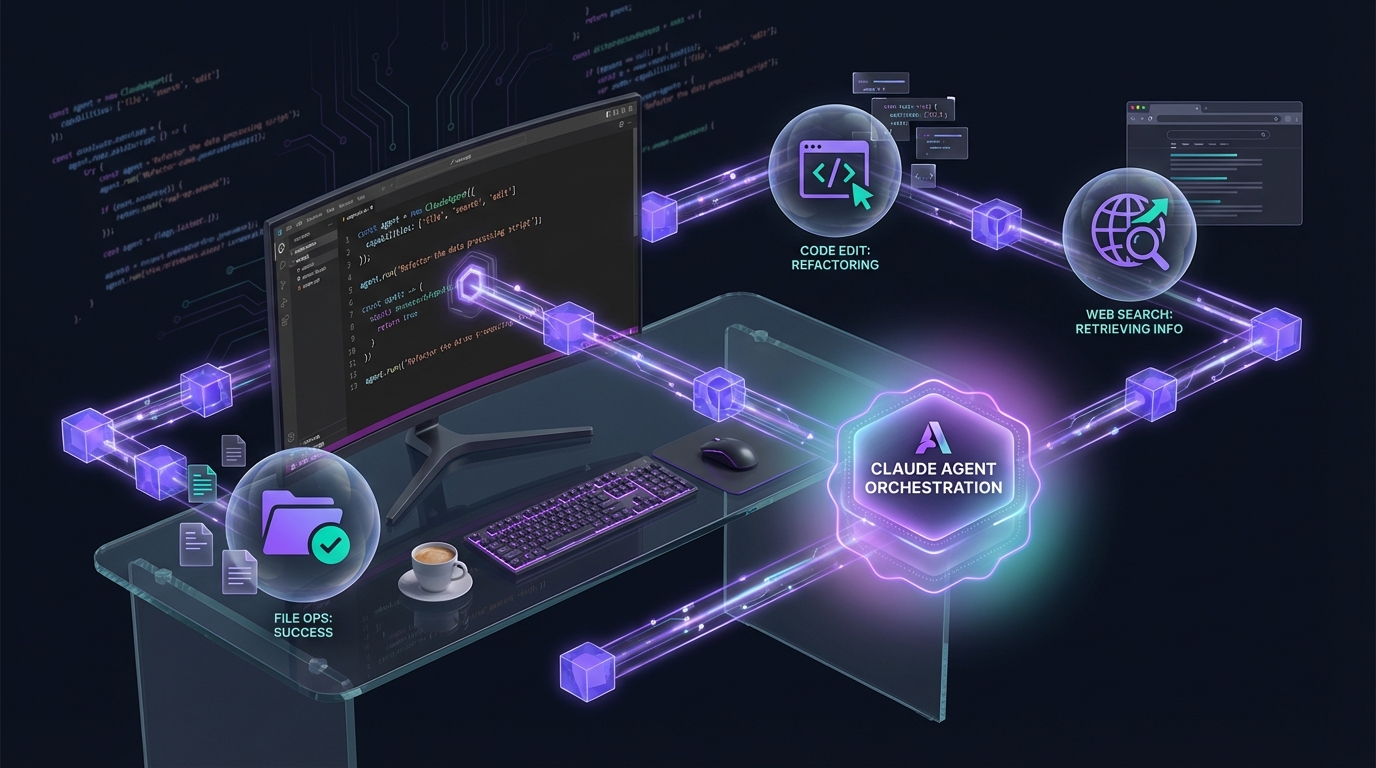
Anthropic just open-sourced the engine behind Claude Code. The Claude Agent SDK — now available for Python and TypeScript — gives developers the same tools and agent loop that power Anthropic's flagship coding assistant. File operations, bash commands, web searches, code editing with precision: all programmable through a clean API backed by Claude Opus 4.6.
For teams building autonomous AI systems, this is significant. The SDK includes built-in tools for file I/O, shell execution, and codebase search. It supports Agent Skills — packaged as SKILL.md files that Claude autonomously invokes when relevant. Multi-layered security, long-running task management, and permission controls come standard. This isn't a toy framework; it's production infrastructure.
But the Claude Agent SDK shares an assumption with most agent frameworks: memory is context-window-bounded. And that assumption limits what autonomous agents can actually become.
Claude Agent SDK: What Developers Are Building
The SDK's design philosophy centers on giving agents access to computers the way humans use them. Read files, write code, run commands, search the web — the tools programmers reach for daily. Claude Opus 4.6 orchestrates these capabilities through an agent loop that breaks down complex tasks into executable steps.
Agent Skills extend this foundation. Teams can package domain-specific capabilities into SKILL.md files that Claude loads and invokes contextually. A DevOps skill might handle infrastructure provisioning. A data science skill might manage notebook workflows. Skills compose — an agent can draw on multiple capabilities to solve complex problems.
The architecture works. Claude Code proves it at scale. But here's the gap: skills execute in context-window isolation. What an agent learned during yesterday's deployment doesn't inform today's. Insights from debugging one service don't transfer to debugging another. Every task starts with whatever fits in the current context, not what the agent has accumulated over time.
How the Claude Agent SDK Handles Memory
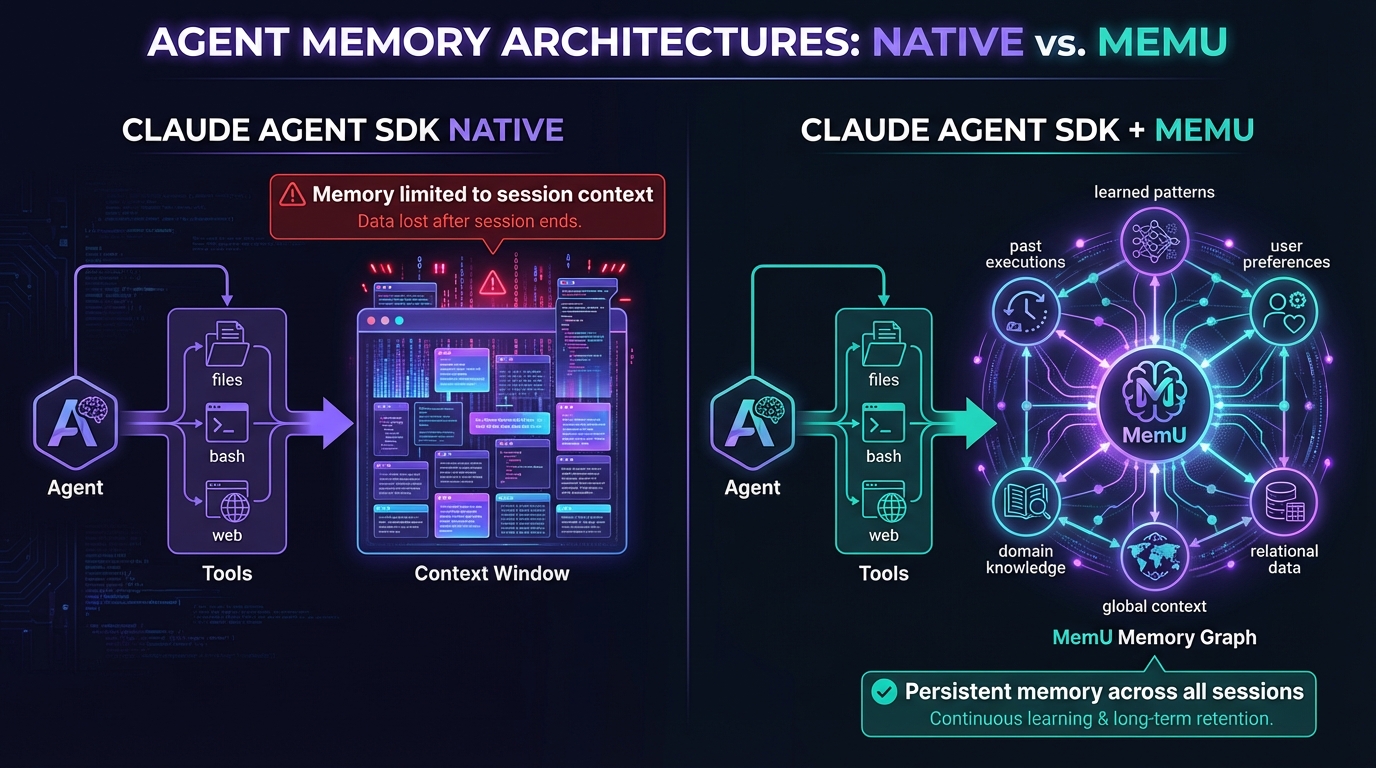
The SDK provides comprehensive context management for individual agent sessions. Conversation history, tool outputs, file contents, and skill invocations all flow through Claude's context window. The framework handles the complexity of assembling relevant context for each step of a multi-step task.
For session-bounded tasks, this works well. An agent can read a codebase, plan changes, implement them across multiple files, run tests, and iterate — all within a single session. The context window holds everything needed.
The limitation emerges across sessions. When an agent finishes a task, its learned context evaporates. The pattern it discovered for handling a specific API? Gone. The user preference it inferred from code review feedback? Lost. The architectural insight it developed while debugging? Starts from scratch next time.
This isn't a Claude Agent SDK flaw — it's the standard model for agent frameworks. CrewAI, AutoGen, LangGraph, and custom pipelines all face the same constraint. Context windows are session storage, not persistent memory.
The MemU Agentic Memory Framework: Persistent Memory for Claude Agents
The MemU Agentic Memory Framework provides the persistence layer that agent frameworks like the Claude Agent SDK don't include. Rather than losing learned context when sessions end, MemU captures insights into a structured memory graph that persists across sessions, projects, and even teams.
Consider a Claude agent managing infrastructure deployments. Today, it debugs a Kubernetes networking issue and discovers the root cause was a specific CNI configuration. With the Claude Agent SDK alone, that insight disappears when the session ends. With the MemU Agentic Memory Framework, the agent stores the diagnosis — and retrieves it instantly when a similar issue appears three months later.
The architecture difference comes down to three capabilities:
- Cross-session persistence: The MemU Agentic Memory Framework maintains full-fidelity memory that survives session boundaries. What your agent learned yesterday remains retrievable tomorrow — and next quarter.
- Structured knowledge graphs: Memory isn't compressed summaries — it's structured relationships. "This API requires header X" connects to "Team prefers pattern Y" connects to "Production uses configuration Z" — as queryable graph.
- Multi-agent sharing: Claude agents working on different aspects of a system can share memory pools. Your deployment agent's infrastructure insights become available to your monitoring agent without custom integration.
MemU gives Claude agents institutional memory — every deployment, every debug session, every code review becomes part of what future sessions can draw on.
Integration is straightforward: the MemU Agentic Memory Framework provides drop-in APIs that work alongside the Claude Agent SDK's existing tools. Your agents call MemU endpoints to store and retrieve memory — adding persistence without rewriting agent logic.
Head-to-Head: Session Context vs. Persistent Memory
Claude Agent SDK alone: Context window as working memory. Works excellently for complex single-session tasks. But agents can't learn across sessions — every project starts fresh, patterns must be rediscovered, and team knowledge doesn't accumulate in the agent layer.
Claude Agent SDK + MemU: Persistent memory graph underlying session context. Agents start each session with access to everything they've previously learned. Retrieval works across 10,000+ memory entries with sub-100ms latency. Knowledge accumulates — agents get genuinely smarter over time.
The Claude Agent SDK provides the tools for autonomous execution. The MemU Agentic Memory Framework provides the memory that makes that execution continuously improve.
Empowering Claude Agents: Better Together
The MemU Agentic Memory Framework isn't a replacement for the Claude Agent SDK — it's the memory layer that makes Claude agents dramatically more capable.
- Development workflow continuity: Agents remember codebase patterns, debugging approaches, and deployment configurations across sessions. What worked before informs what to try now.
- Team knowledge accumulation: Multiple developers' Claude agents can share a memory pool. New team members' agents start with access to accumulated project intelligence.
- Skill enhancement: Agent Skills become more powerful when they can draw on persistent memory — a deployment skill that remembers past issues, a code review skill that knows team preferences.
Adding persistent memory takes a single API integration. The MemU Agentic Memory Framework handles storage, retrieval, and evolution — your Claude agents just get smarter over time.
Get Started with MemU
The Claude Agent SDK represents a significant step forward for autonomous AI development. Anthropic has open-sourced production-grade infrastructure for building agents that can genuinely help with complex programming tasks.
The next step is giving those agents memory that persists. Agents that learn from every task they complete. Teams where agent knowledge accumulates like human expertise. Development workflows where past solutions inform future approaches automatically.
The MemU Agentic Memory Framework provides that foundation. Drop-in integration with the Claude Agent SDK means you can add persistent memory without rewriting existing agent code. Structured knowledge graphs capture the relationships that make retrieval precise. And cross-agent sharing enables team-wide intelligence.
Visit memu.pro to explore the Agentic Memory Framework API, or check out the open-source repository on GitHub to start building persistent memory into your Claude agents today.