Claude Code CLI Turns Your Terminal Into an Autonomous Agent — But Every Session Starts from Zero

Claude Code has redefined what a terminal can do. Anthropic's CLI coding agent doesn't just suggest completions — it autonomously reads codebases, writes files, executes commands, runs tests, manages git workflows, and delegates to subagents for complex multi-step tasks. With support for 3,000+ MCP integrations, a hook system for deterministic automation, and a configurable permission model, Claude Code is the most capable terminal-based AI agent available in 2026.
The adoption curve reflects the capability: developers are replacing multi-tool workflows with a single Claude Code session that handles everything from initial analysis to committed code. The subagent system delegates specialized tasks — security scanning, documentation, refactoring — to separate agent instances that report back to the main session. It's not pair programming; it's having an entire engineering team in your terminal.
But there's a fundamental limitation that undermines the power: every Claude Code session starts with zero knowledge of previous sessions. The agent that spent an hour understanding your codebase yesterday has to rediscover everything today. Subagent insights evaporate. Project patterns are relearned from scratch.
Claude Code's Autonomous Capabilities
The CLI agent's feature set is extensive. Interactive REPL mode allows continuous dialogue with the agent. Non-interactive query mode with the -p flag enables scripted automation. Session continuation (-c) and resumption (-r) allow picking up where a session left off — but only within the same session, not across sessions that span days or weeks.
The MCP integration is what transforms Claude Code from a coding assistant into a software engineering platform. Connect it to GitHub for PR management, Sentry for error tracking, databases for schema analysis, or any of the 3,000+ available MCP servers. The hook system adds deterministic automation: format code on every save, run linters before commits, execute security checks before pushing. These aren't suggestions — they're enforced pipelines.
Subagents handle the complexity that exceeds a single agent's scope. Ask Claude Code to refactor a module, and it might delegate type checking to one subagent, test generation to another, and documentation to a third. Custom subagent definitions via JSON allow teams to create specialized agents for their workflows. This is multi-agent orchestration running entirely in the terminal.
The Session Memory Problem
Despite these capabilities, Claude Code treats each session as independent. Start a new session and the agent has no knowledge of previous work — even work done minutes earlier in the same project. The codebase context must be re-analyzed. Project-specific patterns must be rediscovered. Decisions made in previous sessions are invisible.
This creates a painful pattern for developers who use Claude Code daily. Monday's session identifies a tricky race condition in the authentication module and develops a testing strategy. Tuesday's session has no knowledge of that discovery — the developer must re-explain the issue and the approach. Wednesday's session learns (again) that the project uses a custom ORM with specific query patterns. Every session repeats the learning curve.
Subagent knowledge loss is even more acute. A subagent that discovers a critical pattern during a refactoring task generates valuable insight that disappears when the subagent completes. The main agent receives the subagent's output but not its accumulated understanding. Over hundreds of subagent delegations, the amount of discarded knowledge is enormous.
What Persistent Terminal Memory Changes
With persistent memory, Claude Code becomes qualitatively different. The agent remembers that your project uses a custom middleware stack, that the payments module has a known race condition, that the team prefers composition over inheritance, and that the CI pipeline has a flaky test in the integration suite. This isn't conversation history — it's structured project knowledge that the agent has accumulated through experience.
Subagent insights persist and compound. A security scanning subagent that discovers a vulnerability pattern records it in memory. The next time a similar pattern appears, the main agent knows to flag it before delegating. A testing subagent that learns the project's testing conventions produces more aligned tests from the first session. Over time, the entire subagent system becomes more effective because collective knowledge accumulates.
The MCP integrations also benefit. An agent connected to GitHub learns which PRs get approved quickly and which trigger review cycles. An agent connected to Sentry learns which error patterns are genuine bugs versus expected behavior. This contextual learning transforms raw tool connections into intelligent integrations that understand the project's specific context.
How MemU Adds Memory to Claude Code
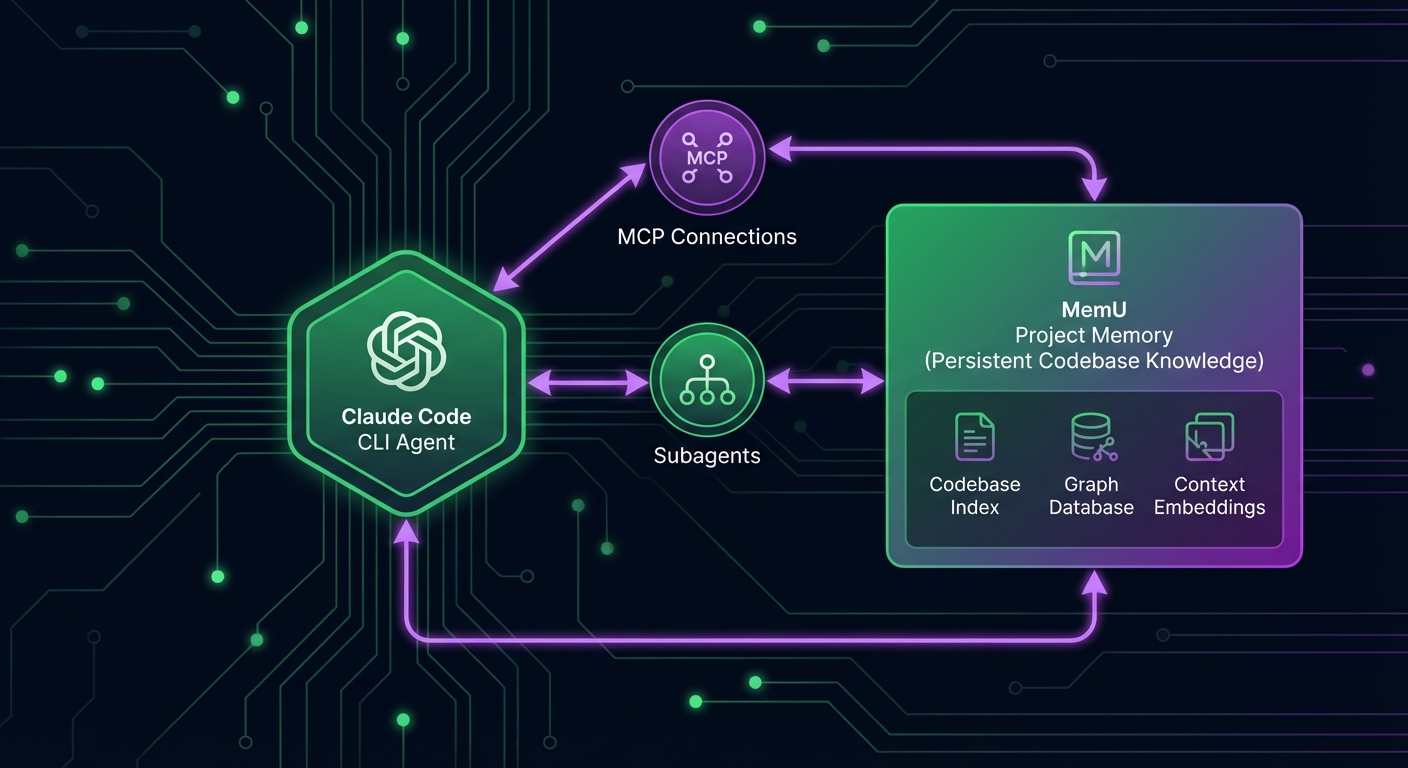
MemU integrates with Claude Code to provide persistent memory across sessions. Every session's discoveries, decisions, and learned patterns are written to MemU's memory layer. Before each new session, relevant memories are retrieved automatically — the agent starts with accumulated project knowledge rather than a blank slate.
For subagents, MemU captures the insights generated during delegated tasks and makes them available to future subagents working on related tasks. The security subagent's discoveries inform the next security scan. The refactoring subagent's patterns guide the next refactoring task. Knowledge compounds across hundreds of delegations.
The result is a terminal agent that gets smarter over time. Claude Code provides the autonomous capabilities. MemU provides the memory. Together, they create an AI engineering partner that genuinely knows your project, your patterns, and your preferences — not because you told it this session, but because it remembers.
Get Started
Give your terminal agent a memory that persists. Explore MemU at memu.pro and on GitHub.