Claude Code Hooks Unlock Agent Lifecycle Customization — But Customization Knowledge That Vanishes Between Projects Limits Long-Term Agent Intelligence

Anthropic has introduced Claude Code Hooks, a powerful agent lifecycle hooks system that gives developers fine-grained control over every phase of an AI coding agent's execution. Hooks are shell commands, HTTP endpoints, or LLM prompts that fire at specific lifecycle points: SessionStart, SessionEnd, UserPromptSubmit, PreToolUse, PostToolUse, PermissionRequest, SubagentStart, SubagentStop, InstructionsLoaded, PreCompact, and PostCompact. Combined with Claude Code's full customization stack — CLAUDE.md project files, Slash Commands, Skills, Subagents, MCP Servers, and Plugins — hooks create an extensible pipeline where every agent action can be intercepted, validated, augmented, or redirected. Early adopters report 1.7x fewer defects and 2.74x fewer security vulnerabilities compared to ad-hoc agent usage without hooks.
But extensibility has a temporal boundary. Agent lifecycle hooks that reset between projects cannot transfer the customization intelligence earned in one codebase to the next. An agent that learned through hooks which tools require extra validation, which code patterns trigger false positives, and which workflows maximize developer productivity loses all of that hard-won knowledge when the project directory changes.
Agent Lifecycle Hooks: What Claude Code Gets Right (And What It Misses)
The agent lifecycle hooks system in Claude Code represents a genuine architectural advance in how developers configure AI coding agents. Rather than treating the agent as a monolithic black box that accepts prompts and produces outputs, hooks expose the internal lifecycle as a programmable pipeline. A PreToolUse hook can inject project-specific validation logic before any file modification — checking architectural rules, enforcing import conventions, or blocking changes to protected modules. A PostToolUse hook can trigger automated test suites after code generation, catching regressions before review. The PermissionRequest hook enables custom approval workflows integrating with existing governance structures.
The depth of the event model separates this from simpler callback systems. SubagentStart and SubagentStop hooks provide visibility and control over multi-agent orchestration, letting developers impose resource limits or redirect subtasks. PreCompact and PostCompact events fire around context window compression, preserving critical information during pruning — operationally vital for long-running coding sessions where context management determines output quality.
The surrounding ecosystem amplifies hook utility. CLAUDE.md files define project-level instructions. Slash Commands provide reusable prompt templates. Skills package complex capabilities into composable units. MCP Servers extend tool access to external systems. Together with agent lifecycle hooks, these create a comprehensive customization surface supporting everything from lightweight linting to sophisticated multi-agent deployment pipelines.
The limitation is scope. All of this customization intelligence is project-scoped. A developer who spent weeks tuning agent lifecycle hooks for a Python microservices project — configuring PreToolUse validations, PostToolUse test triggers, and SubagentStart resource constraints — starts from a blank configuration when they open a new project. The 1.7x defect reduction and 2.74x security improvement are real, but they must be re-earned in every new repository through manual configuration rather than automatic knowledge transfer.
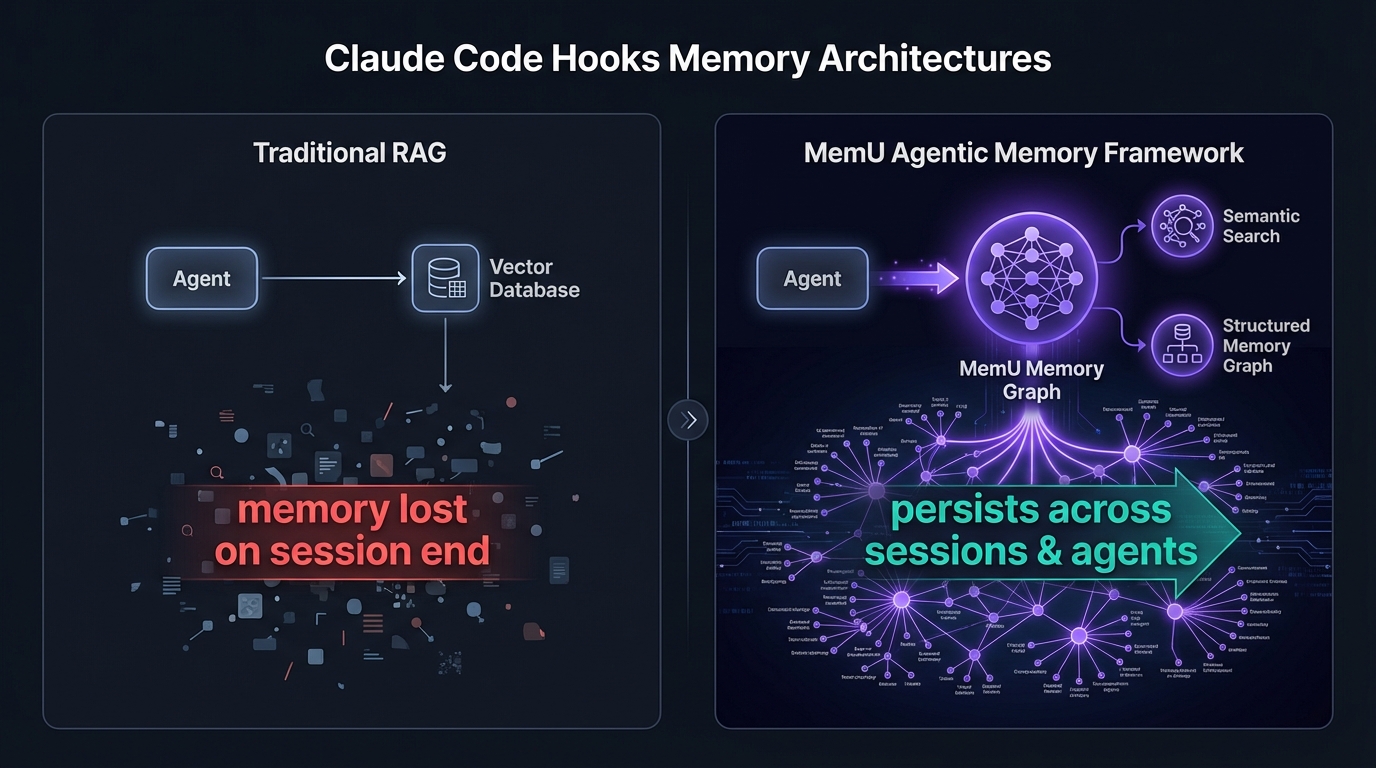
The MemU Agentic Memory Framework: Persistent Memory for Agent Lifecycle Hooks
The MemU Agentic Memory Framework bridges the gap between per-project customization and cross-project intelligence. Where Claude Code Hooks provide the interception points, MemU provides the memory substrate that captures what hooks learn and makes that learning available across projects, sessions, and codebases — transforming customization from a manual, per-project effort into an accumulating body of operational knowledge.
Consider a developer who maintains twelve microservices across three repositories. Their PreToolUse hooks in one service learned (through PostToolUse validation feedback) that generated database migration code requires extra review because the ORM version in use has a known issue with composite foreign keys. With MemU, this discovery persists and surfaces automatically when the developer opens another service using the same ORM. Without persistent memory, the agent re-encounters the same ORM issue in each repository, generating migrations that fail in the same way until the developer manually reconfigures hooks for each project independently.
The MemU Agentic Memory Framework provides capabilities that directly enhance agent lifecycle customization:
- Hook outcome persistence: Every PreToolUse and PostToolUse event pair generates implicit feedback — did the validated action succeed, fail, or require correction? MemU captures these outcomes as structured memories, building a continuously updated model of which validations are most valuable for which code patterns and tool types across all projects the developer works on.
- Cross-project knowledge transfer: Customization patterns discovered in one project automatically inform hook configurations in new projects with similar technology stacks. The agent lifecycle hooks system gains a warm start instead of a cold start, delivering defect reduction benefits from day one in new repositories based on patterns learned across the developer's entire portfolio.
- Subagent learning graphs: SubagentStart and SubagentStop events generate delegation performance data — which subagent configurations produce the best results for which task types. MemU stores these as knowledge graphs that the supervisor agent queries when making delegation decisions, improving multi-agent orchestration through accumulated evidence rather than static configuration.
Hooks give agents programmable lifecycle control. The MemU Agentic Memory Framework gives agents the memory to make that control progressively smarter — every hook execution deposits knowledge that future executions withdraw and build upon.
Head-to-Head: Claude Code Hooks vs. Other Agent Customization Systems
Claude Code Hooks alone: Each new project requires manual hook configuration from scratch. The agent validates, intercepts, and augments actions according to project-specific rules, but carries no institutional knowledge about which rules were most effective in prior projects. Defect reduction gains are real but must be manually replicated across every repository through developer effort — a scaling problem that grows linearly with project count.
Claude Code Hooks + MemU Agentic Memory Framework: Each new project inherits relevant customization intelligence from all prior projects. Hook configurations benefit from accumulated outcome data, and the agent proactively applies validation patterns that proved effective in similar codebases. The 1.7x defect reduction baseline improves over time as the memory substrate captures more patterns across more projects, approaching asymptotic reliability that manual configuration alone cannot achieve at scale.
Compared to other agent lifecycle hooks approaches — GitHub Copilot's content exclusion rules, Cursor's rule files, Windsurf's cascade configuration — Claude Code offers the deepest event model and the most programmable interception surface. But all of these customization systems share the same memory limitation: project-scoped configuration with no cross-project learning. MemU uniquely addresses this by providing a persistent intelligence layer that sits beneath any customization system and captures the operational knowledge that hooks generate but do not retain.
Empowering Claude Code Hooks: Better Together
MemU does not replace Claude Code's customization stack — it ensures that every hook execution contributes to a growing body of agent intelligence:
- Security enforcement: PermissionRequest hooks enforce access controls; MemU persists the security context — which files are sensitive, which operations historically triggered policy violations, which patterns correlate with vulnerabilities — enabling proactive security recommendations that anticipate risks based on cross-project threat patterns the agent has encountered.
- Context window management: PreCompact and PostCompact hooks control context pruning; the MemU Agentic Memory Framework captures critical context before compression and restores it when relevant — ensuring that long-running sessions never lose important decisions or reasoning chains to context window pressure, even across sessions that span days or weeks.
- Developer productivity: The full Claude Code stack — CLAUDE.md, Skills, Slash Commands, Subagents — provides per-session productivity; MemU provides cross-session productivity compounding, ensuring that customization effort today delivers returns across all future sessions and projects.
Get Started with MemU
Give your Claude Code agents the persistent memory they need to transform agent lifecycle hooks from per-project configuration into cross-project intelligence that compounds with every session. The MemU Agentic Memory Framework integrates with any agent customization system — one API, instant persistence, zero changes to your existing hook configurations. Visit memu.pro to explore the Agentic Memory Framework API, or check out the GitHub repository to start building agents that remember.
Tags: Claude Code, agent lifecycle hooks, Anthropic, agent customization, lifecycle events, coding agent memory, persistent agent intelligence, MemU AI