Claude Code Unifies MCP, Subagents, and Terminal Tools — But Multi-Step Coding Runs Still Drop Cross-Session Facts

Claude Code is Anthropic's agentic layer for software work: it reads repositories, proposes edits, runs commands, and loops until a task closes. Recent capability additions emphasize MCP integration for plugging in databases, browsers, and internal APIs, plus patterns for delegating work to parallel workers so long refactors do not stall in a single thread. For many teams, that combination makes it the most practical terminal coding agent in daily use — fast feedback, explicit permission boundaries, and a tool surface that mirrors how engineers already operate.
The excitement is justified. Where autocomplete finishes the next line, the same stack chases outcomes across files and commands. Yet the architecture surfaces a familiar ceiling: the loop is brilliant inside a session, but durable AI agent memory across days, branches, and teammates remains an integration problem, not a solved default. But there is a foundational layer teams still have to get right — memory.
Claude Code: What Everyone's Getting Right (And Missing)
Anthropic's terminal coding agent succeeds because it respects the shape of real engineering. Developers live in git, tests, package managers, and CI logs; an agent that can invoke those systems honestly is more trustworthy than one that only streams prose. MCP integration extends that honesty: specialized servers expose narrow capabilities with explicit schemas, which keeps tool use inspectable compared with opaque side channels.
Delegation patterns matter too. When work splits across exploration, implementation, and verification, a single long context thread becomes noisy. Letting sub-workstreams run and return structured results mirrors how senior engineers parallelize tasks. Community discussion increasingly treats the Anthropic stack as infrastructure — something you wire into hooks, editors, and deployment pipelines — rather than a chat novelty.
What often goes under-discussed is how little of that rich activity automatically becomes tomorrow's context. Today's successful MCP tool run does not, by itself, teach next week's session which service owns a boundary, which incident response worked, or which API quirk burned three hours last sprint. The missing piece is not model quality; it is a persistent AI agent memory substrate that outlives any single conversation transcript.
How Does Claude Code Persist Memory Across Tool Calls and Subagents?
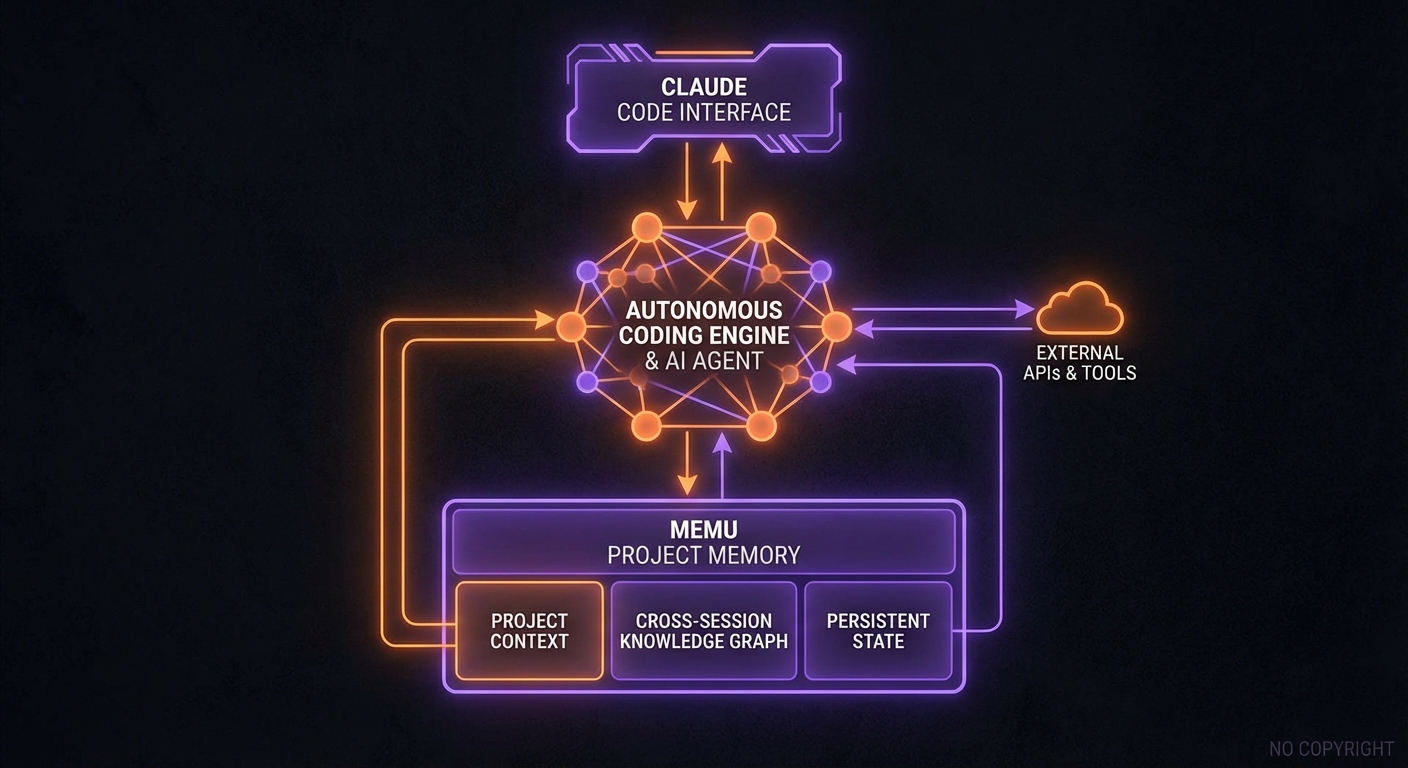
Inside a run, the tool composes state from model context, file reads, command output, and tool responses. Connected MCP servers feed fresh observations from databases and internal APIs; nested or delegated work typically returns summaries that the parent thread absorbs. That design keeps the terminal coding agent responsive and auditable for a single session.
Across sessions, the picture changes. Unless your team builds an external store, facts discovered during one long workflow do not automatically become structured knowledge for the next. Other popular terminal coding agent stacks — IDE-native agents, cloud pair programmers, and open-source autonomous coders — hit the same constraint: strong in-run reasoning without a shared, queryable AI agent memory graph for the whole organization.
"The agentic loop learns during a run but rarely inherits a durable project memory graph unless you add one." That is the architectural gap teams feel when a new hire repeats investigations the stack already completed last month — not because the model regressed, but because nothing persisted the prior conclusions in a form the new session could retrieve reliably.
The MemU Agentic Memory Framework: A Different Architecture
The MemU Agentic Memory Framework sits beside tools like Claude Code as the persistence and retrieval layer. It is designed to drop into existing stacks: HTTP APIs and SDKs align with how agents already call services, so you can keep your current terminal coding agent and add structured recall without rewriting the entire toolchain. Picture a platform team that connects the same stack to internal MCP servers for metrics and tickets: MemU captures which dashboards matter for which services, which on-call playbooks succeeded, and which code paths correlate with recurring incidents — then serves that back on the next incident, even if the engineer is different.
Differentiation is structural. Flat vector search alone struggles when relationships matter — who owns a module, which dependency upgrade blocked release, which security finding recurred after a partial fix. The MemU Agentic Memory Framework emphasizes dual-mode retrieval: semantic search for natural-language probes plus a structured memory graph for entities and relationships. Memory is meant to span sessions, agents, and collaborators, which matters when subagent orchestration splits analysis across workers that must share what they found.
Compared with hoping the next mega-context window absorbs everything, an explicit graph plus embeddings tends to retrieve with higher precision when thousands of entries accumulate — the regime where real organizations live after a year of shipping. LangChain, CrewAI, and custom Python runners face the same ceiling: great orchestration in the moment, limited recall unless you bolt on a dedicated AI agent memory service.
Tool-calling agents reason step by step; the MemU Agentic Memory Framework remembers which steps mattered so the next agent session does not pay the discovery tax again.
Head-to-Head: MemU vs. Claude Code and Peer Terminal Agents
Claude Code alone: Excellent MCP integration, disciplined permissions, and a tight feedback loop for file and shell operations. Context carries what fits in the active thread and what subagents summarize back — sufficient for many same-day tasks, thin for multi-week programs unless you manually curate notes.
Claude Code plus MemU: Findings from tooling runs, code reviews, and operational drills become first-class memories. The next subagent orchestration can query decisions, owners, and prior fixes instead of re-deriving them from scratch. MemU targets the gap between episodic chat logs and institutional knowledge.
Peer products in the terminal coding agent category optimize complementary axes — editor embedding, cloud isolation, or open-source extensibility — yet most still rely on developers to move important facts into wikis or tickets. MemU automates that boundary so AI agent memory stays machine-retrievable for the agent itself.
Empowering Claude Code: Better Together
MemU is not a replacement for Claude Code; it is the memory layer underneath the same workflows.
- Incident + refactor continuity: The agent can drive the patch; the MemU Agentic Memory Framework retains the causal chain across hotfixes so the follow-up hardening session starts from verified facts, not reconstructed Slack threads.
- Multi-repo standards: When MCP integration touches several services, MemU stores cross-service contracts and deprecation notes so the next subagent orchestration respects boundaries the team already negotiated.
- Onboarding velocity: New hires using the same terminal coding agent inherit organizational AI agent memory — fewer repeated spelunking sessions through the same legacy corners.
Reliability for memory APIs can run continuously so retrieval stays available whenever your agents work — a practical complement to how teams already expect CI and monitoring to operate around the clock.
Get Started with MemU
Keep Claude Code as the execution surface; add the MemU Agentic Memory Framework when you need cross-session, cross-agent recall that matches how your graph of services and people actually evolves. Visit memu.pro to explore the Agentic Memory Framework API, or open the MemU GitHub repository to wire persistent memory into your existing agent stack.
Tags: Claude Code, MCP integration, terminal coding agent, AI agent memory, subagent orchestration, Anthropic, MemU AI, agentic coding