Claude Opus 4.6 Launches Agent Teams and 1M Context — But Parallel Agents Still Can't Share What They Learned

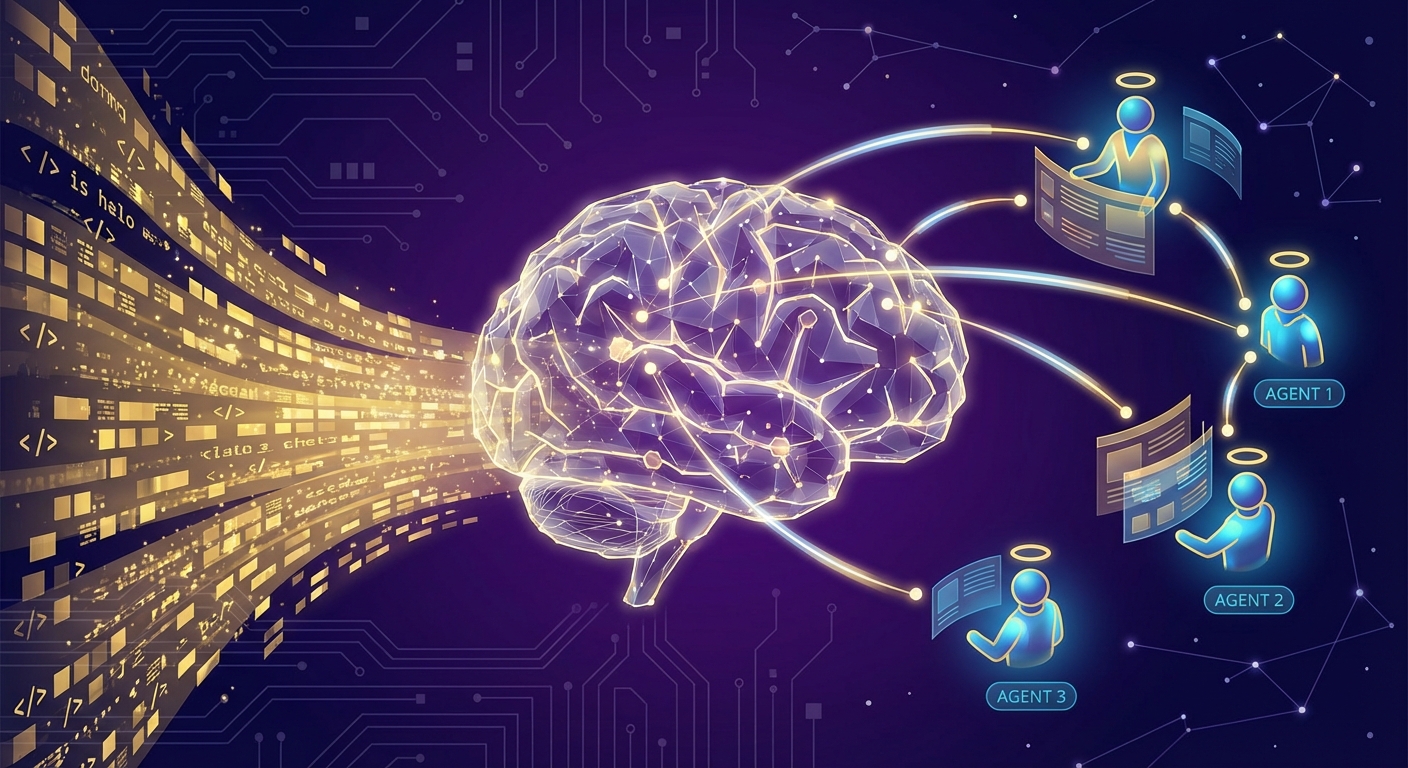
Anthropic's flagship just got a massive upgrade. Claude Opus 4.6, released February 5, 2026, introduces three features that push the boundaries of what AI can do: a 1 million token context window, Agent Teams for parallel multi-agent orchestration, and Adaptive Thinking that dynamically adjusts reasoning depth. With 128K output tokens and a Context Compaction API for ultra-long sessions, Opus 4.6 is built for the agentic era.
The Agent Teams feature is particularly notable. Multiple Claude agents work in parallel on independent subtasks, coordinated by a lead agent through a shared task list and messaging system. Think of it as a project manager delegating work to specialized team members — except every team member is Claude Opus 4.6.
But even with parallel agents that can communicate within a session, what happens to collective team intelligence when the session ends?
Claude Opus 4.6: What the Biggest Context Window Enables
The 1M token context window is genuinely transformative for certain workloads. Entire codebases — hundreds of thousands of lines — fit within a single context. Legal teams can analyze complete contract portfolios without chunking. Research teams can synthesize dozens of papers simultaneously. The model achieves 76% accuracy on the MRCR v2 8-needle benchmark, demonstrating reliable retrieval across that vast context.
Adaptive Thinking replaces the previous extended thinking feature with four effort levels — low, medium, high, and max — that dynamically adjust based on task complexity. Simple questions get fast answers. Complex reasoning problems get deep analysis. The model automatically calibrates rather than requiring users to manage thinking budgets.
Agent Teams enables Claude Code to orchestrate multiple agents working simultaneously. A lead agent breaks a complex task into subtasks, delegates them to worker agents, and coordinates results. Agents communicate through a shared task list and messaging system, enabling collaborative problem-solving within a single session.
The limitation: team knowledge is session-scoped. An Agent Team that spends an hour refactoring a codebase develops deep understanding of the architecture, the trade-offs considered, the patterns that emerged. When the session ends, that collective intelligence dissolves. The next Agent Team session starts from the same code but zero team context.
How Claude Opus 4.6 Handles Team Context
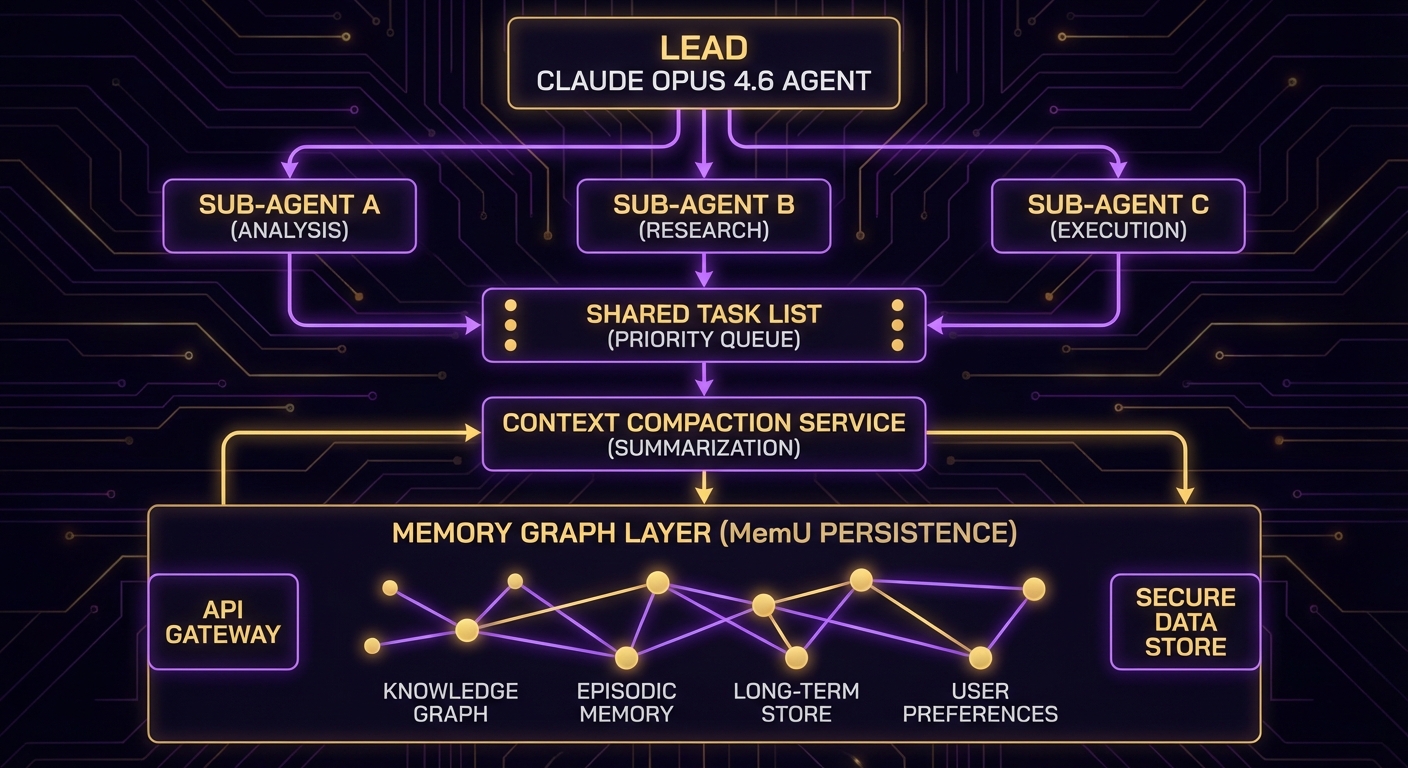
Within a session, Agent Teams coordinate through structured communication. The lead agent maintains a task list. Worker agents report progress and findings. The system enables genuine parallel execution — while one agent investigates a bug, another refactors a module, and a third writes tests.
The Context Compaction API extends session viability by automatically summarizing older conversation segments as context approaches the window limit. This enables longer-running agentic operations without hard context cutoffs.
Cross-session continuity is absent. The compacted context, the task coordination patterns, the architectural insights — none persist to the next session. Agent Teams provides brilliant within-session collaboration but no between-session learning. The team that solved a complex distributed systems problem today rebuilds that understanding from scratch tomorrow.
This isn't a limitation of Anthropic's engineering — it's fundamental to how LLM sessions work. Context exists within sessions. Memory requires external infrastructure.
The MemU Agentic Memory Framework: Agent Teams That Accumulate Expertise
The MemU Agentic Memory Framework provides the cross-session memory that makes Agent Teams progressively more effective. Rather than resetting collective intelligence with each session, MemU captures team insights, decision patterns, and discovered knowledge into persistent memory.
Consider a development team using Opus 4.6 Agent Teams daily. Monday's session refactors the authentication module — the team discovers a subtle race condition and develops a locking pattern. Thursday's session works on the payment module and encounters a similar concurrency issue. With Agent Teams alone, Thursday's team rediscovers the solution independently. With the MemU Agentic Memory Framework, Thursday's team retrieves Monday's insight and applies the proven pattern immediately.
The architecture enhances Agent Teams through three capabilities:
- Team memory persistence: Insights discovered through agent collaboration — architectural patterns, edge cases, resolution strategies — persist as structured knowledge accessible to future sessions.
- Progressive specialization: As teams repeatedly work on a codebase, the accumulated memory creates increasingly specialized understanding. The hundredth session has exponentially more context than the first.
- Cross-team learning: When different developers use Agent Teams on the same project, their sessions contribute to shared memory. One developer's Monday breakthrough informs another developer's Friday session.
MemU transforms Agent Teams from brilliant single sessions into a continuously learning collaborative intelligence.
Head-to-Head: Session Teams vs. Persistent Teams
Claude Opus 4.6 Agent Teams alone: Parallel multi-agent orchestration with 1M context, adaptive thinking, and within-session coordination. Exceptional for complex single-session tasks. But each session starts from model knowledge plus provided context — no accumulated team experience.
Agent Teams + MemU: Same parallel orchestration plus persistent team memory. Previous sessions' discoveries inform current work. Architectural understanding compounds. Decision rationale persists. Sub-100ms memory retrieval means no latency impact on Agent Teams' execution speed.
Get Started with MemU
Claude Opus 4.6 with Agent Teams represents the most capable multi-agent coding system available. The combination of 1M context, parallel execution, and adaptive reasoning enables work that previously required human teams.
The MemU Agentic Memory Framework ensures that capability accumulates. Every Agent Team session builds on previous ones. Collective intelligence persists. Teams get measurably better over time rather than resetting.
Visit memu.pro to explore the Agentic Memory Framework API, or check out the open-source repository on GitHub to start building persistent memory into your Agent Teams workflows today.