The ClawHub Attack Exposed 1,184 Malicious Skills — And a Memory-Sized Blind Spot


The ClawHavoc attack just became the AI agent ecosystem's wake-up call. Security researchers discovered over 1,184 malicious "skills" — roughly 20% of the entire ClawHub registry — poisoning OpenClaw's skill marketplace in late January 2026. The attack campaign lasted only three days but compromised everything from browser credentials to cryptocurrency wallets to SSH keys.
The mechanics were devastatingly simple. Attackers uploaded skills with legitimate-sounding names but embedded social engineering in README and SKILL.md files. Users were tricked into running shell commands or downloading executables disguised as "prerequisites." No code signing. No security review. No sandboxing. The only barrier was a GitHub account older than one week.
But here's what the security audits missed: the AI agent memory layer is equally vulnerable — and almost entirely unmonitored.
ClawHub Security: What Got Breached (And What Didn't Get Noticed)
The attack surface was substantial. Koi Security initially reported 341 malicious skills; deeper investigation revealed over 1,184 across at least 12 malicious author IDs. One uploader alone published 677 poisoned packages. Snyk's comprehensive audit found 36.82% of skills contain at least one security flaw, with 13.4% harboring critical vulnerabilities.
The payloads were sophisticated. macOS users faced multi-stage attacks deploying Atomic Stealer (AMOS), a commodity infostealer targeting browser credentials, crypto wallets, and API keys. Windows targets received password-protected ZIP files containing keyloggers and trojans. Some skills embedded reverse shell backdoors in otherwise functional code.
OpenClaw responded by partnering with VirusTotal to scan third-party skills. Security reviews are being implemented. The immediate crisis is being addressed.
But the response focuses entirely on code execution — not on what agents remember. AI agents accumulate sensitive context: API keys passed in conversations, authentication tokens, infrastructure details, business logic, user preferences. This memory is a high-value target that current security frameworks don't protect.
The AI Agent Memory Security Gap
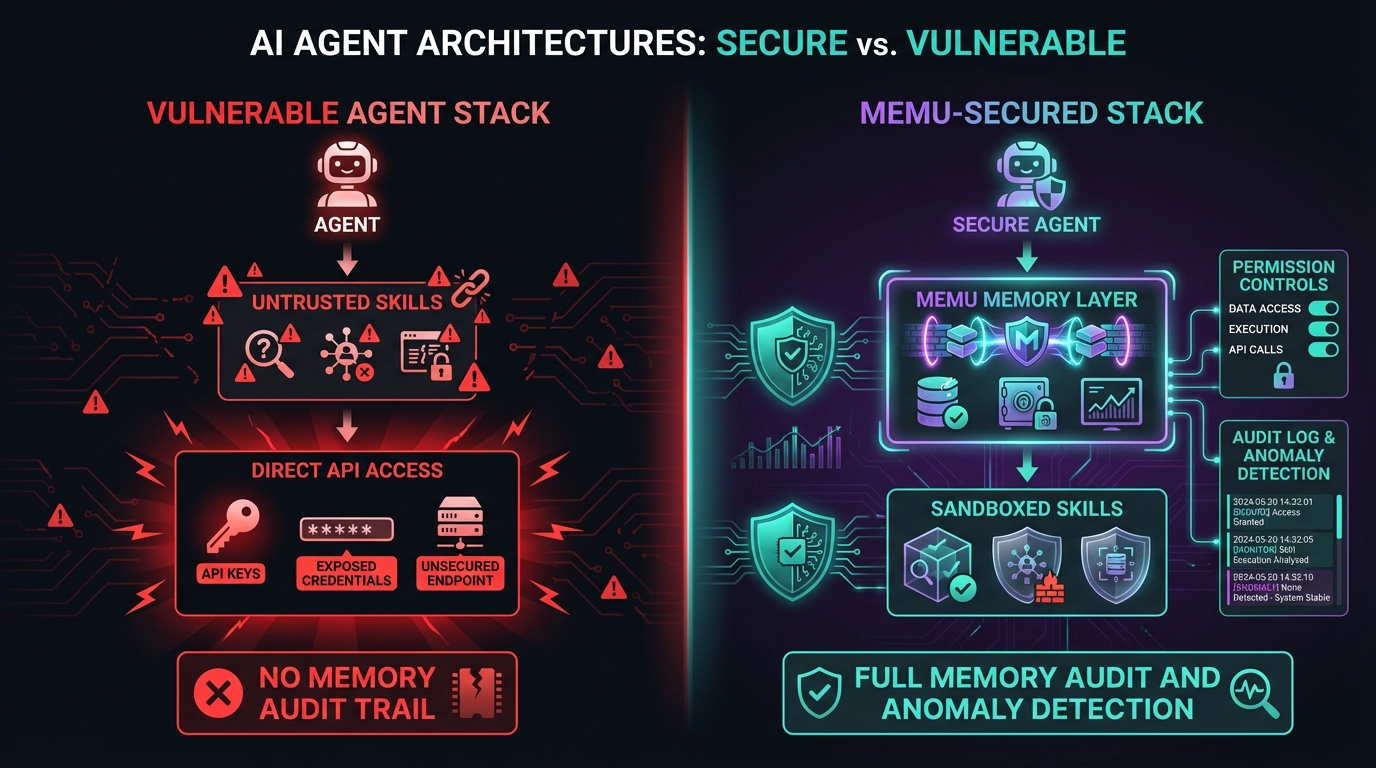
Agent security today focuses on what agents can do — sandboxing execution, reviewing code, validating inputs. This matters. But it overlooks what agents know — the accumulated context that makes them useful and makes them targets.
Consider a typical OpenClaw deployment. The agent handles email, manages calendars, books travel, interacts with banking services. Over time, it accumulates: email patterns revealing business relationships, calendar entries exposing meeting schedules, travel preferences including frequent flyer numbers, banking interactions revealing account structures.
This context lives in agent memory — and current security frameworks provide no visibility into it. No audit trail for what's being stored. No anomaly detection for unusual memory access patterns. No controls over what skills can read from memory.
A malicious skill doesn't need to install malware if it can simply read the agent's accumulated context and exfiltrate it through legitimate-looking API calls. The 1.5 million API keys exposed in the Moltbook database breach hint at this risk's scale.
The MemU Agentic Memory Framework: Security-First Memory Architecture
The MemU Agentic Memory Framework was designed with security as a foundational requirement, not an afterthought. Memory operations are logged, auditable, and controllable — providing the visibility that agent ecosystems currently lack.
Imagine an OpenClaw agent using MemU for persistent memory. Every memory write is logged with context: what triggered it, what skill requested it, what data was stored. Unusual patterns — a skill suddenly accessing payment information it never needed before — generate alerts. Access controls define what each skill can read and write.
The security architecture includes three protective layers:
- Full audit trails: The MemU Agentic Memory Framework logs every memory operation — reads, writes, searches, deletions. Security teams can review what agents learned, when, and through what interactions.
- Anomaly detection: Unusual memory access patterns trigger alerts. A skill that normally accesses calendar data suddenly querying financial information raises flags before exfiltration can occur.
- Granular permissions: Skills receive scoped memory access. A travel skill can read flight preferences; it cannot access banking context. Memory becomes a protected resource, not an open store.
MemU treats agent memory as a security boundary — not just storage, but a controlled asset requiring audit, access control, and monitoring.
Integration provides defense-in-depth: the MemU Agentic Memory Framework complements code-level security by protecting the data layer that code-scanning can't see.
Head-to-Head: Unprotected vs. Security-First Memory
Current agent memory: Local storage with no audit trail. Skills read and write freely. No visibility into what's accumulated or who's accessing it. Memory exfiltration is undetectable by design.
MemU Agentic Memory Framework: Security-first architecture with full audit logging. Granular access controls define what each skill can touch. Anomaly detection identifies suspicious patterns. Memory operations are as auditable as network traffic — visible, controllable, defensible.
The ClawHub attack proved that AI agent security requires more than code review. The MemU Agentic Memory Framework provides the memory-layer protection that completes the security model.
Empowering Secure Agent Deployments: Better Together
The MemU Agentic Memory Framework isn't a replacement for code-level security — it's the complementary layer that protects what agents learn.
- Enterprise compliance: Organizations using AI agents for sensitive workflows gain audit capabilities. Memory operations become reviewable for compliance requirements and incident response.
- Defense in depth: Even if a malicious skill passes code review, memory access controls and anomaly detection provide additional protection layers.
- Incident response: When security events occur, memory audit logs provide forensic capability. What did the agent know? What was accessed? When did patterns change?
Adding memory security takes a single integration. The MemU Agentic Memory Framework handles logging, access control, and anomaly detection — your agent deployments gain enterprise-grade memory protection.
Get Started with MemU
The ClawHub attack demonstrated that AI agent ecosystems face real security threats. The 1,184 malicious skills represented sophisticated, targeted attacks against a growing infrastructure. The community is responding with code-level protections.
The next step is protecting what agents know. Memory that's auditable, not opaque. Access that's controlled, not open. Patterns that are monitored, not invisible. Security that covers the full agent stack.
The MemU Agentic Memory Framework provides that foundation. Drop-in integration means you can add memory security without rewriting agent code. Full audit trails satisfy compliance requirements. And anomaly detection provides early warning before breaches escalate.
Visit memu.pro to explore the Agentic Memory Framework API, or check out the open-source repository on GitHub to start building secure memory into your agent deployments today.