Cline Brings AI Agents to VS Code — But IDE Agents Without Project Memory Re-Explore Codebases Every Session


Cline — formerly Claude Dev — has become one of the most popular open-source AI coding agents, with over 58,000 GitHub stars and an Apache 2.0 license. Running as a VS Code sidebar panel, Cline operates as a fully autonomous coding agent with direct access to the project filesystem, terminal, and optionally the browser. Unlike code completion tools that suggest the next line, Cline executes multi-step development tasks: reading files, understanding architecture, writing code, running tests, and debugging failures — all within the IDE. The agent supports any LLM provider — Anthropic, OpenAI, Google Gemini, local models via Ollama — and integrates with the Model Context Protocol (MCP) for extensible tool access.
But Cline's autonomy is bounded by session context. When a developer opens a new chat session, the agent must re-explore the codebase from scratch — re-reading file structures, re-discovering architectural patterns, and re-learning project conventions. An IDE agent without project memory re-explores codebases every session, spending tokens and time rebuilding understanding that already existed.
Cline: What Everyone's Getting Right (And Missing)
Cline's architecture is well-designed for autonomous coding. The Plan/Act mode lets developers review the agent's intended approach before execution, and the checkpoint system takes project snapshots that enable safe rollback if changes go wrong. The human-in-the-loop approval flow — where the agent requests permission before file writes and command execution — balances autonomy with control. For developers who want AI assistance that goes beyond autocomplete, Cline provides a genuine agent experience inside the familiar IDE environment.
The MCP integration is particularly powerful. Developers can extend Cline's capabilities with custom tools — database access, API testing, documentation search — that the agent invokes autonomously during task execution. This extensibility means the agent adapts to the developer's specific workflow rather than forcing a fixed set of capabilities.
What Cline loses between sessions is everything it learned about the project. The agent that spent 500 tokens reading your project structure, understanding your testing patterns, and mapping your dependency graph discards all of that knowledge when the session ends. The next session starts the same exploration process. Other AI coding agents — including Aider, Continue, and GitHub Copilot Workspace — share this same limitation. They optimize for in-session intelligence; none persist the project understanding that agents build during execution.
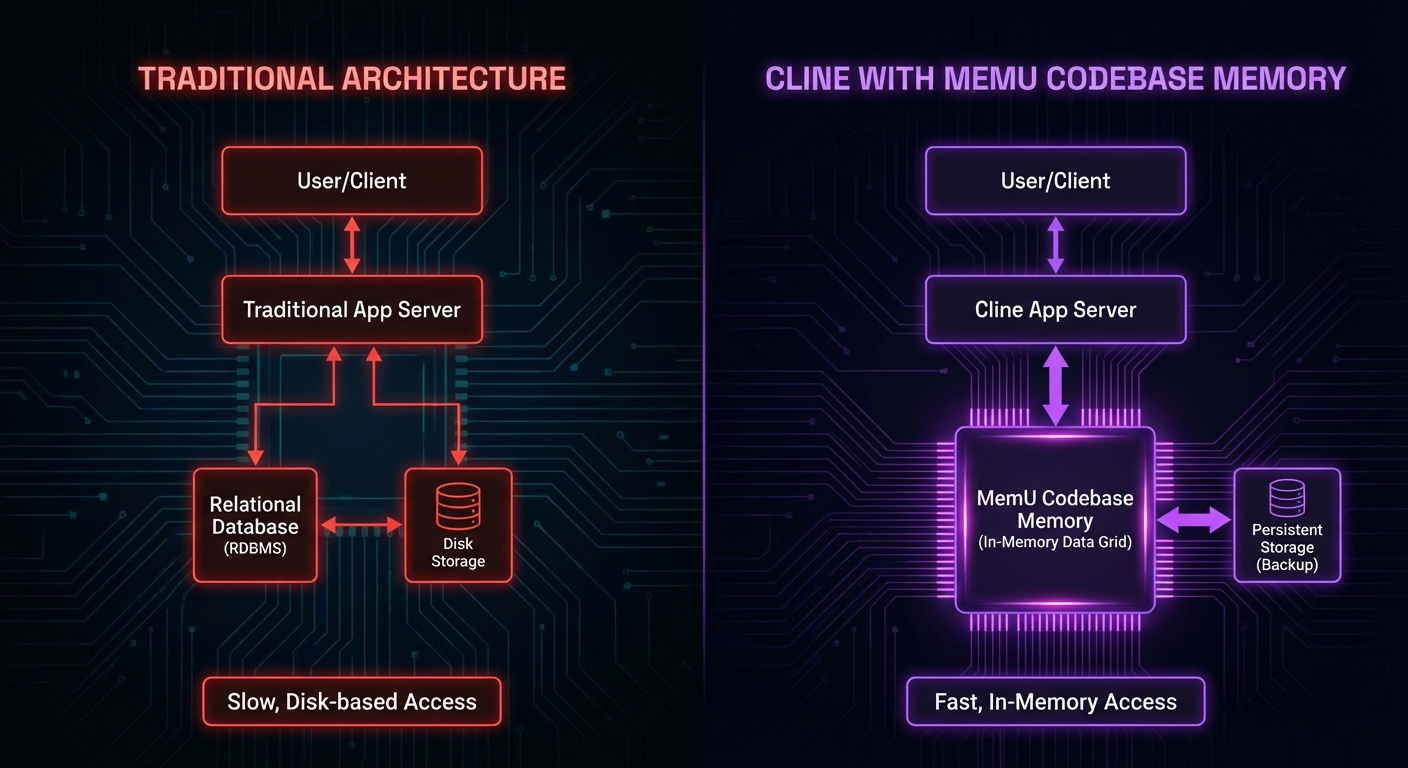
The MemU Agentic Memory Framework: Project Intelligence That Persists Across Sessions
The MemU Agentic Memory Framework provides the persistent memory layer that IDE coding agents like Cline do not include natively. Instead of treating each session as an independent exploration, MemU captures the project knowledge, coding patterns, and debugging insights that agents accumulate during execution and stores them in a structured memory graph that persists across sessions, projects, and developer contexts.
Consider a developer working on a large monorepo with Cline. Without persistent memory, every session begins with the agent reading package.json files, exploring directory structures, and inferring coding conventions. With the MemU Agentic Memory Framework, the agent immediately recalls: this monorepo uses Turborepo with pnpm workspaces, the API package uses Express with Zod validation, the frontend uses Next.js App Router with server actions, and tests follow the AAA pattern with Vitest. That context — which previously cost hundreds of tokens and minutes of exploration — is available instantly from persistent memory.
The framework addresses three core limitations of session-bounded coding agents:
- Codebase knowledge persistence: Project architecture, dependency relationships, module boundaries, and coding conventions are stored after each session. The MemU Agentic Memory Framework eliminates the repeated exploration that consumes tokens and developer patience in every new chat.
- Debugging history retention: When an agent encounters and resolves a bug — a race condition in the auth middleware, a type mismatch in the API layer — that debugging knowledge persists. Future sessions where similar issues arise benefit from accumulated troubleshooting intelligence rather than starting diagnosis from scratch.
- Developer preference learning: The corrections a developer makes to agent-generated code — preferring early returns over nested conditionals, using specific error handling patterns, applying particular naming conventions — become persistent intelligence. The agent adapts to the developer's coding style over time rather than applying generic patterns.
Coding agents are most powerful when they understand your project deeply. But understanding rebuilt from scratch every session is expensive, slow, and never as thorough as accumulated knowledge. The MemU Agentic Memory Framework gives Cline the project memory that makes every session start where the last one left off.
The MemU Agentic Memory Framework integrates naturally with Cline's MCP architecture. Memory retrieval and storage can be exposed as MCP tools that the agent invokes during its normal workflow — querying project context at the start of a task and storing new insights upon completion. No modifications to Cline's core codebase required.
Head-to-Head: Stateless IDE Agents vs. Memory-Enhanced Coding
Cline alone: A capable autonomous coding agent with file access, terminal execution, and MCP extensibility. The Plan/Act workflow and checkpoint system provide safety rails for autonomous changes. But every session starts from zero project context — the agent re-explores, re-reads, and re-learns the codebase structure, consuming tokens and time on knowledge it had in the previous session.
Cline + MemU: The same autonomous capabilities, now backed by persistent project memory. The agent begins each session with complete project context — architecture, conventions, dependencies, and the developer's coding preferences. Tasks that previously required extensive codebase exploration can begin execution immediately. Debugging benefits from historical context about similar issues and their resolutions.
The token savings are substantial. A typical codebase exploration in Cline can consume 2,000-5,000 tokens per session just to rebuild project understanding. With persistent memory, that context is retrieved in a single API call, freeing the token budget for actual coding work rather than repeated exploration.
Empowering Cline: Better Together
The combination of Cline's autonomous IDE agent and the MemU Agentic Memory Framework's persistent memory unlocks coding workflows that neither capability achieves alone:
- Progressive codebase understanding: Each session deepens the agent's knowledge of the project. The first session maps the high-level architecture. Subsequent sessions add module-level details, test patterns, deployment configurations, and edge cases. After twenty sessions, the agent has a richer understanding of the codebase than any single-session exploration could achieve.
- Cross-project pattern transfer: Developers working on multiple projects with Cline benefit from pattern transfer. A debugging technique learned in one project — a specific approach to handling async errors in Node.js — is available when a similar issue appears in another project.
- Team onboarding acceleration: When a new developer joins a project, Cline with shared project memory can immediately provide context that would otherwise require weeks of codebase exploration. The agent serves as a persistent knowledge base that captures the institutional understanding of the codebase.
Adding persistent memory transforms Cline from a powerful session-based assistant into an intelligent coding partner that grows more effective with every interaction, accumulating the deep project understanding that makes autonomous coding genuinely productive.
Get Started with MemU
Cline has earned its 58,000 GitHub stars by delivering genuine autonomous coding capabilities inside VS Code. The model-agnostic architecture, MCP extensibility, and thoughtful safety controls make it a practical tool for developers who want AI assistance that goes beyond code completion.
The next step is giving that agent project memory that persists. Sessions where the agent starts with full project context instead of re-exploring the filesystem. Codebases where the agent's understanding deepens over time rather than resetting with every new chat. Teams where accumulated project knowledge is shared across developers through persistent memory.
The MemU Agentic Memory Framework provides that foundation. MCP-compatible integration, dual-mode retrieval with semantic search and structured memory graphs, and cross-session persistence that turns every coding interaction into compounding project intelligence.
Visit memu.pro to explore the Agentic Memory Framework API, or check out the GitHub repository to start building agents that remember.
Tags: Cline, VS Code, AI coding agent, agentic AI, agent memory, MemU AI, LLM memory