Codex Spark Delivers 1,000 Tokens Per Second — But Speed Without Memory Is Just Fast Forgetting


OpenAI just made AI coding fifteen times faster. Codex Spark, released February 12, 2026, delivers over 1,000 tokens per second on Cerebras hardware — a 15x speedup over the full GPT-5.3-Codex. Time-to-first-token drops by 50%. Roundtrip overhead shrinks by 80%. For developers who live inside their editors, this is the real-time AI coding assistant that finally feels instantaneous.
The model isn't just fast — it's capable. Codex Spark matches GPT-5.3-Codex on SWE-Bench Pro while consuming roughly half the tokens. It handles debugging, deployment, monitoring, and broad development tasks well beyond basic code completion. OpenAI built this for interactive, real-time coding through persistent WebSocket connections and an optimized inference stack.
But here's the question Codex Spark's speed alone can't answer: what happens to everything the model learned during today's coding session?
Codex Spark: What Blazing Speed Enables (And What It Doesn't Preserve)
The speed improvement is transformational for developer experience. At 1,000+ tokens per second, Codex Spark makes AI assistance feel like autocomplete rather than a network request. The 128K context window handles substantial codebases within a single session. The model generates targeted edits rather than rewriting entire files, keeping suggestions precise and actionable.
OpenAI's partnership with Cerebras unlocks this through custom Wafer-Scale Engine 3 hardware. The optimization isn't just model architecture — it's full-stack inference engineering: persistent connections, reduced per-token overhead, and hardware-software co-design.
For single-session tasks, Codex Spark is genuinely impressive. Debugging a complex issue, refactoring a module, implementing a feature from spec — all happen at conversational speed. The model understands context, makes precise changes, and iterates based on feedback.
The limitation: speed doesn't create memory. Codex Spark processes tokens faster than any coding model, but when the session ends, learned context vanishes just as quickly. The debugging pattern that took twenty minutes to discover? Gone. The team's preferred architecture decisions? Not retained. The codebase conventions absorbed during a refactoring session? Start over tomorrow.
How Codex Spark Handles Session Context
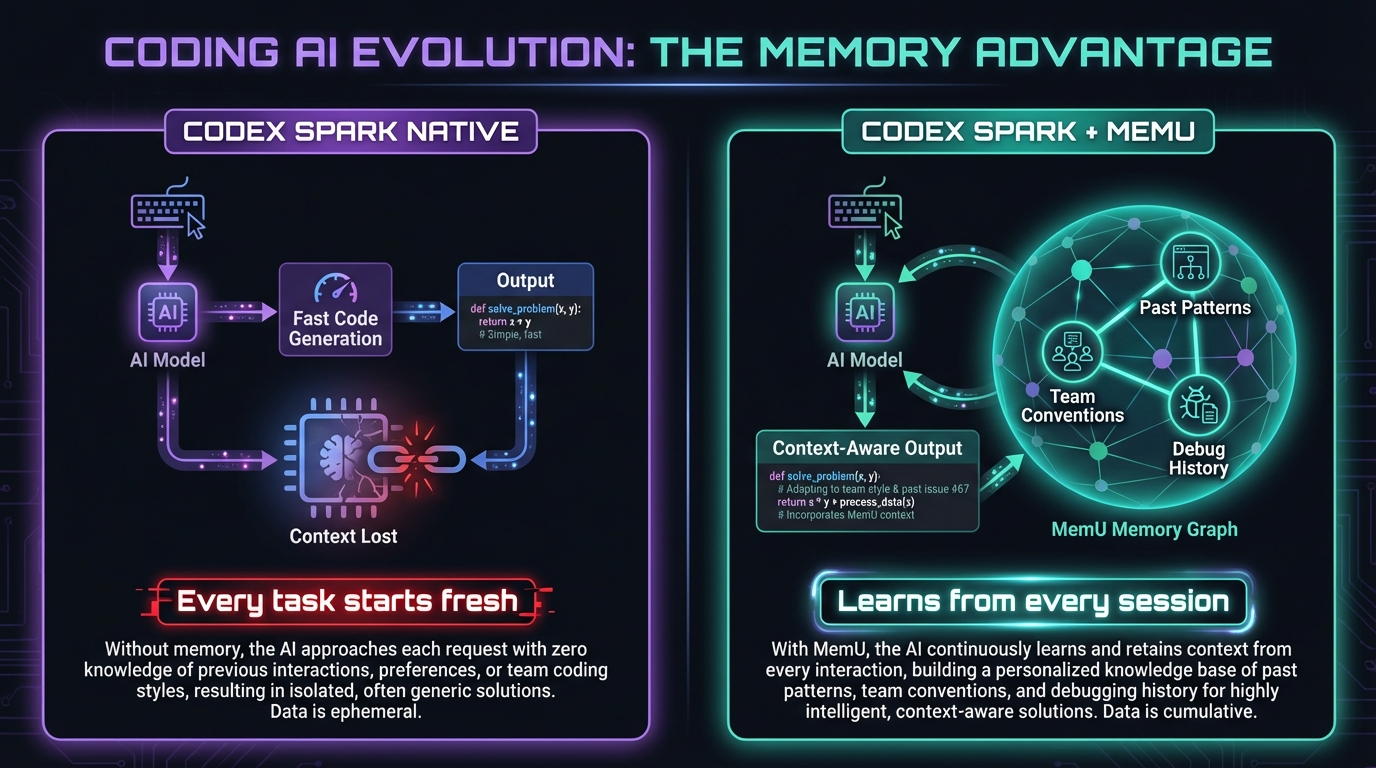
Codex Spark's 128K context window is substantial for interactive coding. Feed it files, error logs, test outputs, and conversation history — the model maintains coherent understanding throughout a development session. The WebSocket-based architecture keeps context alive without repeated setup costs.
Within a session, the experience is seamless. Ask Codex Spark to debug an issue, and it remembers the approaches that didn't work. Request a refactor, and it maintains awareness of the broader architecture from earlier in the conversation. The speed makes iteration feel like pair programming with a colleague who thinks very, very fast.
Cross-session, the slate is blank. Tomorrow's Codex Spark session knows nothing about today's discoveries. The pattern you identified for handling a recurring API inconsistency? Not available. The team convention for error handling that was discussed three sessions ago? Must be re-specified. Speed without persistence creates a developer experience that's brilliant in the moment but amnesic across time.
This isn't specific to Codex Spark — GitHub Copilot, Cursor, and every LLM-based coding assistant face the same constraint. Sessions are isolated.
The MemU Agentic Memory Framework: Speed That Remembers
The MemU Agentic Memory Framework adds the persistence layer that makes Codex Spark's speed compound over time. Rather than starting each session fresh, MemU captures coding insights, patterns, and decisions into a structured memory graph that persists across sessions.
Consider a team using Codex Spark for a microservices migration. Today's session discovers that Service A requires a specific retry pattern for Service B's flaky endpoint. With Codex Spark alone, that discovery evaporates tonight. With the MemU Agentic Memory Framework, it becomes retrievable context — and when Service C needs the same pattern next week, the model already knows the approach.
The architecture provides three capabilities that complement Codex Spark's speed:
- Pattern persistence: The MemU Agentic Memory Framework captures coding patterns, debugging approaches, and architectural decisions — not as static notes, but as structured relationships queryable by context.
- Team knowledge accumulation: Multiple developers' Codex Spark sessions contribute to shared memory. One developer's discovery becomes everyone's context. Codebase conventions become retrievable rather than tribal.
- Progressive expertise: Each session builds on previous ones. The model doesn't just code fast — it codes fast with the accumulated understanding of every past interaction.
MemU makes Codex Spark's speed cumulative — every fast session adds to what future sessions can draw on.
Integration is straightforward: the MemU Agentic Memory Framework provides API endpoints that work alongside OpenAI's Codex API. Store insights after sessions, retrieve relevant context before new ones.
Head-to-Head: Fast Sessions vs. Fast + Persistent
Codex Spark alone: 1,000+ tokens/second, 128K context, brilliant within individual sessions. But each session is isolated — patterns must be rediscovered, conventions re-specified, and debugging approaches reinvented across sessions.
Codex Spark + MemU: Same speed plus persistent memory. Previous sessions inform current ones. Team knowledge accumulates. Retrieval across 10,000+ memory entries with sub-100ms latency means memory lookup never bottlenecks Codex Spark's speed.
Codex Spark provides the fastest code generation available. The MemU Agentic Memory Framework ensures that speed compounds into expertise rather than evaporating between sessions.
Empowering Fast Coding: Better Together
The MemU Agentic Memory Framework isn't a replacement for Codex Spark — it's the memory layer that makes fast coding genuinely cumulative.
- Onboarding acceleration: New team members' Codex Spark sessions start with access to accumulated codebase knowledge. Architecture decisions, naming conventions, and known pitfalls are immediately available.
- Debug continuity: When a similar issue resurfaces months later, the model retrieves the previous diagnosis and solution approach rather than re-investigating from scratch.
- Convention consistency: Team coding standards become memory-backed rather than document-dependent. Codex Spark generates code that follows established patterns because it remembers them.
Adding persistent memory takes a single API integration. The MemU Agentic Memory Framework handles storage, retrieval, and evolution — your Codex Spark sessions just get smarter over time.
Get Started with MemU
Codex Spark represents a genuine breakthrough in AI coding speed. OpenAI and Cerebras have pushed inference performance to the point where AI assistance feels truly real-time. For developers, that's transformative.
The next step is making that speed persistent. Coding sessions that build on previous ones. Teams where AI-assisted knowledge compounds like developer expertise. Workflows where the patterns discovered today inform the code generated tomorrow.
The MemU Agentic Memory Framework provides that foundation. Drop-in integration means you can add persistent memory without changing your Codex Spark workflow. Structured knowledge graphs capture the coding patterns that matter. And retrieval is fast enough that memory never becomes a bottleneck for Codex Spark's speed.
Visit memu.pro to explore the Agentic Memory Framework API, or check out the open-source repository on GitHub to start building persistent memory into your coding workflows today.