Cohere Command A Delivers 111B-Parameter Enterprise RAG and Tool Use — But LLM Agents Without Persistent Memory Re-Retrieve and Re-Reason From Scratch


Cohere Command A is an enterprise-grade language model purpose-built for agentic workloads. At 111 billion parameters with a 256K context window, it delivers the reasoning depth and context capacity that complex enterprise tasks demand — while requiring only two A100 or H100 GPUs, a deployment efficiency that makes private hosting practical for regulated industries. The model achieves 150% higher throughput than Command R+, excels at multi-step tool use with self-correction, supports RAG with in-line citations to mitigate hallucinations, and operates across 23 languages for global deployments. It is available through Cohere's hosted API, major cloud platforms including Oracle OCI, and private on-premises deployment for organizations requiring complete data sovereignty.
But there is a fundamental gap between what the model delivers per inference call and what enterprise agents need across calls. The model's RAG capabilities retrieve relevant documents brilliantly — then discard the retrieval context the moment the response is generated. Multi-step tool use with self-correction is powerful within a session — but when the session ends, every correction is forgotten. An enterprise agent re-retrieves the same documents, re-reasons through the same chains, and re-corrects the same errors in every new session.
Cohere Command A: What Enterprise LLM Agents Get Right (And What Stateless Reasoning Cannot Sustain)
The engineering reflects deep understanding of enterprise requirements. The 256K context window means agents can process entire legal contracts, financial reports, or technical specifications in a single pass — eliminating chunking artifacts that smaller windows introduce. Multi-step tool use with self-correction means the model can call external APIs, evaluate results, identify errors, and retry with adjusted parameters autonomously. In-line citations pinned to specific source passages give enterprises the auditability that generative AI typically lacks.
Deployment efficiency is strategically important. Running a 111B-parameter model on two GPUs makes private deployment economically viable for financial services, healthcare, legal, and government organizations where data cannot leave the network perimeter. The 23-language support means a single deployment serves global operations without language-specific model variants.
What the model does not provide is continuity between reasoning sessions. An enterprise legal agent that spends 45 seconds analyzing a complex contract — retrieving clauses, reasoning through implications, citing provisions — produces a thorough response. When the same user asks a follow-up the next day, the agent re-retrieves the same documents and re-reasons through the same framework. Every RAG cycle starts from zero. Every tool use chain begins without knowledge of which configurations succeeded previously. For enterprise deployments handling thousands of recurring analytical tasks, this stateless pattern wastes significant compute on redundant retrieval and reasoning.
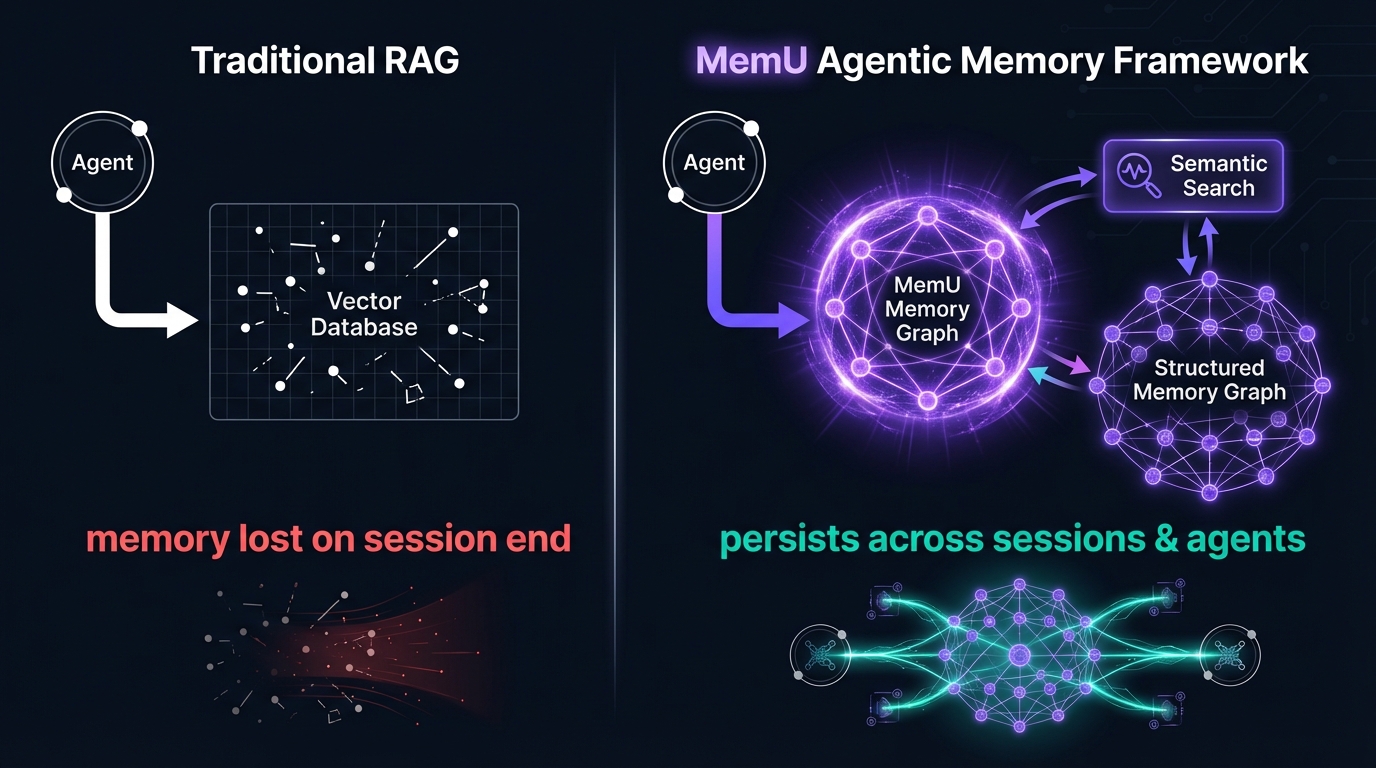
The MemU Agentic Memory Framework: Persistent Intelligence for Enterprise LLM Agents
The MemU Agentic Memory Framework provides the persistent memory layer that enterprise LLM agents need to stop re-reasoning from scratch. Instead of treating each session as independent, MemU captures retrieval results, reasoning chains, tool use outcomes, citation mappings, and analytical conclusions in a structured memory graph that persists across sessions, users, and deployment environments.
Consider an enterprise compliance agent running on the model. The agent analyzes regulatory documents, identifies applicable requirements, and maps them to internal policies. Without persistent memory, a question about GDPR data retention triggers a full RAG cycle — retrieving texts, reasoning through applicability, generating citations. When a colleague asks a related question next week, the agent repeats the entire analysis from scratch. With the MemU Agentic Memory Framework, the prior analysis is stored — retrieval results, reasoning chain, citations, conclusions. The follow-up draws on accumulated context, producing a faster, more comprehensive response that builds on prior reasoning.
The framework addresses three critical limitations of stateless enterprise agents:
- Retrieval memory: Documents retrieved and analyzed in prior sessions are indexed with their analytical context — eliminating redundant retrieval cycles for recurring queries and ensuring previous RAG results inform future reasoning.
- Reasoning chain persistence: Multi-step analytical chains — the logical steps from retrieval through interpretation to conclusion — are stored as reusable artifacts. Similar questions build on prior reasoning rather than reconstructing it entirely.
- Tool use learning: When the model self-corrects a tool use error, the MemU Agentic Memory Framework stores the correction pattern. Future calls benefit from accumulated knowledge of what configurations work, eliminating repetitive trial-and-error.
Enterprise RAG without memory is research without institutional knowledge — every analysis starts from primary sources, ignoring everything the organization has already concluded. The MemU Agentic Memory Framework gives enterprise agents persistent analytical context to build on prior work.
Integration with enterprise deployments uses MemU's REST APIs. Before each call, the agent queries persistent memory for relevant prior analyses and tool use patterns. After the response, new reasoning artifacts are stored. The MemU Agentic Memory Framework integrates cleanly with existing RAG pipelines, adding persistent context retrieval alongside document retrieval.
Head-to-Head: Stateless RAG vs. Memory-Enhanced Enterprise Agents
Cohere Command A alone: Enterprise-grade 111B-parameter model with 256K context, multi-step tool use with self-correction, in-line citations, and 23-language support. Two-GPU deployment enables private hosting for regulated industries. But every session starts stateless — re-retrieving documents, re-reasoning through analyses, re-correcting tool errors with no memory of prior sessions.
Cohere Command A + MemU: The same enterprise reasoning with persistent analytical memory. Prior retrieval results inform current analysis. Reasoning chains build on accumulated conclusions. Tool use patterns benefit from learned correction histories. The 256K context window is enriched with persistent memory context for responses combining real-time analysis with institutional knowledge.
For enterprise deployments handling recurring analytical workloads — compliance reviews, contract analysis, financial reporting — persistent memory reduces redundant compute, improves quality through accumulated reasoning, and creates an organizational knowledge base growing more valuable with every interaction.
Cohere Command A + MemU: Better Together
The combination of enterprise LLM capabilities and persistent memory unlocks behaviors neither achieves alone:
- Cumulative enterprise intelligence: Every RAG cycle contributes analytical artifacts to persistent memory — building an organizational knowledge graph of conclusions, interpretations, and citations that makes the agent more capable with every query.
- Cross-user analytical continuity: When one analyst's question builds on another's prior research, persistent memory connects related analyses — creating continuity across users, departments, and time horizons.
- Efficient compute utilization: Persistent memory eliminates redundant retrieval and reasoning for recurring patterns — reducing GPU costs on private deployments while improving quality through accumulated context.
Persistent memory transforms the model from a powerful per-session reasoning engine into a cumulative enterprise intelligence platform — where every analysis deepens the organizational knowledge base.
Get Started with MemU
Cohere Command A delivers enterprise-grade reasoning with the deployment flexibility, security posture, and multilingual capability that regulated industries demand. As enterprise agents move from ad-hoc question answering to sustained analytical workloads, persistent memory transforms capable models into intelligent organizational assets.
The MemU Agentic Memory Framework provides that foundation. Drop-in API integration with any LLM pipeline, dual-mode retrieval combining semantic search and structured memory graphs, and cross-session persistence that ensures enterprise agents build cumulative intelligence rather than re-reasoning from scratch.
Visit memu.pro to explore the Agentic Memory Framework API, or check out the GitHub repository to start building enterprise agents with persistent analytical memory.
Tags: Cohere Command A, enterprise LLM, RAG, AI agent memory, agentic AI, MemU AI, tool use, persistent memory