Coinbase x402 Gives AI Agents Payment Wallets — But Transacting Agents Without Financial Memory Can't Build Spending Intelligence


The Coinbase x402 protocol represents a fundamental shift in how AI agents interact with the economy. Proposed by Coinbase and championed by CEO Brian Armstrong, x402 enables AI agents to hold stablecoin wallets and execute autonomous micropayments — paying for blockchain data, API calls, computation, and services in USDC without human intervention. The protocol operates on the HTTP 402 "Payment Required" status code, creating a standard where AI agents encounter a paywall, negotiate a price, execute payment, and receive access — all programmatically. Demonstrations have shown agents executing sub-cent microtransactions at high frequency, enabling machine-to-machine payment flows that traditional card networks cannot support. As AI agents evolve from assistants into autonomous actors, x402 provides the financial infrastructure for an agent economy.
But x402 gives agents the ability to transact without the ability to remember transactions. An agent that paid $0.003 for API data from a provider that returned poor-quality results has no way to recall that experience the next time it encounters the same provider. Transacting agents without financial memory repeat bad purchases, miss bulk discount opportunities, and cannot optimize spending across sessions.
x402: What Everyone's Getting Right (And Missing)
The x402 protocol's design is elegant. By leveraging an existing HTTP status code (402 Payment Required), the standard integrates payment into the web's existing infrastructure without requiring new protocols or intermediaries. An agent makes an HTTP request, receives a 402 response with pricing information, evaluates the cost, executes payment via stablecoin, and retries the request with a payment receipt. The sub-cent granularity enables use cases that traditional payment systems cannot support — paying $0.001 per API call, $0.0001 per data point, or incremental charges for computation time. For the emerging agent economy, this frictionless payment layer is infrastructure-level important.
The stablecoin foundation is also strategically sound. USDC provides price stability that volatile cryptocurrencies cannot, and the on-chain settlement gives both parties verifiable transaction records. Traditional card networks — Visa and Mastercard are developing their own agent payment tools — face fundamental limitations in micropayment scenarios due to per-transaction fees that exceed the transaction value itself. x402's stablecoin approach makes sub-cent transactions economically viable.
What x402 does not provide is financial intelligence. The protocol handles payment execution — moving value from agent wallet to service provider — but has no mechanism for agents to learn from their spending patterns. An agent that discovered a cheaper data provider last week, or identified that certain API calls consistently return low-value results, cannot apply those insights to future purchasing decisions. Other agent payment frameworks — including Visa's agent payment APIs and PayPal's agent transaction tools — share this same limitation. They process payments; none build spending intelligence.
The MemU Agentic Memory Framework: Financial Intelligence for Autonomous Agents
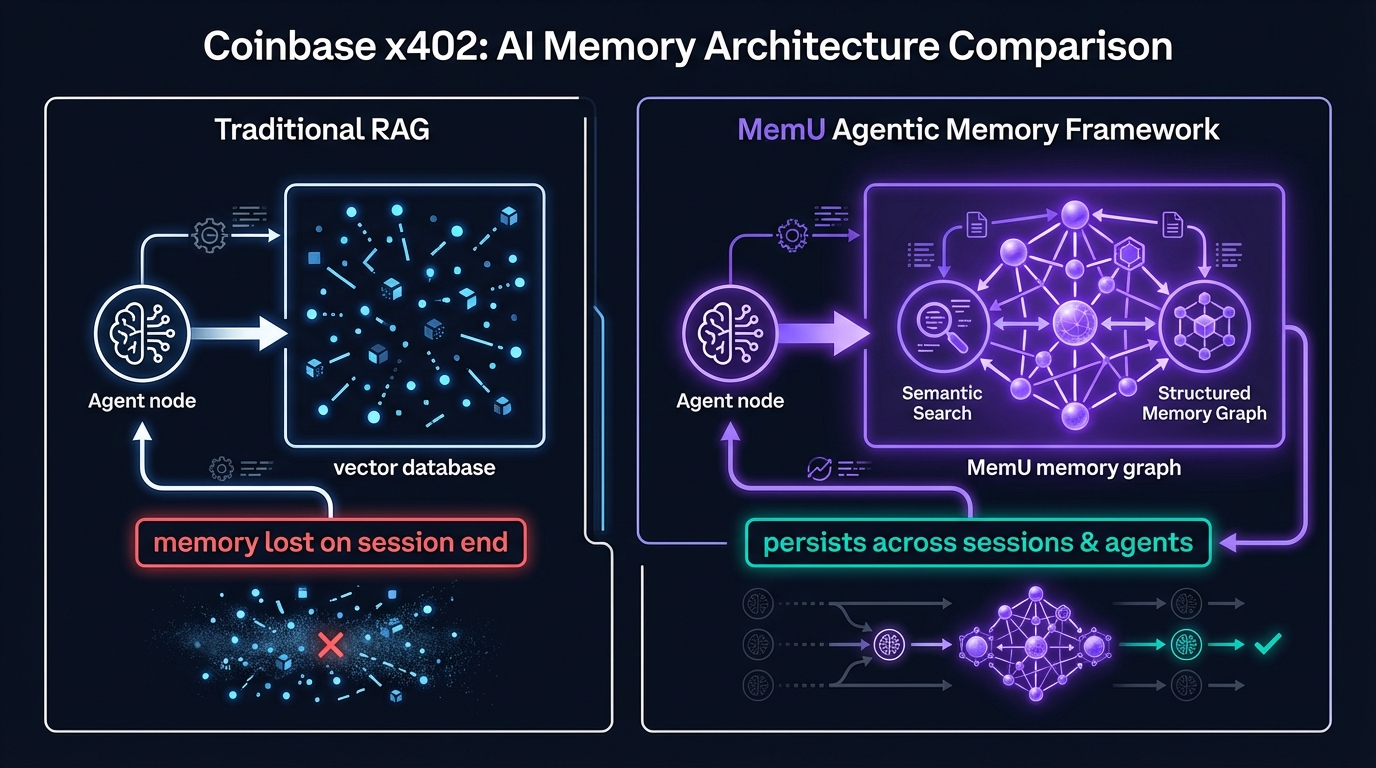
The MemU Agentic Memory Framework provides the persistent memory layer that agent payment protocols like x402 do not include natively. Instead of treating each transaction as an isolated payment event, MemU captures the spending context, service quality assessments, and cost-optimization insights that emerge from agent transactions and stores them in a structured memory graph that persists across sessions, agents, and organizational contexts.
Consider an AI research agent using x402 to pay for data from multiple providers. Without persistent memory, the agent evaluates each provider's pricing at face value and has no historical context for quality assessment. With the MemU Agentic Memory Framework, the agent recalls transaction history: Provider A charges $0.005 per query but returns structured data that requires no cleaning, while Provider B charges $0.002 but returns data that fails validation 30% of the time — making the effective cost $0.004 after re-queries. Provider C offers bulk pricing at $0.001 per query for volumes over 1,000 per day, which the agent's consumption patterns would qualify for. That accumulated financial intelligence transforms naive price comparison into informed procurement.
The framework addresses three core limitations of memoryless agent transactions:
- Spending pattern intelligence: Every transaction's cost, provider, quality outcome, and value-received assessment is stored. The MemU Agentic Memory Framework builds a financial history that enables agents to optimize spending based on accumulated experience rather than current-price-only decisions.
- Provider quality tracking: When agents pay for services — data, computation, API access — persistent memory tracks the quality of what was received. Agents learn which providers deliver consistent value, which have reliability issues, and which offer the best cost-per-quality ratio for specific task types.
- Budget optimization: Organizations deploying multiple agents with x402 wallets need visibility into collective spending patterns. Persistent memory enables cross-agent spending analysis, identifying duplicate purchases, negotiating bulk access, and routing requests to the most cost-effective providers based on accumulated transaction intelligence.
Giving agents wallets without giving them financial memory is like giving an employee a corporate card without an expense tracking system. The MemU Agentic Memory Framework ensures that every transaction an agent makes contributes to spending intelligence that makes future transactions smarter.
Integration with x402 workflows uses the MemU Agentic Memory Framework's REST APIs. Before each payment decision, the agent queries stored transaction history for relevant provider and pricing intelligence. After payment and service delivery, the transaction context and quality assessment are stored. The memory layer operates alongside the payment protocol, adding financial intelligence without modifying the transaction flow.
Head-to-Head: Stateless Agent Payments vs. Memory-Enhanced Financial Autonomy
x402 alone: Elegant micropayment protocol that enables AI agents to transact autonomously using stablecoin wallets. Sub-cent granularity and HTTP-native integration make machine-to-machine payments practical. But every transaction is independent — no learning from previous purchases, no provider quality tracking, no spending optimization.
x402 + MemU: The same frictionless payment protocol, now backed by persistent financial memory. Agents make purchasing decisions informed by accumulated transaction history. Provider selection considers historical quality data, not just current pricing. Spending patterns across agents are visible and optimizable. The autonomous economy becomes not just transactional but intelligent.
For agents that make hundreds of micro-transactions daily, the optimization opportunity is significant. Even small improvements in provider selection or pricing optimization — saving $0.001 per transaction through informed choices — compound into meaningful cost reductions at the scale that autonomous agents operate.
Empowering x402: Better Together
The combination of x402's payment infrastructure and the MemU Agentic Memory Framework's persistent memory unlocks agent economy capabilities that neither achieves alone:
- Autonomous procurement optimization: Agents that remember past transactions negotiate better — routing requests to providers with the best cost-quality ratio, timing purchases based on observed pricing patterns, and splitting workloads across providers based on accumulated performance data.
- Fraud and anomaly detection: Persistent spending memory enables agents to detect anomalous pricing — a provider that suddenly doubles rates, a data source that starts returning degraded quality, or unusual spending patterns that might indicate compromised credentials. Financial memory creates a baseline against which anomalies become visible.
- Organizational spending intelligence: When multiple agents share financial memory, organizations gain visibility into their agent economy participation. Which data sources are agents paying for most? Which services provide the best ROI? Where are there opportunities for negotiated rates or alternative providers? Persistent memory transforms scattered microtransactions into actionable financial analytics.
Persistent memory transforms x402 from a payment protocol into a financial intelligence layer for the autonomous agent economy — where every transaction makes every future transaction smarter.
Get Started with MemU
The x402 protocol represents essential infrastructure for the emerging agent economy — enabling AI agents to transact autonomously with sub-cent granularity through stablecoin wallets. As agents evolve from assistants into autonomous economic actors, frictionless payment becomes foundational.
The next step is giving those transacting agents financial memory. Agents where purchasing decisions are informed by accumulated transaction history. Organizations where agent spending patterns are visible and optimizable. An agent economy where financial intelligence compounds across every transaction.
The MemU Agentic Memory Framework provides that foundation. Drop-in API integration alongside x402 payment flows, dual-mode retrieval with semantic search and structured memory graphs, and cross-transaction persistence that turns autonomous payments into compounding financial intelligence.
Visit memu.pro to explore the Agentic Memory Framework API, or check out the GitHub repository to start building agents that remember.
Tags: Coinbase x402, AI agent payments, agentic AI, agent memory, MemU AI, LLM memory, agent economy