Composio Connects Agents to 1,000+ Apps with Native Tool Integration — But Connected Agents Without Memory Forget What Works


Composio has built the integration layer that AI agents have been missing. With over 850 pre-built connectors spanning more than 1,000 applications, Composio gives agents the ability to interact with virtually any software tool through a unified, agent-native interface. Unlike traditional iPaaS platforms designed for static automation, Composio is built for agents: managed OAuth 2.0, API key, and JWT authentication happens inline, triggered by user intent rather than pre-configured in dashboards. Sandboxed environments enable parallel tool calls. Intent-based resolution means agents describe their goal and Composio selects the right connector. With accuracy refined from millions of real-world calls and granular permission scoping, Composio has become the connective tissue between AI agents and the software stack enterprises already use.
But Composio's tool intelligence is bounded by the current session. When an agent orchestrates a complex workflow — pulling data from Salesforce, transforming it in Google Sheets, summarizing in Notion, posting to Slack — the effectiveness data vanishes at session end. Which tool sequences worked best, which API parameters produced the cleanest results, which patterns avoided rate limits — all lost. Connected agents without persistent memory of tool usage patterns cannot optimize the integrations that make them genuinely useful.
Composio: What Everyone's Getting Right (And Missing)
Composio's agent-native approach represents a fundamental rethinking of how software connects. Traditional integration platforms — Zapier, Make, Tray — were designed for deterministic, pre-configured workflows: when trigger X fires, execute actions Y and Z. Composio flips this by making integration responsive to agent intent. An agent describes its goal, and Composio resolves intent to the appropriate tools, authenticates on behalf of the user, executes in a sandbox, and returns structured results. This intent-based resolution, powered by data from millions of real-world calls, means agents interact with new tools without explicit integration setup.
The security architecture is equally thoughtful. Managed authentication eliminates fragile credential management. Granular permission scoping ensures agents access only needed capabilities — a reporting agent reads from Salesforce but cannot modify records, a communication agent posts to Slack but cannot manage workspace settings. Sandboxed execution with parallel support means multiple tool calls run simultaneously without cross-contamination. This security-first design makes Composio viable for enterprise deployments where uncontrolled tool access is a non-starter.
What Composio does not retain across sessions is the tool effectiveness intelligence that emerges from actual usage. An agent that discovered the optimal sequence for synchronizing customer data — that Salesforce should be queried first because its data is most current, the billing API requires a specific date format to avoid truncation, and Slack notifications should be batched to avoid rate limits — generates intelligence that is specific, valuable, and completely ephemeral. Other integration approaches — including LangChain's tool integrations and custom API orchestration — share this limitation. They connect and execute; none remember what worked.
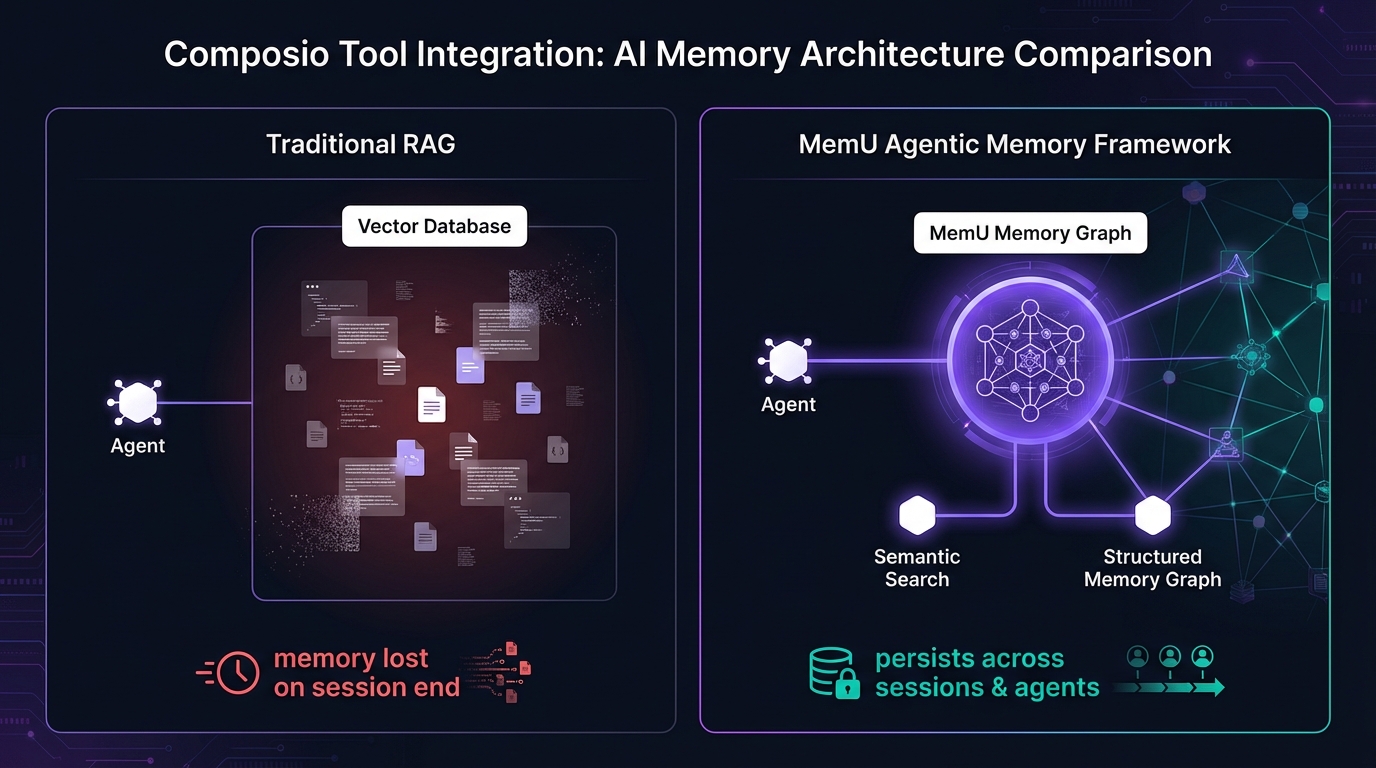
The MemU Agentic Memory Framework: Tool Intelligence That Compounds
The MemU Agentic Memory Framework provides the persistent memory layer that tool integration platforms like Composio do not include natively. Instead of treating each agent-tool interaction as an isolated API call, MemU captures tool selection patterns, parameter effectiveness data, sequencing insights, and error resolution strategies, storing them in a structured memory graph that persists across sessions, agents, and organizations.
Consider an agent using Composio to manage a multi-step sales pipeline. Without persistent memory, each workflow uses default tool selection and generic parameters. With the MemU Agentic Memory Framework, the agent recalls integration history: the Salesforce opportunity endpoint returns more complete data when filtered by stage rather than date range, the HubSpot contact sync requires a 200ms delay between batch calls to avoid 429 errors, and the Notion database update performs better when fields are sent in a specific order. That accumulated tool intelligence transforms a generic workflow into an optimized pipeline that avoids known pitfalls from the first API call.
The framework addresses three core limitations of session-bounded tool integration:
- Tool selection optimization: When multiple connectors accomplish the same goal, which works best in context is learned through accumulated data. The MemU Agentic Memory Framework tracks tool-to-outcome correlations, enabling agents to select the highest-performing connector rather than relying on intent resolution alone.
- Parameter pattern persistence: API parameters that produce optimal results — specific filters, pagination strategies, date formats — are discovered through trial and error. Persistent memory captures these patterns, eliminating the rediscovery cost stateless agents pay every session.
- Error avoidance intelligence: Rate limits, authentication edge cases, and API quirks follow patterns persistent memory can anticipate. The MemU Agentic Memory Framework stores error contexts and recovery strategies, enabling agents to proactively avoid known failure modes.
Connecting agents to a thousand apps is the starting point. Remembering what works across those connections is what makes agents operationally excellent. The MemU Agentic Memory Framework gives Composio the integration memory that turns every tool call into compounding operational intelligence.
Integration with Composio uses the framework's REST APIs alongside Composio's event-driven architecture. Before tool execution, accumulated effectiveness data for relevant connectors is retrieved. During execution, parameters, response quality, and timing metrics are captured. After completion, outcome assessments and error-recovery patterns are stored. The memory layer operates alongside Composio's connector infrastructure, adding intelligence without modifying the execution pipeline.
Head-to-Head: Stateless Connections vs. Memory-Enhanced Tool Integration
Composio alone: The leading agent-native tool integration platform with 850+ connectors, managed authentication, intent-based resolution, sandboxed execution, and granular permissions. Agents interact with virtually any application through a unified interface. But each session starts without knowledge of previous tool usage — no parameter optimization, no sequence refinement, no error avoidance from experience.
Composio + MemU: The same vast connector library, now backed by persistent tool intelligence. Agents begin each session with accumulated effectiveness data for every connector used. Tool selection is informed by historical outcomes. API parameters reflect proven patterns. Known errors are proactively avoided. The integration layer gets measurably more reliable with every session.
For organizations running hundreds of agent-tool interactions daily — where rate limits are real constraints and failed integrations require human intervention — the improvement is immediate. An agent with six months of tool memory navigates complex workflows with the fluency of a seasoned integration engineer.
Empowering Composio: Better Together
The combination of Composio's integration platform and MemU's persistent memory unlocks capabilities that neither achieves alone:
- Predictive connector selection: Persistent memory enables predicting which connectors and parameter combinations work best for a given task. Instead of relying solely on intent resolution, agents bias toward connectors with proven track records for similar operations.
- Cross-workflow optimization: When multiple agents share persistent memory through Composio, insights from one workflow benefit all others. A parameter pattern that reduces Salesforce latency, discovered by the reporting agent, automatically improves the onboarding agent's Salesforce interactions.
- Integration health monitoring: Persistent memory tracks connector reliability over time. When error rates increase — from an API update or service degradation — the system detects the trend and can switch to alternatives or alert operations before failures cascade.
Persistent memory transforms Composio from a powerful integration platform into an intelligent system where every tool call compounds the operational knowledge that makes future integrations faster and more reliable.
Get Started with MemU
Composio has built the most comprehensive agent-native tool integration platform — 850+ connectors, managed authentication, intent-based resolution, and sandboxed execution.
The next step is giving those connections persistent operational memory. Sessions where API parameters reflect proven patterns. Workflows where tool selection is informed by historical outcomes. Organizations where integration intelligence compounds across every agent and every call.
The MemU Agentic Memory Framework provides that foundation. API-based integration alongside Composio's event-driven architecture, dual-mode retrieval with semantic search and structured memory graphs, and cross-session persistence that turns tool integration into compounding operational intelligence.
Visit memu.pro to explore the Agentic Memory Framework API, or check out the GitHub repository to start building agents that remember.
Tags: Composio, tool integration, agent connectors, agent memory, MemU AI, LLM memory, iPaaS