CrewAI Enables Multi-Agent Collaboration — But Agent Crews Without Shared Memory Can't Compound Team Intelligence

CrewAI has emerged as the leading framework for building multi-agent collaborative systems. The framework organizes AI agents into "crews" — teams of specialized agents that work together on complex tasks, each with defined roles, goals, and backstories. A researcher agent gathers data, an analyst agent processes it, and a writer agent produces the final output — coordinating through a structured workflow that mirrors how human teams collaborate. CrewAI supports sequential, parallel, and hierarchical process types, enabling developers to model sophisticated collaboration patterns. With built-in tool integration, delegation capabilities, and support for any LLM, CrewAI has become the go-to framework for teams building multi-agent applications that require role-based specialization and coordinated execution.
But CrewAI's collaboration intelligence is bounded by crew execution scope. When a crew completes its task, the coordination patterns, delegation decisions, and role effectiveness data that emerged during execution are lost. Agent crews without shared persistent memory can't compound the team intelligence that makes collaboration increasingly effective over time.
CrewAI: What Everyone's Getting Right (And Missing)
CrewAI's role-based agent architecture reflects genuine insight about effective AI collaboration. By giving each agent a distinct role, goal, and backstory, the framework creates specialization that improves output quality. A research agent with the goal "find comprehensive, accurate data" approaches information gathering differently than a generalist agent would. The delegation system allows agents to assign subtasks to crew members with more appropriate skills, creating emergent coordination patterns that mirror human team dynamics.
The process flexibility is equally important. Sequential execution ensures that each agent's output feeds into the next — research feeds analysis, analysis feeds writing. Parallel execution allows independent tasks to run simultaneously, reducing total execution time. Hierarchical processes introduce manager agents that coordinate subordinate agents, enabling complex workflows with oversight. This range of process types means CrewAI can model most real-world collaboration patterns without forcing developers into a single paradigm.
What CrewAI does not persist across crew executions is the collaboration intelligence that emerges during teamwork. A crew that discovered the optimal delegation pattern for a content research task — the researcher should check three specific source types, the analyst should focus on quantitative comparisons, and the writer should lead with the most counterintuitive finding — loses that collaboration insight when the execution ends. The next crew run applies the same default delegation patterns. Other multi-agent frameworks — including AutoGen, MetaGPT, and ChatDev — share this same structural limitation. They coordinate agents within sessions; none preserve the team dynamics that make repeated collaboration increasingly effective.
The MemU Agentic Memory Framework: Team Intelligence That Compounds
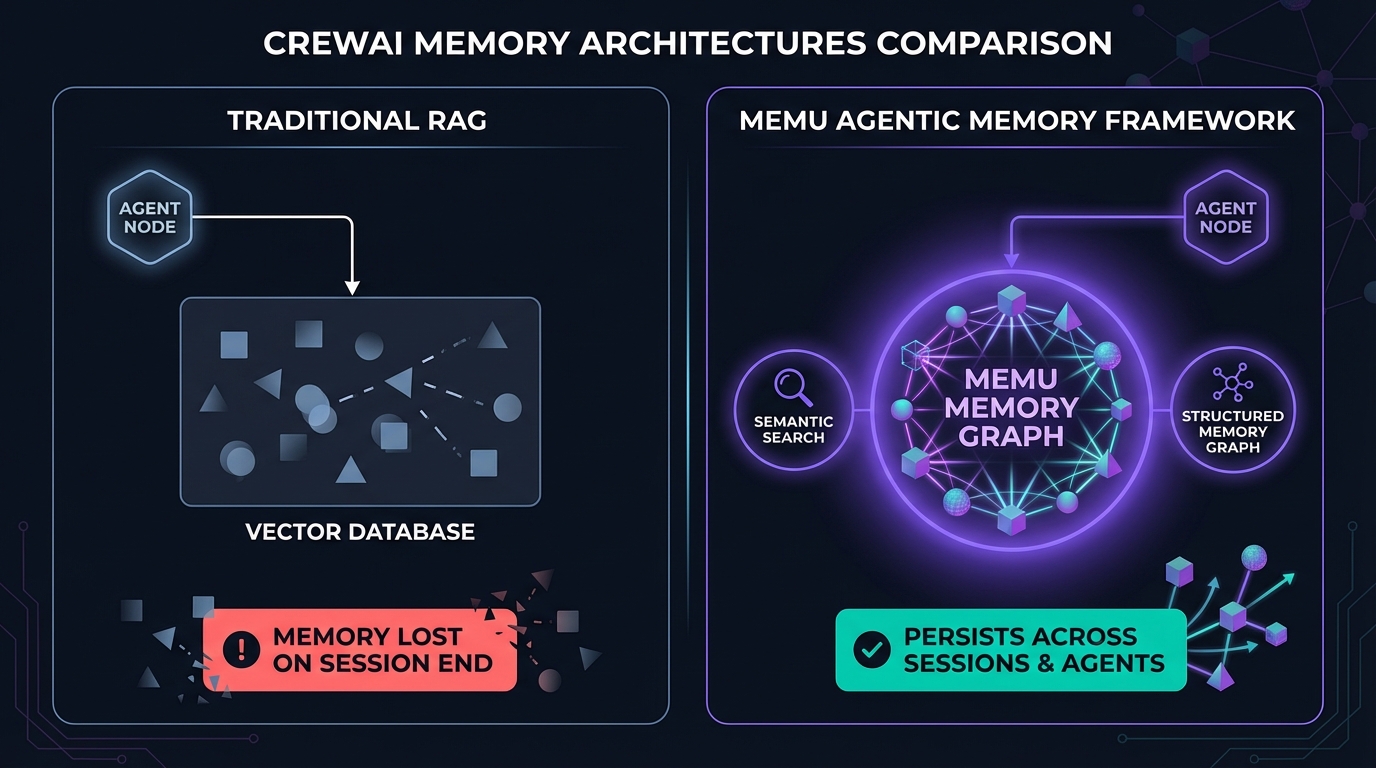
The MemU Agentic Memory Framework provides the persistent memory layer that multi-agent frameworks like CrewAI do not include natively. Instead of treating each crew execution as an isolated collaboration, MemU captures the delegation patterns, role effectiveness data, and coordination insights that emerge during teamwork and stores them in a structured memory graph that persists across executions, crew configurations, and organizational contexts.
Consider a CrewAI crew that produces weekly market analysis reports. Without persistent memory, each week's crew starts with default role assignments and delegation patterns. With the MemU Agentic Memory Framework, the crew recalls collaboration history: the researcher agent produces better results when given specific industry verticals rather than broad searches, the analyst agent's comparative frameworks are more insightful when given the researcher's raw data rather than pre-summarized findings, and the writer agent produces higher-quality output when the analyst includes confidence scores with each data point. That accumulated collaboration intelligence transforms a generic multi-agent workflow into an optimized team that improves with every execution.
The framework addresses three core limitations of execution-bounded multi-agent collaboration:
- Delegation pattern persistence: Which agent handles which subtask type most effectively is learned through accumulated execution data. The MemU Agentic Memory Framework captures delegation decisions and their outcomes, enabling crews to optimize task assignment based on proven effectiveness rather than static role definitions.
- Inter-agent communication optimization: The format, depth, and structure of information that agents pass to each other significantly affects output quality. Persistent memory tracks which communication patterns between agents produced the best final results, enabling crews to refine their coordination protocols over time.
- Role specialization evolution: As crews accumulate execution data, role definitions can be refined based on observed performance. A researcher agent that consistently produces better results when given specific constraints can have those constraints incorporated into its default configuration, progressively specializing the crew based on empirical evidence.
The best human teams improve through repeated collaboration — learning each member's strengths, optimizing handoffs, and developing shared context. Agent crews deserve the same opportunity. The MemU Agentic Memory Framework gives CrewAI the collaboration memory that turns every crew execution into compounding team intelligence.
Integration with CrewAI uses the MemU Agentic Memory Framework's REST APIs through custom CrewAI tools. At crew kickoff, accumulated collaboration intelligence is loaded. During execution, agents can query shared memory for relevant context. At completion, delegation patterns, role effectiveness data, and output quality assessments are stored. The memory layer operates within CrewAI's tool integration system, adding persistence without modifying the core framework.
Head-to-Head: Stateless Crews vs. Memory-Enhanced Collaboration
CrewAI alone: The leading multi-agent collaboration framework with role-based specialization, flexible process types, delegation, and broad LLM support. Crews effectively model team collaboration for complex tasks. But each crew execution starts from default configurations — no learning from previous runs, no delegation optimization, no collaboration pattern refinement.
CrewAI + MemU: The same role-based collaboration, now backed by persistent team memory. Crews begin each execution with accumulated collaboration intelligence. Delegation decisions are informed by historical effectiveness data. Communication patterns between agents are optimized based on observed output quality. The crew gets measurably better with every run.
For recurring crew tasks — weekly reports, daily data processing, ongoing research — the improvement is significant. A crew that has run 50 times with persistent memory operates with the refined coordination of a team that has worked together for months, producing higher-quality output in less time than a crew running with default configurations.
Empowering CrewAI: Better Together
The combination of CrewAI's multi-agent framework and the MemU Agentic Memory Framework's persistent memory unlocks collaboration capabilities that neither achieves alone:
- Adaptive crew composition: Persistent memory reveals which agent configurations produce the best results for different task types. A content production crew might work best with two researchers for technical topics but one researcher and two analysts for market analysis. This compositional intelligence emerges from accumulated execution data.
- Cross-crew knowledge transfer: When multiple crews share persistent memory, insights from one crew's execution benefit others. A research technique discovered by the market analysis crew becomes available to the competitive intelligence crew, creating organizational knowledge that spans crew boundaries.
- Quality regression detection: Persistent memory enables tracking output quality across executions. When a crew's output quality drops — perhaps due to a model update or data source change — the system can detect the regression by comparing against historical baselines and alert the team.
Persistent memory transforms CrewAI from a multi-agent execution framework into a collaborative intelligence system where every crew execution compounds the team dynamics that make future collaboration more effective.
Get Started with MemU
CrewAI has built the most intuitive framework for multi-agent collaboration — role-based specialization, flexible processes, and delegation that mirrors human team dynamics. The framework makes building sophisticated multi-agent applications accessible to developers at every skill level.
The next step is giving those crews persistent collaboration memory. Executions where delegation decisions are informed by historical effectiveness data. Crews where coordination patterns improve based on accumulated outcome analysis. Organizations where multi-agent team intelligence compounds across every run.
The MemU Agentic Memory Framework provides that foundation. Tool-based integration that fits within CrewAI's existing architecture, dual-mode retrieval with semantic search and structured memory graphs, and cross-execution persistence that turns multi-agent collaboration into compounding team intelligence.
Visit memu.pro to explore the Agentic Memory Framework API, or check out the GitHub repository to start building agents that remember.
Tags: CrewAI, multi-agent, agentic AI, agent memory, MemU AI, LLM memory, AI collaboration