Cursor 2.4 Introduces Subagents and a Skills Marketplace — But Project Knowledge Still Resets Every Session


The AI coding IDE that half of Fortune 500 companies use just got dramatically more capable. Cursor 2.4, released January 2026, introduces subagents with agent-to-agent communication, a skills marketplace with reusable SKILL.md manifests, AI-powered image generation for mockups, and "Cursor Blame" that links code changes to issues and PRs. NVIDIA reports 40,000 engineers now use Cursor with measurable productivity improvements.
Subagents are the headline feature. Rather than a single AI assistant handling everything, Cursor 2.4 delegates specialized tasks to sub-agents — one handles code generation, another manages testing, a third processes documentation. Custom subagents via the `.cursor/agents/` directory let teams build specialized workflows tailored to their stack.
The skills marketplace creates a reusable ecosystem of AI coding capabilities. Teams share proven workflows through SKILL.md manifests that any Cursor installation can import and execute. It's the beginning of an app store for AI coding patterns.
But even with subagents and skills, project knowledge doesn't persist between coding sessions.
Cursor 2.4: What Subagents and Skills Enable
The subagent architecture is a genuine evolution in AI-assisted development. Instead of one model trying to handle debugging, refactoring, testing, and documentation simultaneously, Cursor 2.4 delegates to specialized agents. A debugging subagent investigates errors while a testing subagent generates coverage — in parallel, communicating through Cursor's agent-to-agent protocol.
The skills marketplace extends this modularity to workflows. A SKILL.md manifest defines a repeatable AI workflow — "deploy to staging," "generate API documentation," "refactor for performance" — that any team member can invoke. Skills encapsulate best practices as executable AI instructions.
With 80%+ adoption rates at some organizations and multi-agent research previewing "self-driving codebases," Cursor is pushing AI coding from assistance toward autonomy.
The gap: subagents are session-scoped. A debugging subagent that spent fifteen minutes diagnosing a race condition develops deep understanding of the concurrency model — then loses it when the session closes. Skills define what to do but can't learn from doing it. The testing subagent doesn't remember which test patterns caught bugs most effectively in this codebase.
How Cursor 2.4 Handles Project Context
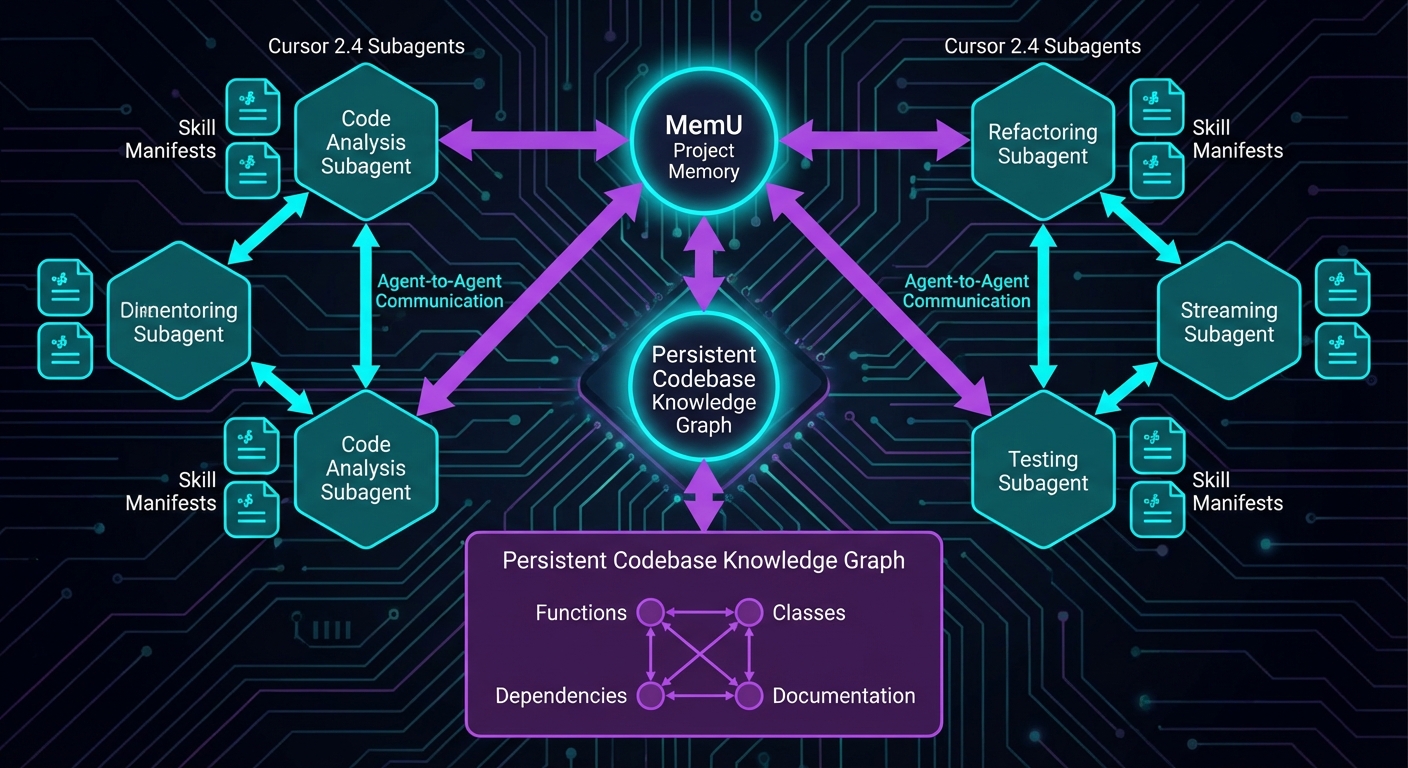
Cursor indexes your codebase for semantic search, providing relevant file context to agents during sessions. The `.cursorrules` file provides project-specific instructions that persist across sessions. Skills marketplace manifests encode reusable workflow patterns.
Within a session, subagent coordination is sophisticated. Agents share context through Cursor's internal protocol, build on each other's work, and produce coordinated results. Long-running agents (in research preview) extend this coordination across longer timeframes.
Project-level learning doesn't accumulate. Static rules and skills define behavior. But the adaptive knowledge — which debugging approaches work best for this codebase, which refactoring patterns the team prefers, which test strategies provide the best coverage-to-time ratio — exists only in the current session's context. The difference between a junior developer and a senior one is accumulated project knowledge. Cursor's agents reset to junior-level project understanding every session.
The MemU Agentic Memory Framework: Subagents That Build Expertise
The MemU Agentic Memory Framework provides the persistent project knowledge that makes Cursor's subagents progressively more effective. Rather than resetting expertise every session, MemU captures the adaptive learning that emerges from subagent work.
Consider a team's debugging subagent over three months. It encounters authentication bugs, concurrency issues, and API integration failures across hundreds of sessions. With Cursor alone, each debugging session starts from code analysis. With the MemU Agentic Memory Framework, the debugging subagent starts with accumulated diagnostic intelligence — "this error pattern typically originates in the middleware layer," "the team resolved similar issues by adjusting the retry configuration" — making diagnosis faster with every session.
The architecture enhances Cursor 2.4 through three capabilities:
- Subagent memory: Each specialized subagent builds expertise in its domain. The testing agent remembers effective test strategies. The debugging agent accumulates diagnostic patterns. Specialization deepens over time.
- Skill evolution: While SKILL.md manifests define static workflows, MemU captures how those workflows perform in practice. Skills that consistently need adjustment get flagged. Effective variations get recorded.
- Team knowledge persistence: When developers use Cursor subagents across the same codebase, collective learning accumulates. One developer's debugging session informs another's.
MemU makes Cursor's subagents accumulate expertise the way human developers do — every session builds on the last.
Head-to-Head: Session Agents vs. Learning Agents
Cursor 2.4 alone: Subagent coordination, skills marketplace, agent-to-agent communication. Powerful within sessions. But agents reset every session — no accumulated project expertise, no adaptive learning, no diagnostic memory.
Cursor 2.4 + MemU: Same subagent capabilities plus persistent expertise. Agents get measurably better at your codebase over time. Sub-100ms memory retrieval integrates seamlessly with Cursor's fast agent execution.
Get Started with MemU
Cursor 2.4 represents the most sophisticated AI coding environment available. Subagents, skills, and the trajectory toward self-driving codebases make it the IDE of choice for AI-native development teams.
The MemU Agentic Memory Framework provides the learning layer that makes those capabilities compound. Subagents that get smarter. Skills that evolve. Project knowledge that persists.
Visit memu.pro to explore the Agentic Memory Framework API, or check out the open-source repository on GitHub to start building persistent memory into your AI coding environment today.