Cursor Hits $29.3 Billion — The AI Coding Giant Still Rebuilds Project Context Every Session


Cursor just closed a $2.3 billion Series D at a $29.3 billion valuation, generating over $1 billion in annualized revenue. The funding will fuel Composer, Cursor's proprietary model, reducing dependence on external AI providers. This is the most valuable AI coding company in the world — and the numbers prove developers are willing to pay for AI-assisted development.
But there is a foundational layer that even the most valuable coding tool depends on getting right — memory.
Cursor: What Everyone's Getting Right (And Missing)
Cursor's product-market fit is undeniable. The IDE reads your codebase, provides intelligent completions, and handles multi-file edits with impressive accuracy. The new Composer agent goes further — planning and executing multi-step coding tasks across your project. A billion dollars in ARR says developers agree this is valuable.
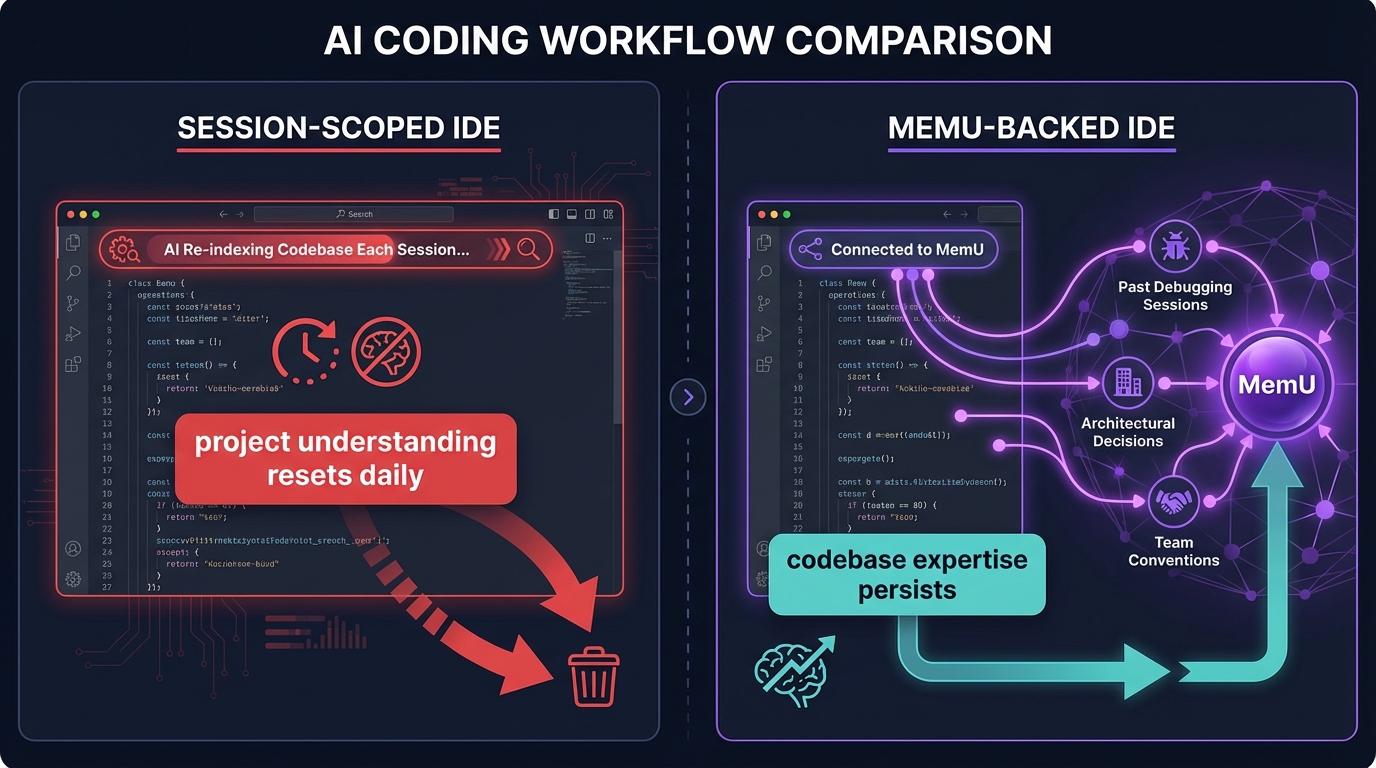
What Cursor has not yet solved is project continuity. When you close your editor and reopen it tomorrow, the agent has no memory of yesterday's debugging session, the architectural decisions you discussed, or the patterns it discovered in your codebase. Cursor indexes your code, but it does not remember your coding journey.
Windsurf, GitHub Copilot, and other AI coding tools share this limitation. Each session re-derives context from the codebase rather than building on prior understanding.
The MemU Agentic Memory Framework: Codebase Memory That Persists
The MemU Agentic Memory Framework adds persistent developer memory to any coding workflow.
Picture this: you spent three hours yesterday debugging a race condition in the payment service. Today, when a similar concurrency issue appears in the notification service, the AI recalls your debugging approach, the root cause pattern, and the fix — without you re-explaining anything.
- Architectural decisions: MemU stores why you chose a particular pattern, not just what the code looks like. "We use event sourcing here because of X" persists across sessions.
- Bug pattern memory: The MemU Agentic Memory Framework remembers past bugs, their root causes, and resolutions. Similar issues get flagged instantly instead of re-investigated.
- Team knowledge: When one developer's AI assistant learns something about the codebase, that knowledge can be shared across the team's agents through MemU's memory graph.
A $29 billion coding tool that resets every session is a brilliant consultant who forgets every engagement. The MemU Agentic Memory Framework gives it the institutional memory to compound its value.
Head-to-Head: Session-Scoped vs. Memory-Backed Coding AI
Session-scoped: Cursor reads your codebase each session via indexing. Good for autocomplete and in-context edits. But the fiftieth session has the same starting understanding as the first — no accumulated project wisdom.
MemU-backed: The coding agent retrieves developer memory before each session. Past decisions, debugging insights, and team conventions inform every interaction. The fiftieth session is dramatically more productive than the first.
Empowering Cursor: Better Together
- Onboarding: Cursor navigates the code; MemU provides the institutional knowledge that explains why the code exists and what tradeoffs were made.
- Debugging: Cursor reads the error; MemU recalls that this service failed identically three sprints ago and what fixed it.
- Refactoring: Cursor executes the changes; MemU remembers the last refactoring attempt, what broke, and which approach was abandoned.
Get Started with MemU
Give your AI coding assistant a memory that compounds with every session. The MemU Agentic Memory Framework integrates with any IDE or coding workflow. Visit memu.pro to explore the API, or check out the GitHub repository to start building agents that remember.
Tags: Cursor, AI coding, $29.3B valuation, developer tools, MemU AI, persistent code memory