Cursor Automations Turns Coding Agents Into Always-On Background Processes — But Continuous Execution Still Needs Persistent Memory

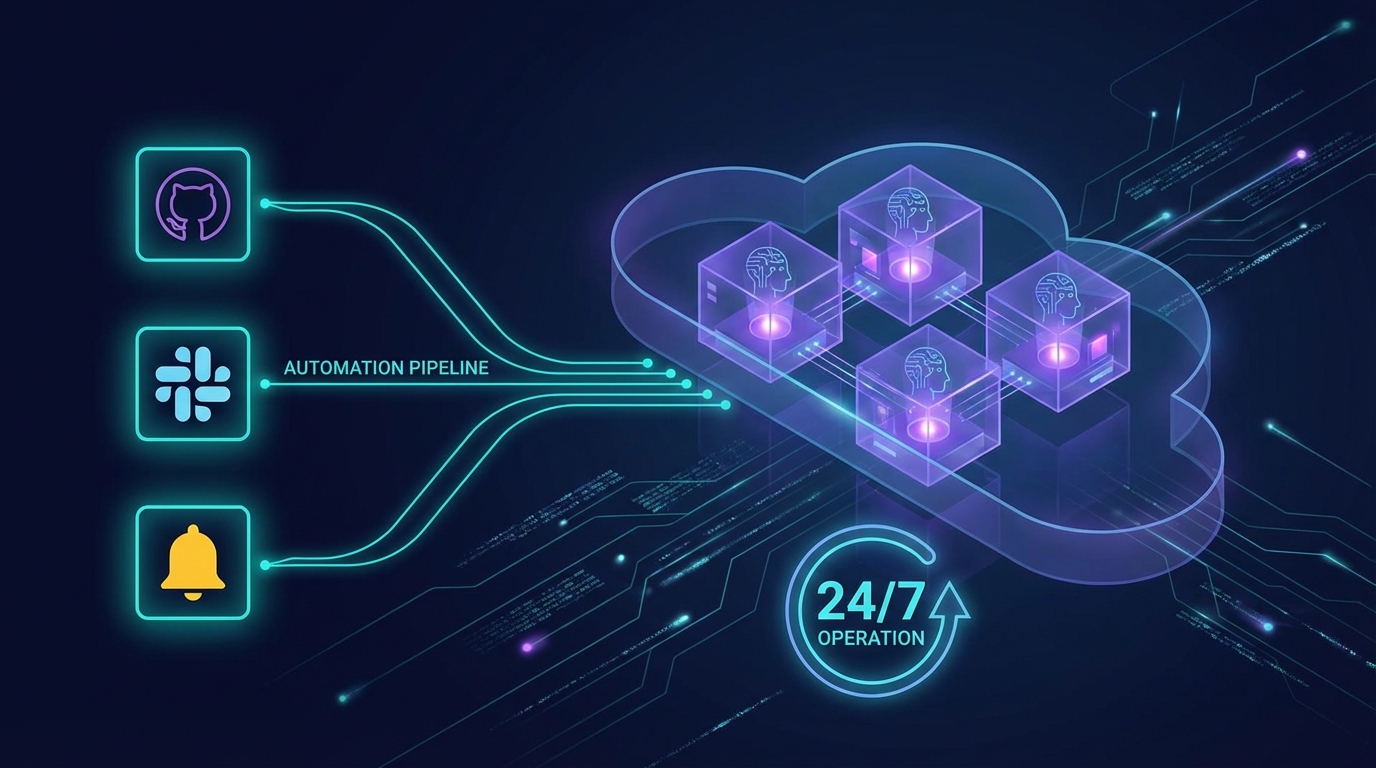
Cursor Automations just launched a system that transforms AI coding agents from on-demand assistants into always-on background processes. Triggered by GitHub pull requests, Slack messages, PagerDuty incidents, or scheduled intervals, these cloud-based agents continuously monitor, review, and maintain codebases without human initiation. Cursor reports running hundreds of automations per hour internally, with early adopters like Rippling already using them to aggregate engineering workflows into centralized dashboards.
But there is a foundational layer that always-on agents depend on even more than intermittent assistants — persistent memory that spans across runs, triggers, and codebases.
Cursor Automations: What Everyone's Getting Right (And Missing)
Automations get the execution model right. Moving coding agents from pull-to-push changes the developer workflow fundamentally. Instead of asking an agent to review code, the agent watches for PRs and reviews them automatically. Instead of triaging bugs manually, the agent monitors issue trackers and classifies severity. The shift from interactive to ambient computing for development is significant.
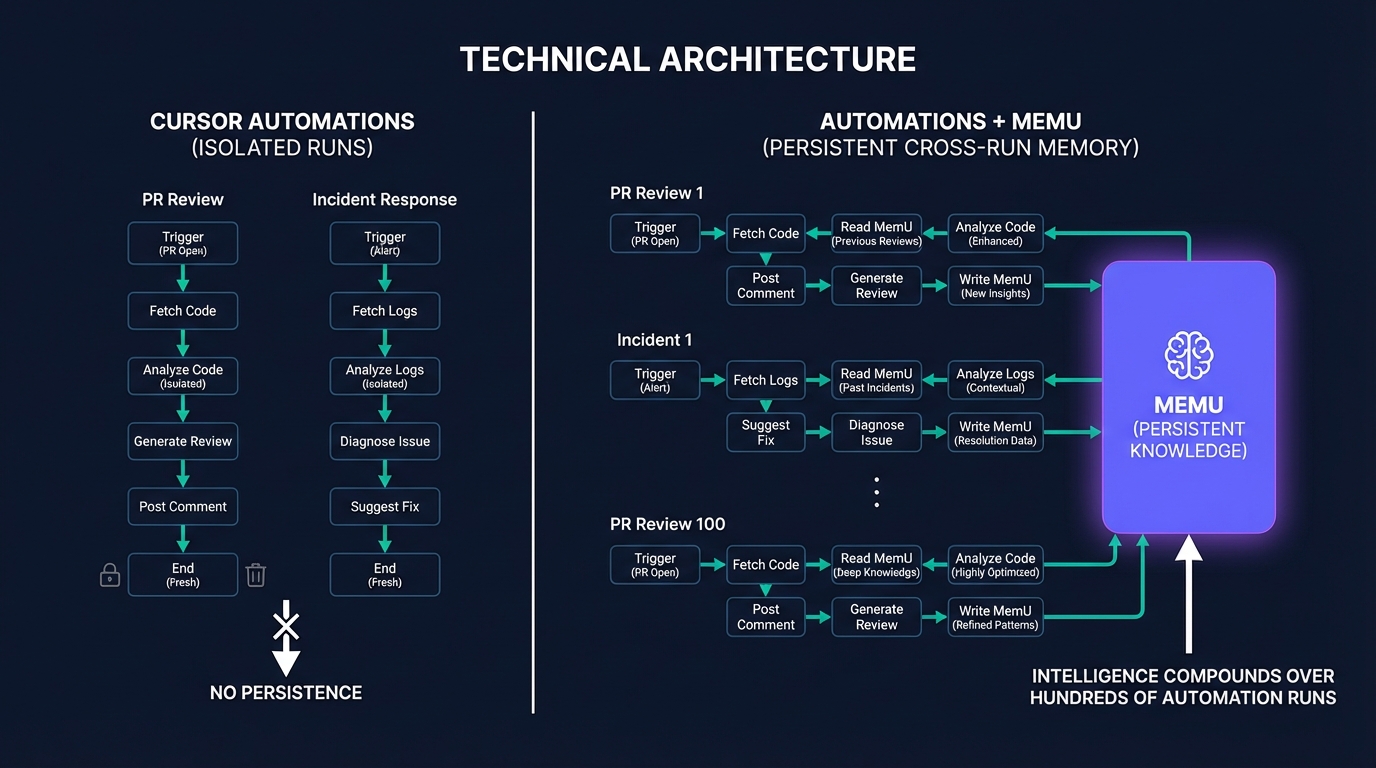
What Automations have not fully solved is the depth of memory across runs. Cursor includes memory tools that let agents learn from previous executions, but the underlying challenge remains architectural: each automation run operates with limited context from prior runs. The agent that reviewed fifty PRs last week cannot synthesize patterns across all of them to identify systemic code quality trends. Automations run continuously, but intelligence does not compound continuously.
Other always-on coding systems — GitHub Copilot Workspace, Devin background tasks, Windsurf Cascade — share this same architectural constraint. They automate execution; few of them automate learning.
The MemU Agentic Memory Framework: Deep Memory for Always-On Agents
The MemU Agentic Memory Framework adds the missing layer. Where Cursor Automations manage when and how agents run, MemU manages what agents retain across every run.
Consider a security review automation that audits every PR pushed to main. With MemU, the agent recalls that this developer's PRs frequently introduce unvalidated inputs, that similar patterns in the payments service led to a vulnerability last month, and that the team adopted a new sanitization library three weeks ago. Without MemU, each PR review starts with only the diff and whatever fits in the context window.
The MemU Agentic Memory Framework provides:
- Drop-in integration: A simple API that works alongside Cursor Automations or any always-on agent system. Add memory calls to your automation hooks; every run inherits the full history of prior runs.
- Dual-mode retrieval: Semantic search for pattern-matching across hundreds of past runs plus a structured memory graph for tracking relationships between code changes, reviewers, issues, and outcomes. Not just run logs — actual engineering intelligence.
- Cross-run persistence: Memory survives across automation triggers, codebase changes, and model updates. The thousandth PR review benefits from nine hundred ninety-nine reviews of accumulated insight.
Always-on execution without always-on memory is automation without learning. The MemU Agentic Memory Framework ensures that continuous agents become continuously smarter.
Retrieval operates across 10,000+ memory entries with sub-100ms latency, adding negligible overhead to automation trigger-to-action time.
Head-to-Head: Automations Alone vs. Automations + MemU
Cursor Automations alone: Agents run on every trigger with the context of the current event. PR reviews evaluate the current diff. Incident responses investigate the current alert. Each run is fast and focused, but the hundredth run carries no more institutional knowledge than the first.
Cursor Automations + MemU Agentic Memory Framework: Every automation run reads from and writes to persistent memory. PR reviews incorporate patterns from all previous reviews. Incident responses recall similar past incidents and their resolutions. Automation intelligence deepens with every trigger.
Pattern synthesis: With MemU, the always-on agent can surface trends invisible to individual runs — "this module has had increasing complexity in the last twenty PRs" or "incident frequency for this service correlates with deployment velocity." Without MemU, each run only sees its own slice.
Empowering Cursor Automations: Better Together
MemU does not replace Cursor Automations — it makes always-on agents dramatically more valuable:
- Code review: Automations trigger on every PR; MemU provides historical context about the codebase, the developer's patterns, and similar changes that caused issues — turning mechanical review into informed mentorship.
- Incident response: Automations react to PagerDuty alerts; MemU recalls past incidents with similar symptoms, what root causes were found, and which fixes worked — turning reactive response into pattern-informed diagnosis.
- Repository maintenance: Automations run scheduled audits; MemU tracks technical debt trends, test coverage evolution, and dependency health over time — turning snapshots into longitudinal intelligence.
Get Started with MemU
Add persistent memory to your always-on coding agents in minutes. The MemU Agentic Memory Framework works with any automation system — one API, zero lock-in, immediate compounding intelligence. Visit memu.pro to explore the Agentic Memory Framework API, or check out the GitHub repository to start building agents that remember.
Tags: Cursor Automations, always-on agents, background AI agents, agentic coding, agentic memory, LLM memory, MemU AI